MCQ
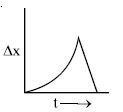
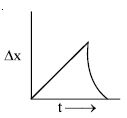
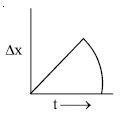
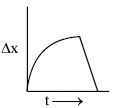
Two stones are thrown up vertically and simultaneously but with different speeds. Which graph correctly represents the time variation of their relative positions $\Delta x$.Assume that stones do not bounce after hitting ground.
  • A

  • B


  • D

Answer

Correct option: C.

c

Need a full question paper?

Generate a complete, print-ready paper with questions like this in minutes — across 16+ boards, with answer keys.

Start Generating Free

Similar questions

Velocity of transverse wave in stretched string doesn't depend on:
The ratio of angular speeds of minute hand and hour hand of a watch is
An object moves at a constant speed along a circular path in a horizontal plane with centre at the origin. When the object is at $x =+2\,m$, its velocity is $-4 \hat{ j }\, m / s$. The object's velocity $(v)$ and acceleration $(a)$ at $x =-2\,m$ will be
Adiabatic modulus of elasticity of a gas is $2.1 \times {10^5}N/{m^2}.$ What will be its isothermal modulus of elasticity $\left( {\frac{{{C_p}}}{{{C_v}}} = 1.4} \right)$
A gas at absolute temperature $300\,K$ has pressure $= 4 \times 10^{-10}\,N /m^2$  . Boltzmann constant, $k = 1.38 \times 10^{-23}\,J / K$ . The number of molecules per $cm^3$ is of the order of
$Assertion :$ It is hotter over the top of a fire than at the same distance of the sides.

$Reason :$ Air surrounding the fire conducts more heat upwards.
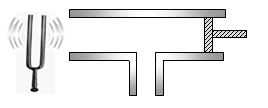
Vibrating tuning fork of frequency $n$ is placed near the open end of a long cylindrical tube. The tube has a side opening and is fitted with a movable reflecting piston. As the piston is moved through $8.75 cm$, the intensity of sound changes from a maximum to minimum. If the speed of sound is $350 \,m/s. $ Then $n$ is .... $Hz$
Boiling water is changing into steam. At this stage the specific heat of water is
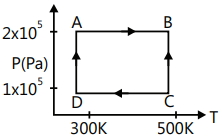
Two moles of helium gas are taken over the cycle $ABCDA$, as shown in the $P-T$ diagram. Assuming the gas to be ideal the work done on the gas in taking it from $A $ to $B$ is ...... $R$
Two planets have masses $M$ and $16\, M$ and their radii are $a$ and $2\, a$ respectively. The separation between the centres of the planets is $10\, a.$ A body of mass $m$ is fired from the surface of the larger planet towards the smaller planet along the line joining their centres. For the body to be able to reach at the surface of smaller planet, the minimum firing speed needed is