Question
Derive a mathematical expression for the force per unit length experienced by each of the two long current carrying conductors placed parallel to each other in air. Hence define one ampere of current.Explain why two parallel straight conductors carrying current in the opposite direction kept near each other in air repel?
Answer

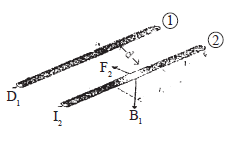
  1. Diagram:
  1. Magnetic field due to the current $\text{I}_{1}$ flowing in conductor 1 at a point on conductor 2  $\text{B}_{1} = \frac{\mu_\circ\text{I}_{1}}{2\pi\text{d}}$
$\therefore $  force on conductor 2 due to $\text{B}_{1}$ is 
$\text{F}_{2} = \text{I}_{2} \big( \overrightarrow\ell{_2}\times\overrightarrow{\text{B}}_{1}\big)$
$=\text{I}_{2}\ell_{2}\times\text{B}_{1}$
$\therefore \frac{\text{F}_{2}}{\ell_2} = \frac{\mu_\circ\text{I}_{1}\text{I}_2}{2{\pi}\text{d}}$
  1. Ampere: The equal currents, flowing through two thin long straight parallel conductors said to be one ampere each if they interact with each other with a force of $2\times 10^{-7}$ N/m when kept one metre apart in vacuum.
  2. Direction of magnetic field, at the second conductor, due to current in the first conductor.
Direction of force on the second conductor, (carrying a parallel current) due to this magnetic field.

Need a full question paper?

Generate a complete, print-ready paper with questions like this in minutes — across 16+ boards, with answer keys.

Start Generating Free

Similar questions

A car goes on a horizontal circular road of radius R, the speed increasing at a constant rate $\frac{\text{d}\nu}{\text{dt}}=\text{a}.$ The friction dt coefficient between the road and the tyre is $\mu.$ Find the speed at which the car will skid.
Compare three magnetic substances on the basis of following properties :
(i) Behaviour in magnetic field
(ii) Main reason for magnet formation
(iii) Behaviour in non-uniform magnetic field
(iv) Behaviour on bringing magnetic pole near
(v) Magnitude of $\mu_r$
(vi) Number of field lines passing through substance in magnetic field
(vii) Direction of magnetisation.
First a set of n equal resistors of R each are connected in series to a battery of emf E and internal resistance R. A current I is observed to flow. Then the n resistors are connected in parallel to the same battery. It is observed that the current is increased 10 times. What is 'n'?
Two particles A and B, each carrying a charge Q, are held fixed with a separation d between them. A particle C having mass m and charge q is kept at the middle point of the line AB.
  1. If it is displaced through a distance x perpendicular to AB, what would be the electric force experienced by it.
  2. Assuming x << d, show that this force is proportional to x.
  3. Under what conditions will the particle C execute simple harmonic motion if it is released after such a small displacement?
Find the time period of the oscillations if these conditions are satisfied.
A ball is kept at a height h above the surface of a heavy transparent sphere made of a material of refractive index $\mu.$ The radius of the sphere is R. At t = 0, the ball is dropped to fall normally on the sphere. Find the speed of the image formed as a function of time for $\text{t}<\sqrt{\frac{2\text{h}}{\text{g}}}.$ Consider only the image by a single refraction.
A capacitor of capacitance C is given a charge Q. At t = 0, it is connected to an uncharged capacitor of equal capacitance through a resistance R. Find the charge on the second capacitor as a function of time.
Find the speed of an electron with kinetic energy:
  1.  1eV
  2. 10keV
  3. 10MeV
A card sheet divided into squares each of size 1 mm2 is being viewed at a distance of 9 cm through a magnifying glass (a converging lens of focal length 9 cm) held close to the eye.
(a) What is the magnification produced by the lens? How much is the area of each square in the virtual image?
(b) What is the angular magnification (magnifying power) of the lens?
(c) Is the magnification in (a) equal to the magnifying power in (b)? Explain.
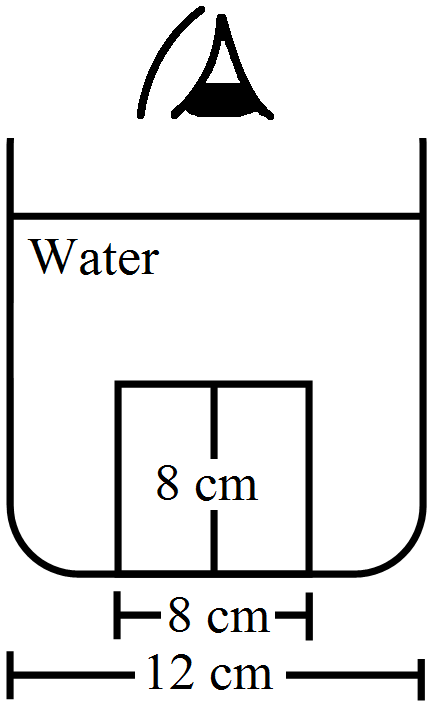
A cylindrical vessel of diameter $12\ cm$ contains $800\pi\text{cm}^3$ of water. A cylindrical glass piece of diameter $8.0 \ cm$ and height $8.0\ cm$ is placed in the vessel. If the bottom of the vessel under the glass piece is seen by the paraxial rays, locate its image. The index of refraction of glass is $1.50$ and that of water is $1.33.$​​​​​​​
Two equal charges, $2.0 \times 10^{-7}C$ each, are held fixed at a separation of $20\ cm.$ A third charge of equal magmtude is placed midway between the two charges. It is now moved to a point $20\ cm$ from both the charges. How much work is done by the electric field durmg the process?