Question
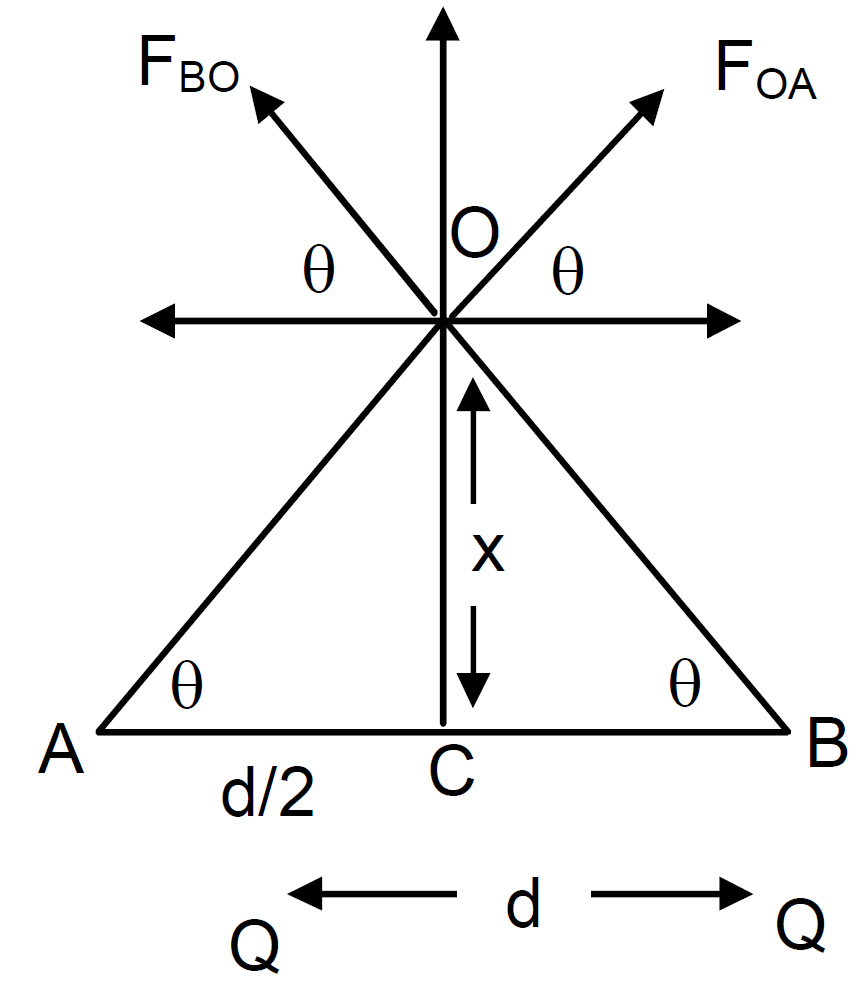
Two particles A and B, each carrying a charge Q, are held fixed with a separation d between them. A particle C having mass m and charge q is kept at the middle point of the line AB.
  1. If it is displaced through a distance x perpendicular to AB, what would be the electric force experienced by it.
  2. Assuming x << d, show that this force is proportional to x.
  3. Under what conditions will the particle C execute simple harmonic motion if it is released after such a small displacement?
Find the time period of the oscillations if these conditions are satisfied.

Answer


  1. Let Q = charge on A & B Separated by distance d
q = charge on c displaced $\bot$ to -AB
So, force on $0=\overline{\text{F}}_\text{AB}+\overline{\text{F}}_\text{BO}$
But $\text{F}_\text{AO}\cos\theta=\text{F}_\text{BO}\cos\theta$
So, force on ‘0’ in due to vertical component.
$\overline{\text{F}}=\text{F}_\text{AO}\sin\theta+\text{F}_\text{BO}\sin\theta$ $|\text{F}_\text{AO}|=|\text{F}_\text{BO}|$
$=2\frac{\text{KQq}}{\Big(\frac{\text{d}}{2^2+\text{x}^2}\big)}\sin\theta$
$\text{F}=\frac{2\text{KQq}}{\Big(\frac{\text{d}}{2}\Big)^2+\text{x}^2}\sin\theta$
$=\frac{4\times2\times2\text{KQq}}{(\text{d}^2+4\text{x}^2)}\times\frac{\text{x}}{\Big[\big(\frac{\text{d}}{2}\big)^2+\text{x}^2\Big]^{\frac{1}{2}}}$
$=\frac{2\text{kQq}}{\Big[\big(\frac{\text{d}}{2}\big)^2+\text{x}^2\Big]^{\frac{3}{2}}}\text{x}$ = Electric force $\Rightarrow\text{F}\propto\text{x}$
  1. When x << d
$\text{F}=\frac{2\text{kQq}}{\Big[\big(\frac{\text{d}}{2}\big)^2+\text{x}^2\Big]^{\frac{3}{2}}}\text{x}$ x << d
$\Rightarrow\text{F}=\frac{2\text{kQq}}{\Big(\frac{\text{d}^2}{4}\Big)^{\frac{3}{2}}}\text{x}\Rightarrow\text{F}\propto\text{x}$
$\text{a}=\frac{\text{F}}{\text{m}}=\frac{1}{\text{m}}\Bigg[\frac{2\text{kQqx}}{\Big[\big(\frac{\text{d}^2}{4}\big)+\ell^2}\Bigg]$
So time period $\text{T}=2\pi\sqrt{\frac{\ell}{\text{g}}}$
$=2\pi\sqrt{\frac{\ell}{\text{a}}}$

Need a full question paper?

Generate a complete, print-ready paper with questions like this in minutes — across 16+ boards, with answer keys.

Start Generating Free

Similar questions

A particle of mass $m$ is kept on the top of a smooth sphere of radius $R.$ It is given a sharp impulse which imparts it a horizontal speed $v.$
  1. Find the normal force between the sphere and the particle just after the impulse.
  2. What should be the minimum value of $v$ for which the particle does not slip on the sphere?
  3. Assuming the velocity $v$ to be half the minimum calculated in part.
  4. Find the angle made by the radius through the particle with the vertical when it leaves the sphere.
Two long wires carrying current $I_1$ and $I_2$ are arranged as shown in Fig. The one carrying current $I_1$ is along is the $x-$axis. The other carrying current $I_2$ is along a line parallel to the $y-$axis given by $x = 0$ and $z = d.$ Find the force exerted at $O_2$  because of the wire along the $x-$axis.
For the same objective, find the ratio of the least separation between two points to be distinguished by a microscope for light of 5000A and electrons accelerated through 100V used as the illuminating substance.
Explain what would happn if in the capacitor given in Q. 2.8, a 3 mm thick mica sheet (of dielectric constant = 6) were inserted between the plates.
(a) while the voltage supply remained connectd.
(b) after the supply was disconncted.
Suppose $a 'n\ ' -$ type wafer is created by doping $Si$ crystal having $5 \times 10^{28} \text{atoms/m^3}$ with $1 \text{ppm}$ concentration of As. On the surface $200 \text{ppm}$ Boron is added to create $'P\ '$ region in this wafer. Considering $n_i = 1.5 \times 10^{16}m^{-3}$.
  1. Calculate the densities of the charge carriers in the $n\ p$ regions.
  2. Comment which charge carriers would contribute largely for the reverse saturation current when diode is reverse biased.
Suppose that the electric field amplitude of an electromagnetic wave is $E_0 = 120 N/C$ and that its frequency is $ν = 50.0 MHz. (a)$ Determine $, B_0, ω, k,$ and $\lambda . (b)$ Find expressions for $E$ and $B$.
Explain construction and working of a nuclear reactor. State its utility also.
Three bulbs, each with a resistance of $180\Omega,$ are connected in parallel to an ideal battery of emf 60V. Find the current delivered by the battery when.
(a) all the bulbs are switched on, (b) two of the bulbs are switched on and (c) only one bulb is switched on.
What happens when a forward bias is applied to a $p-n$ junction?
Ten positively charged particles are kept fixed on the $x-$axis at points $x = 10\ cm, 20\ cm, 30\ cm, ..., 100\ cm.$ The first particle has a charge $1.0 \times 10^{-8}C,$ the second $8 \times 10^{-8}C,$ the third $27 \times 10^{-8}C$ and so on. The tenth particle has a charge $1000 \times 10^{-8}C.$ Find the magnitude of the electric force acting on a $1C$ charge placed at the origin.