Question
Derive a mathematical expression for the force per unit length experienced by each of the two long current carrying conductors placed parallel to each other in air. Hence define one ampere of current.

Explain why two parallel straight conductors carrying current in the opposite direction kept near each other in air repel?
Answer

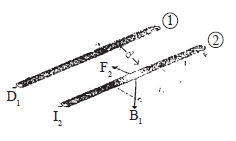
  1. Diagram:

  1. Magnetic field due to the current $\text{I}_{1}$ flowing in conductor 1 at a point on conductor 2  $\text{B}_{1} = \frac{\mu_\circ\text{I}_{1}}{2\pi\text{d}}$

$\therefore $  force on conductor 2 due to $\text{B}_{1}$ is 

$\text{F}_{2} = \text{I}_{2} \big( \overrightarrow\ell{_2}\times\overrightarrow{\text{B}}_{1}\big)$

$=\text{I}_{2}\ell_{2}\times\text{B}_{1}$

$\therefore \frac{\text{F}_{2}}{\ell_2} = \frac{\mu_\circ\text{I}_{1}\text{I}_2}{2{\pi}\text{d}}$

  1. Ampere: The equal currents, flowing through two thin long straight parallel conductors said to be one ampere each if they interact with each other with a force of $2\times 10^{-7}$ N/m when kept one metre apart in vacuum.
  2. Direction of magnetic field, at the second conductor, due to current in the first conductor.

Direction of force on the second conductor, (carrying a parallel current) due to this magnetic field.

Need a full question paper?

Generate a complete, print-ready paper with questions like this in minutes — across 16+ boards, with answer keys.

Start Generating Free

Similar questions

Compare and contrast the nature of $\alpha-, \beta-$ and $\gamma-$radiations.
What is transformer ? Describe its construction and working principle.
In Young’s double-slit experiment using monochromatic light of wavelength λ, the intensity of light at a point on the screen where path difference is λ, is K units. What is the intensity of light at a point where path difference is λ/3?
a. Draw graphs showing the variations of inductive reactance and capacitive reactance with the frequency of the applied ac source.
b. Draw the phasor diagram for a series RC circuit connected to an ac source.
c. An alternating voltage of 220 V is applied across a device X, a current of 0.25 A flows, which lag behind the applied voltage in phase by $\frac{\pi}{2}$ radian. If the same voltage is applied across another device Y, the same current flows but now it is in phase with the applied voltage.
i. Name the devices X and Y.
ii. Calculate the current flowing in the circuit when the same voltage is applied across the series combination of X and Y.
A long solenoid 'S' has 'n' turns per meter, with diameter 'a'. At the centre of this coil we place a smaller coil of 'N' turns and diameter 'b' (where b < a). If the current in the solenoid increases linearly, with time, what is the induced emf appearing in the smaller coil. Plot graph showing nature of variation in emf, if current varies as a function of mt2 +C.
A voltmeter coil has resistance $50.0\Omega$ and a resistor of $1.15\text{k}\Omega$ is connected in series. It can read potential differences up to 12 volts. If this same coil is used to construct an ammeter that can measure currents up to 2.0A, what should be the resistance of the shunt used?
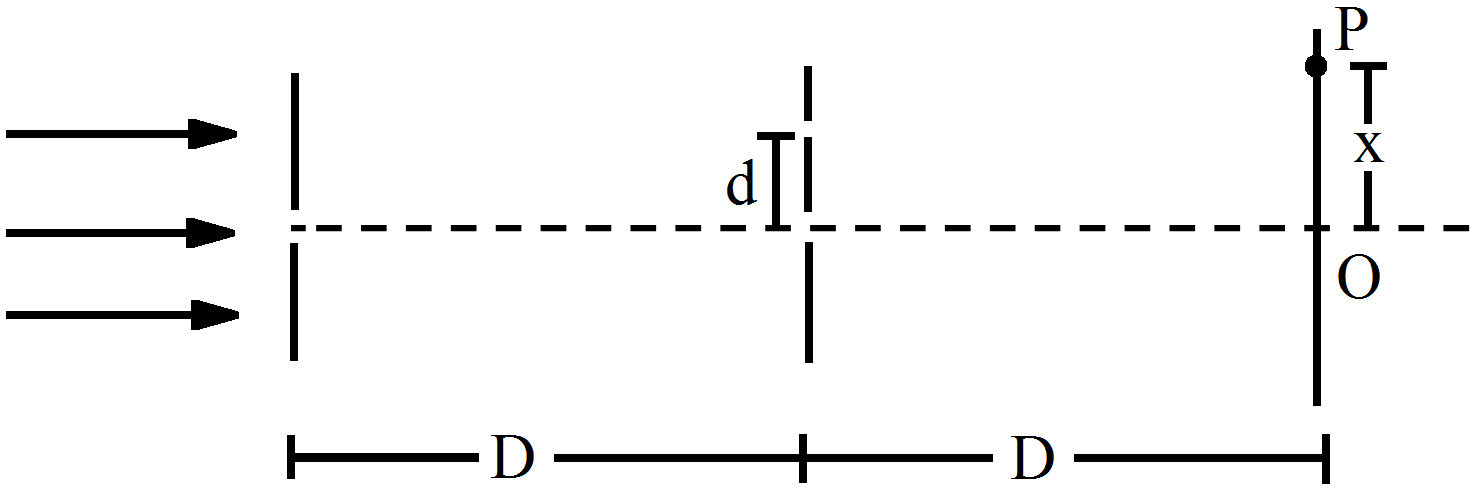
Consider the arrangement shown in figure (17-E4). The distance D is large compared to the separation d between the slits.
  1. Find the minimum value of d so that there is a dark fringe at 0.
  2. Suppose d has this value. Find the distance x at which the next bright fringe is formed.
  3. Find the fringe-width.

If a proton had a radius R and the charge was uniformly distributed, calculate using Bohr theory, the ground state energy of a H-atom when:
  1. R = 0.1Å.
  2. R = 10 Å.
Consider N = n1n2 identical cells, each of emf $\in$ and internal resistance r. Suppose n1 cells are joined in series to form a line and n2 such lines are connected in parallel. The combination drives a current in an external resistance R. (a) Find the current in the external resistance. (b) Assuming that n1 and n2 can be continuously varied, find the relation between n1, n2, R and r for which the current in R is maximum.
Consider the following very rough model of a beryllium atom. The nucleus has four protons and four neutrons confined to a small volume of radius 10-15m. The two 1s electrons make a spherical charge cloud at an average distance of 1.3 × 10⁻¹¹m from the nucleus, whereas the two 2s electrons make another spherical cloud at an average distance of 5.2 × 10⁻¹¹m from the nucleus. Find the electric field at:
  1. A point just inside the 1s cloud.
  2. A point just inside the 2s cloud.