Question
Derive an expression for capacitance of the parallel plate capacitor.

Answer


Image
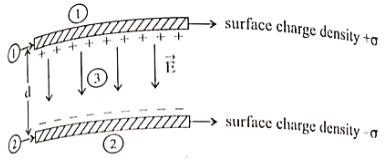
$\rightarrow$ As shown in figure, the charge on plate 1 and 2 are $+Q$ and $-Q$ respectively. And ' d ' is the separation between them, A is the area of each plate.
$\rightarrow$'d' is much smaller than the linear dimension of the plates $[d \ll A]$ so we can use the result on electric field $E =\sigma / 2 \varepsilon_0$ by an infinite plane sheet of uniform surface charge density
where, $\sigma=$ surface charge density, $\pm \sigma= Q / A$
$\varepsilon_0=$ permittivity of space
$A=$ Area of plate, $Q=$ charge on plate
$\rightarrow A s=$ shown in figure in region (1),
$E=\frac{\sigma}{2 \varepsilon_0}-\frac{\sigma}{2 \varepsilon_0}=0 \ldots(1)$
$\rightarrow$ In region (2)
$E=\frac{\sigma}{2 \varepsilon_0}-\frac{\sigma}{2 \varepsilon_0}=0 \ldots(2)$
$\rightarrow$ Electric field between plate 1 and 2 ,
$E=\frac{\sigma}{2 \varepsilon_0}+\frac{\sigma}{2 \varepsilon_0}=\frac{\sigma}{\varepsilon_0}=\frac{\sigma}{\varepsilon_0 A}\ldots(3)$
$\rightarrow$ For uniform electric field,
$\begin{aligned}
V & =E \cdot d \\
& =\frac{Q}{\varepsilon_0 A} \cdot d \ldots(4)
\end{aligned}$
$\rightarrow$ Capacitance $C=\frac{Q}{V}=\frac{Q}{\frac{Q d}{\varepsilon_0 A}}=\frac{\varepsilon_0 A}{d}\ldots(5)$
$C=\frac{\varepsilon_0 A}{d}$ is the equation of parallel plate capacitor.

Need a full question paper?

Generate a complete, print-ready paper with questions like this in minutes — across 16+ boards, with answer keys.
Start Generating Free

Similar questions

Calculate the torque on the square plate of the previous problem if it rotates about a diagonal with the same angular acceleration.
A boy is standing on a platform which is free to rotate about its axis. The boy holds an open umbrella in his hand. The axis of the umbrella coincides with that of the platform. The moment of inertia of ''the platform plus the boy system'' is 3.0 × 10⁻³kg-m2 and that of the umbrella is 2.0 × 10³kg-m2. The boy starts spinning the umbrella about the axis at an angular speed of 2.0rev/s with respect to himself. Find the angular velocity imparted to the platform.
A charge ‘q’ moving along the X-axis with a velocity v is subjected to a uniform magnetic field B acting along the Z-axis as it crosses the origin O.

​​​​​​

  1. Trace its trajectory.
  2. Does the charge gain kinetic energy as it enters the magnetic field? Justify your answer.
  1. The bluish colour predominates in clear sky.
  2. Violet colour is seen at the bottom of the spectrum when white light is dispersed by a prism.

State reasons to explain these observations.

State Kirchhoff's rules. Explain briefly how these rules are justified.
What is the principle of superposition of charges?
Draw the phasor diagram and graph of voltage and current versus $\omega t$  for a purely capacitive circuit and explain it.
Explain the lateral shift for a ray refracted from a glass slab with parallel sides.
Boron has two stable isotopes, ${ }_5^{10} B$ and ${ }_5^{11} B$. Their respective masses are $10.01294 u$ and $11.00931 u$ , and the atomic mass of boron is $10.811 u$ . Find the abundances of ${ }_3^{10} B$ and ${ }_3^{11} B$.
The $V-I$ characteristic of a silicon diode is shown in the Fig. 14.17. Calculate the resistance of the diode at (a) $I_D=15 mA$ and (b) $V_D=-10 V$.
Image