Question
Explain the lateral shift for a ray refracted from a glass slab with parallel sides.

Answer


Image
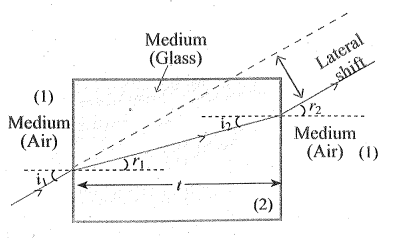
→As shown in figure ray is incident on a rectangular slab at an angle $i_1$ and is refracted through an angle $r_1$ and travels through the glass slab.
→This ray is incident on the other surface of the slab at an angle $i_2$.
→From this point a ray emerges at an angle $r_2$. Here, $i_1=r_2$ can be easily proved from Snell's law.
→Here, emergent ray is parallel to incident ray. Thus there is no deviation of incident ray.
→The perpendicular distance between the incident ray and the emergent ray is called lateral shift.

Need a full question paper?

Generate a complete, print-ready paper with questions like this in minutes — across 16+ boards, with answer keys.
Start Generating Free

Similar questions

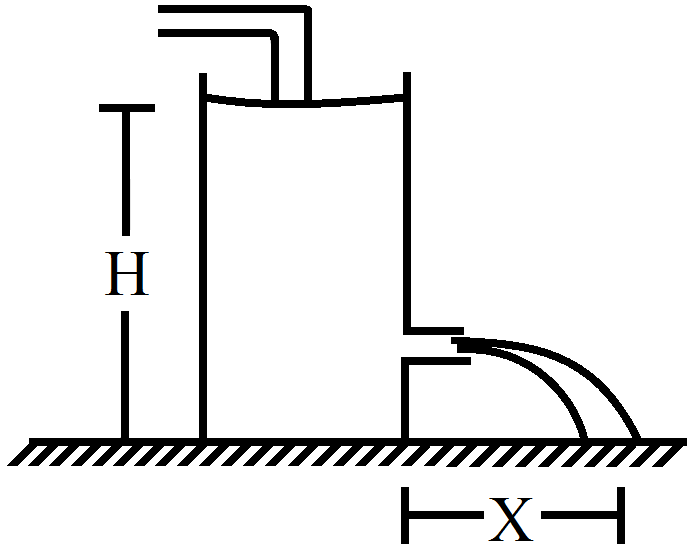
Water level is maintained in a cylindrical vessel upto a fixed height H. The vessel is kept on a horizontal plane. At what height above the bottom should a hole be made in the vessel so that the water stream coming out of the hole strikes the horizontal plane at the greatest distance from the vessel.

A parallel plate capacitor of capacitance C is charged to a potential V. It is then connected to another uncharged capacitor having the same capacitance. Find out the ratio of the energy stored in the combined system to that stored initially in the single capacitor.
The electric field E due to any point charge near it is defined as $\text{E}=\lim\limits_{\text{q}\rightarrow0}\frac{\text{F}}{\text{q}}$ where q is the test charge and F is the force acting on it. What is the physical significance of $\lim\limits_{\text{q}\rightarrow0}$ in this expression?
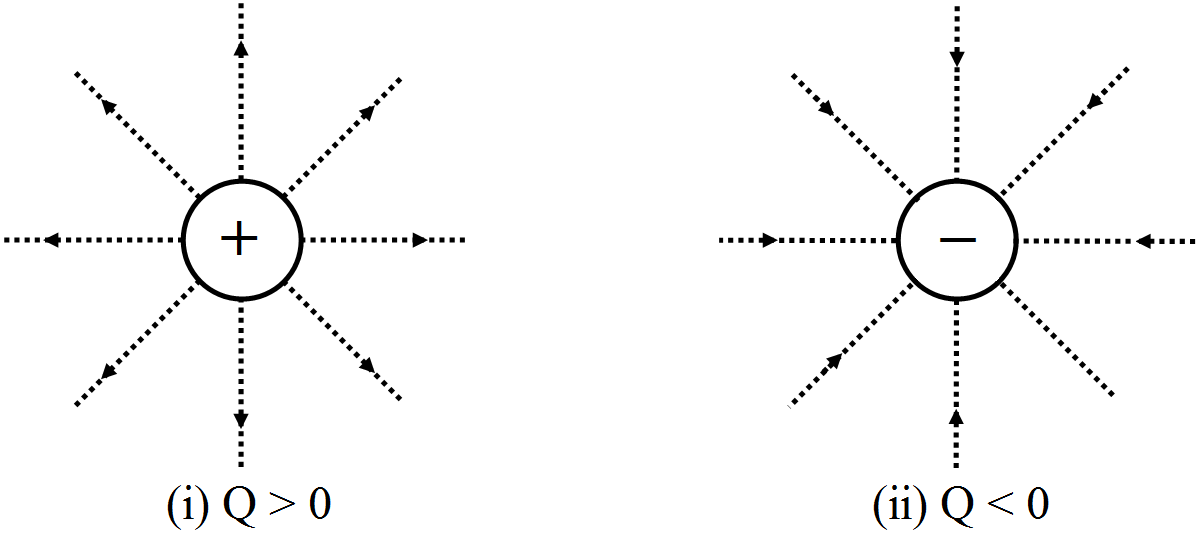
Draw the electric lines of point charge Q when,
  1. Q > 0
  2. Q < 0.

  1. Find the first excitation potential of He+ ion.
  2. Find the ionization potential of Li++ ion.
Explain by graph how the electric field by thin spherical shell depends on the distance, of point from centre.
A block of mass m is kept on a horizontal table. If the static friction coefficient is $\mu,$ find the frictional force acting on the block.
An infinite line charge produces a field of 9 × 10⁴ N/C at a distance of 2 cm. Calculate the linear charge density.
State the importance of coherent sources in the phenomenon of interference.
A proton and a deuteron are accelerated through the same accelerating potential. Which one of the two has,
  1. greater value of de-Broglie wavelength associated with it, and
  2. less momentum?
Give reasons to justify your answer.
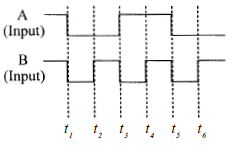
The given inputs A, B are fed to a 2-input NAND gate. Draw the output wave form of the gate.