Maharashtra BoardEnglish MediumSTD 12 SciencePhysicsMechanical Properties of Fluids4 Marks
Question
Derive an expression for capillary rise for a liquid having a concave meniscus.
✓
Answer
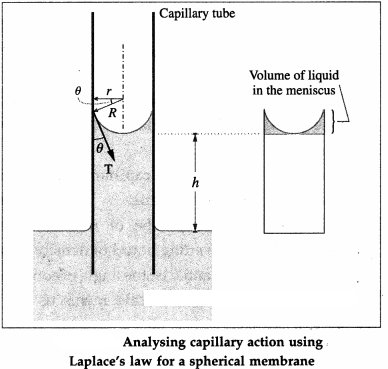
Consider a capillary tube of radius r partially immersed into a wetting liquid of density p. Let the capillary rise be h and θ be the angle of contact at the edge of contact of the concave meniscus and glass. If R is the radius of curvature of the meniscus then from the figure, $r = R \cos \theta .$
Surface tension T is the tangential force per unit length acting along the contact line. It is directed into the liquid making an angle θ with the capillary wall. We ignore the small volume of the liquid in the meniscus. The gauge pressure within the liquid at a depth h, i.e., at the level of the free liquid surface open to the atmosphere, is
$\rho – \rho _o = \rho gh …. (1)$
By Laplace’s law for a spherical membrane, this gauge pressure is
$\rho-\rho_{\circ}=\frac{2 T}{R} \ldots . .(2)$
$\therefore h \rho g =\frac{2 T}{R}=\frac{2 T \cos \theta}{r}$
$\therefore h =\frac{2 T \cos \theta}{r \rho g} \ldots . .(3)$
Thus, narrower the capillary tube, the greater is the capillary rise.
From Eq. (3),
$T =\frac{h \rho r g}{2 T \cos \theta} \ldots$ (4)
Equations (3) and (4) are also valid for capillary depression h of a non-wetting liquid. In this case, the meniscus is convex and θ is obtuse. Then, cos θ is negative but so is h, indicating a fall or depression of the liquid in the capillary. T is positive in both cases.
[Note : The capillary rise h is called Jurin height, after James Jurin who studied the effect in 1718. For capillary rise, Eq. (3) is also called the ascent formula.]
Need a full question paper?
Generate a complete, print-ready paper with questions like this in minutes — across 16+ boards, with answer keys.