Question Bank [2022] — Chemistry STD 12 Science — Question
Maharashtra BoardEnglish MediumSTD 12 ScienceChemistryQuestion Bank [2022]2 Marks
Question
Derive an expression for pressure-volume work.
✓
Answer
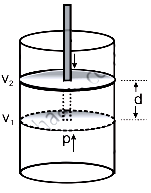
Consider a certain amount of gas at constant pressure $P$ is enclosed in a cylinder fitted with the frictionless, rigid movable piston of area A . Let the volume of the gas be $V _1$ at temperature T . This is shown in the below diagram.
On expansion, the force exerted by a gas is equal to area of the piston multiplied by pressure with which the gas pushes against the piston. This pressure is equal in magnitude and opposite in sign to the external atmospheric pressure that opposes the movement and has its value $-P_{\text {ext }}$.
Thus,$f=-P_{\text {ext }} \times A$
where, $P_{\text {ext }}$ is the external atmospheric pressure.
IIf the piston moves out a distance $d$, then the amount of work done is equal to the force multiplied by distance.
$W=f \times d \ldots(2)$
Substituting equation (1) in (2) gives
$W=-P_{\text {ext }} \times A \times d$
The product of area of the piston and distance it moves is the volume change ( $\Delta V$ ) in the system.
$\Delta V=A \times d \ldots(4)$
Combining equation (3) and (4), we get
$W=-P_{\text {ext }} \Delta V$
$W=-P_{\text {ext }}\left(V_2-V_1\right)$
Where $V_2$ is the final volume of the gas.
Need a full question paper?
Generate a complete, print-ready paper with questions like this in minutes — across 16+ boards, with answer keys.