Question
Derive an expression for terminal velocity of a spherical object falling under gravity through a viscous medium

Answer

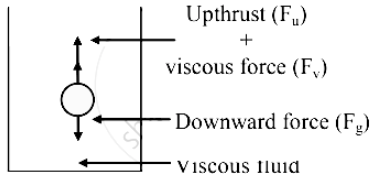
i.Consider a sphere of the radius (r) and density (ρ) falling under gravity through a liquid of density (σ) and coefficient of viscosity (η) as shown in the figure.

Image

ii.Forces acting on the sphere during downward motion are
a. Viscous force =$ F_v$ = 6πηrv (directed upwards)
b. Weight of the sphere, $(F_g)$
\(mg =\frac{4}{3} \pi r^3 \rho g\) (directed downwards)
c. Upward thrust as Buoyant force $(F_u)$
\(F _{ U }=\frac{4}{3} \pi r^3 \sigma g\) (directed upwards)
iii.As the downward velocity increases, the viscous force increases. A stage is reached when the sphere attains terminal velocity.
iv.When the sphere attains the terminal velocity, the total downward force acting on the sphere is balanced by the total upward force acting on the sphere.
∴ Total downward force = Total upward force
∴ Weight of sphere (mg) = Viscous Force +
Buoyant force due to medium
\(\therefore \frac{4}{3} \pi r^3 \rho g=6 \pi \eta r \vee+\frac{4}{3} \pi r^3 \sigma g\)
\(\therefore 6 \pi \eta r v=\left(\frac{4}{3} \pi r^3 \rho g\right)-\left(\frac{4}{3} \pi r^3 \sigma g\right)\)
\(\therefore 6 \pi \eta r v=\left(\frac{4}{3}\right) \pi r^3 g(\rho-\sigma)\)
\(\therefore v =\left(\frac{4}{3}\right) \pi r^3 g(\rho-\sigma) \times \frac{1}{6 \pi \eta r}\)
\(\therefore v=\frac{2}{9} \frac{r^2 g(\rho-\sigma)}{\eta}\)...(1)
v.This is the expression for the terminal velocity of the sphere falling under gravity through a viscous medium. 

Need a full question paper?

Generate a complete, print-ready paper with questions like this in minutes — across 16+ boards, with answer keys.
Start Generating Free

Similar questions

Two coherent sources are $1.8\ mm$ apart and the fringes are observed on a screen $80 \ cm$ away from them. It is found that with a certain source of light, the fourth bright fringe is situated at: a distance of $1.08\ mm$ from the central fringe. Calculate the wavelength of light.
Two discs of moments of inertia $\mathrm{I}_1$ and $\mathrm{I}_2$ about their transverse symmetry axes, respectively rotating with angular velocities to $\omega_1$ and $\omega_2$, are brought into contact with their rotation axes coincident. Find the angular velocity of the composite disc.
Show that even as well as odd harmonics are present as overtones in the case of an air column vibrating in a pipe open at both the ends.
An alternating emf of frequency $50 Hz$ is applied a series combination of an inductor $( L =2H)$ and a resistor $(R=100 \Omega)$. What is the impedance of the circuit?
Derive an expression for the effective capacitance of three parallel plate capacitors connected in series.
The equation of simple harmonic progressive wave is, $y = \sin \pi/2 (4t/0.025 – x/0.25).$ Where all quantities are in the S.I. system. Find the amplitude, frequency, wavelength, and velocity of the wave.
In Young's double$-$slit experiment, the ratio of the intensities of the maxima and minima in an interference pattern is $36: 9$. What is the ratio of the intensities of the two interfering waves?
A circular race course track has a radius of $500 \mathrm{~m}$ and is banked at $10^{\circ}$. The coefficient of static friction between the tyres of a vehicle and the road surface is 0.25 . Compute
(i) the maximum speed to avoid slipping
(ii) the optimum speed to avoid wear and tear of the tyres.
The refractive indices of glass and water with respect to air are $\frac{3}{2}$ and $\frac{4}{3}$, respectively. Determine the refractive index of glass with respect to water.
A solenoid of length $\pi m$ and $5\ cm$ in diameter has winding of $1000$ turns and carries a current of $5\ A.$ Calculate the magnetic field at its centre along the axis.