Question
Derive an expression for the effective capacitance of three parallel plate capacitors connected in series.
Answer

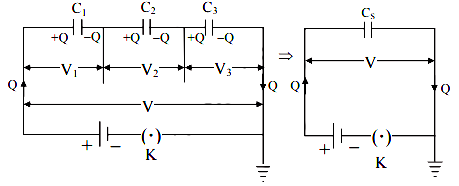
i. Diagram:

ii. Explanation:
a. Capacitors are said to be connected in series if they are connected one after the other in the form of a chain.
b. Let capacitors of capacitances $C_1, C_2, C_3$ be connected in series as shown in the figure.
c. Let $V_1, V_2, V_3$ be the corresponding potential differences in the capacitors.
d. Suppose a potential difference ' $V$ ' is applied across the combination. The left plate of capacitor $C_1$ has a charge $+Q$. An equal but opposite charge $-Q$ is induced on the right plate of this capacitor. This charge $-Q$ induces a charge $+Q$ on the left plate of $C_2$ and so on.
e. Thus, each capacitor receives a magnitude of charge $Q$. Hence, when the capacitors are connected in series, the same current flows through them and all have the same charge $+Q$ induced on the plate. Thus, potential difference induced across capacitors is given by,
$V _1=\frac{ Q }{ C _1}, V _2=\frac{ Q }{ C _2}, V _3=\frac{ Q }{ C _3}$
f. Total potential difference ' $V$ ' across the combination is given by,$V=V_1+V_2+V_3$
$\therefore V =\frac{ Q }{ C _1}+\frac{ Q }{ C _2}+\frac{ Q }{ C _3} \ldots$...[From equation (1)]
$\therefore V = Q \left(\frac{1}{ C _1}+\frac{1}{ C _2}+\frac{1}{ C _3}\right)$
$g$. If these capacitors are replaced by a single capacitor of capacity $C_S$, such that effective capacity remains the same then
$ C _{ s }=\frac{ Q }{ V }$
$\therefore V =\frac{ Q }{ C _{ S }} \ldots .(3) $
From equation (2) and (3),
$ \frac{ Q }{ C _{ s }}= Q \left(\frac{1}{ C _1}+\frac{1}{ C _2}+\frac{1}{ C _3}\right)$
$\therefore \frac{1}{ C _{ s }}=\left(\frac{1}{ C _1}+\frac{1}{ C _2}+\frac{1}{ C _3}\right)$
$\therefore C _{ s }=\frac{ C _1 C _2 C _3}{ C _1 C _2+ C _2 C _3+ C _3 C _1} $

Need a full question paper?

Generate a complete, print-ready paper with questions like this in minutes — across 16+ boards, with answer keys.
Start Generating Free

Similar questions

A body starts rotating from rest. Due to a couple of \(20 Nm\) it completes $60$ revolutions in one minute. Find the moment of inertia of the body.
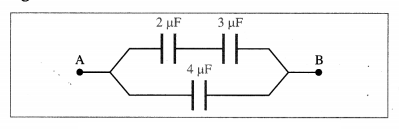
Three capacitors are connected as shown in the figure below. Calculate the effective capacitance between $A$ and $B.$​​​​​​​
Image
A dynamo attached to a bicycle has a 200 turn coil, each of area $0.10 m ^2$. The coil rotates half a revolution per second and is placed in a uniform magnetic field of $0.02 T$. Find the maximum voltage generated in the coil.
What is capillary? What is capillarity or capillary action?
The back emf in a motor is $100 V$ when operating . at $2500 rpm$. What would be the back emf at $1800 rpm$ ? Assume the magnetic field remains unchanged.
What are step-up and step-down transformers?
Explain back emf in a motor.
Effective magneton numbers for iron group ions (No. of Bohr magnetons)
Ion Electron configuration Magnetic moment (in terms of /$i_B$)
$Fe^3 +$ [Ar] $3s^23p^63d^5$ $5.9$
$Fe^2^+$ [Ar] $3s^23p^63d^6$ $5.4$
$Co^2^+$​​​​​​​ [Ar] $3s^23p^63d^7$ $4.8$
$n^{2+}$​​​​​​​ [Ar] $3s^23p^63d^8$ $3.2$
(Courtsey: Introduction to solid state physics by Charles Kittel, pg. $306$ )
These magnetic moments are calculated from the experimental value of magnetic susceptibility. In several ions the magnetic moment is due to both orbital and spin angular momenta.
What is diamagnetism?
Magnetic field at a distance $2.4\ cm$ from a long straight wire is $16 \mu T.$ What must be current through the wire?