Question
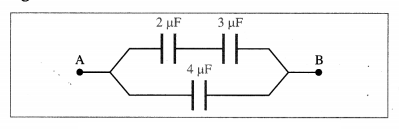
Three capacitors are connected as shown in the figure below. Calculate the effective capacitance between $A$ and $B.$​​​​​​​
Image

Answer

Data: $C _1=2 \mu F , C _2=3 \mu F , C _3=4 \mu F$
The resultant capacitance $C_5$ of $C_1$ and $C_2$ in series is given by
$\frac{1}{C_n}=\frac{1}{C_1}+\frac{1}{C_2}=\frac{1}{2}+\frac{1}{3}=\frac{5}{6}$
$\therefore C_5=\frac{6}{5}=1.2 \mu F$
The effective capacitance between $A$ and $B$ is due to the parallel combination of $C_5$ and $C_3$.
$C_p=C_5+C_3=1.2+4=5.2 \mu F$

Need a full question paper?

Generate a complete, print-ready paper with questions like this in minutes — across 16+ boards, with answer keys.
Start Generating Free

Similar questions

The critical angle for a glass-air interface is $\sin 1 \frac{5}{8}$. A ray of unpolarized monochromatic light in air is incident on the glass. What is the polarizing angle?
A simple pendulum of length $1 m$ has a bob of mass $10 g$ and oscillates freely with an amplitude of $2 cm$. Find its potential energy at the extreme position. [ $g =9.8 m / s ^2$ ]
The wavelength of blue light in air is $4500 A$. What is its frequency? If the refractive index of glass for blue light is $1.55 ,$ what will be the wavelength of blue light in glass?
The equation of a standing wave is given by $y=0.02 \cos (\pi x) \sin (100 \pi t ) m$. Find the amplitude of either wave interfering, wavelength, time period, frequency and wave speed of interfering waves.
What is gravitational Potential ?
Write an expression for an alternating emf that varies sinusoidally with time. Show graphically variation of emf with time.
A parallel beam of monochromatic light is incident on a glass slab at an angle of incidence \(60^{\circ}\). Find the ratio of width of the beam in the glass to that in the air if refractive index of glass is \(\frac{3}{2}\).
State any two limitations of a cyclotron.
Two long parallel wires going into the plane of the paper are separated by a distance $R$, and carry a current I each in the same direction. Show that the magnitude of the magnetic field at a point $P$ equidistant from the wires and subtending angle $\theta$ from the plane containing the wires, is $B =\frac{\mu_0}{\pi} \frac{I}{R} \sin 2 \theta$ What is the direction of the magnetic field?
What will happen if the magnetic field in a moving-coil galvanometer is not radial?