Question
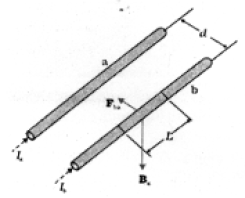
  1. Derive an expression for the force between two long parallel current carrying conductors.
  2. Use this expression to define S.I. unit of current.
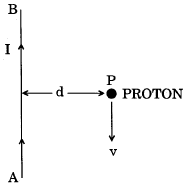
  3. A long straight wire AB carries a current I. A proton P travels with a speed v, parallel to the wire, at a distance d from it in a direction opposite to the current as shown in the figure. What is the force experienced by the proton and what is its direction?

Answer

  1.  

Two long parallel conductors ‘a’ and ‘b’ are separated by a distance d and carry (parallel) currents Ia and Ib, respectively. The conductor ‘a’ produces, the same magnetic field Ba at all points along the conductor ‘b’.

$\text{B}_{a} = \frac{\mu_{0}\text{I}_{a}}{2\pi\text{d}}$

Fba, is the force on a segment L of ‘b’ due to ‘a’. The magnitude of this force is given by

Fba = Ib LBa

$=\frac{\mu_{0}\text{I}_{a}\text{I}_{b}}{2\pi\text{d}}\text{L}$

  1. The ampere is the value of that steady current which, when maintained in each of the two very long, straight, parallel conductors of negligible cross-section, and placed one metre apart in vacuum, would produce on each of these conductors a force equal to 2 × 10⁻⁷ newton per metre of length.
  2. Magnetic field due to the straight wire AB at a perpendicular distance d from it.

$\text{B} = \frac{\mu_{0}\text{I}}{2\pi\text{d}}$

Therefore, force on proton moving with velocity ‘v’ perpendicular to B, is

$\text{f} = \text{qvB} = \frac{\mu_{0}\text{Iqv}}{2\pi\text{d}}$

Direction: Towards right.
Need a full question paper?

Generate a complete, print-ready paper with questions like this in minutes — across 16+ boards, with answer keys.

Start Generating Free

Similar questions

Is it possible that in a Coolidge tube characteristic $\text{L}_\alpha$ X-rays are emitted but not $\text{K}_\alpha$ X-rays?
In a semiconductor, electrons and holes move in opposite directions to each other. How? Explain with figure.
In a Young's double slit interference experiment the fringe pattern is observed on a screen placed at a distance D from the slits. The slits are separated by a distance d and are illuminated by monochromatic light of wavelength $\lambda$. Find the distance from the central point where the intensity falls to,
  1. Half the maximum.
  2. One fourth of the maximum.
A particle stays at rest as seen in a frame. We can conclude that:
  1. The frame is inertial.
  2. Resultant force on the particle is zero.
  3. The frame may be inertial but the resultant force on the particle is zero.
  4. The frame may be non-inertial but there is a non-zero resultant force.
Explain quantitatively the order of magnitude difference between the diamagnetic susceptibility of N2 (~5 × 10-9) (at STP) and Cu (~10-5).
Determine the equivalent resistance of networks shown in Fig.


A force F1 acts on a particle so as to accelerate it from rest to a velocity v. The force F1 is then replaced by F2 which decelerates it to rest:
  1. F1 must be equal to F2.
  2. F1 may be equal to F2.
  3. F1 must be unequal to F2.
  4. None of these.
A wire of resistance $15.0\Omega$ is bent to form a regular hexagon ABCDEFA. Find the equivalent resistance of the loop between the points (a) A and B (b) A and C and (c) A and D.
A rectangular loop of sides 20cm and 10cm carries a current of 5.0A. A uniform magnetic field of magnitude 0.20T exists parallel to the longer side of the loop.
  1. What is the force acting on the loop?
  2. What is the torque acting on the loop?
A stone is thrown vertically upward with a speed of 28m/s.
  1. Find the maximum height reached by the stone.
  2. Find its velocity one second before it reaches the maximum height.
  3. Does the answer of part.
  4. Change if the initial speed is more than 28m/s suchas 40m/s or 80m/s?