Question
Derive an expression for the gravitational field due to a uniform rod of length L and mass M at a point on its perpendicular bisector at a distance d from the centre.
Answer

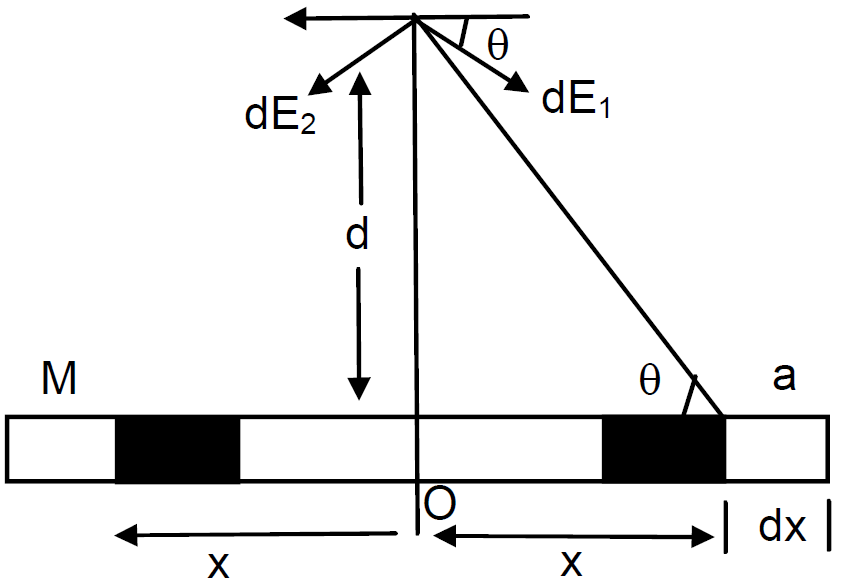
A small section of rod is considered at ‘x’ distance mass of the element = (M/L). dx = dm$\text{dE}_1=\frac{\text{G}(\text{dm})\times1}{(\text{d}^2+\text{x}^2)}=\text{dE}_2$
Resultant $\text{dE}=2\text{dE}_1\sin\theta$$=2\times\frac{\text{G(dm)}}{(\text{d}^2+\text{x}^2)}\times\frac{\text{d}}{\sqrt{(\text{d}^2+\text{x}^2})}=\frac{2\times\text{GM}\times\text{d dx}}{\text{L}(\text{d}^2+\text{x}^2)\big(\sqrt{\text{d}^2+\text{x}^2}\big)}$
Total gravitational field$\text{E}=\int\limits_{0}^{\frac{\text{L}}{2}}\frac{2\text{Gmd dx}}{\text{L}\big(\sqrt{\text{d}^2+\text{x}^2}\big)^{\frac{3}{2}}}$
Integrating the above equation it can be found that,$\text{E}=\frac{2\text{GM}}{\text{d}\sqrt{\text{L}^2+4\text{d}^2}}$

Need a full question paper?

Generate a complete, print-ready paper with questions like this in minutes — across 16+ boards, with answer keys.
Start Generating Free

Similar questions

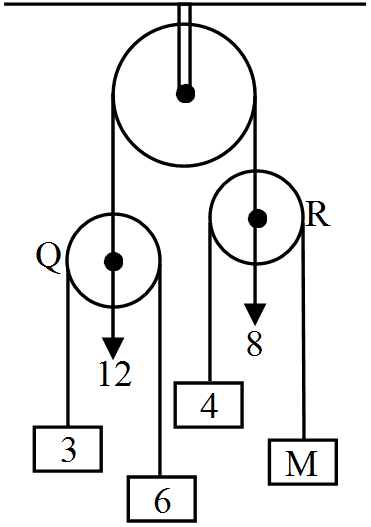
Two pulleys of masses $12kg$ and $8kg$ are connected by a fine string hanging over a fixed pulley as shown. Over the $8kg$ pulley is hung a fine string with masses $4kg$ and M. Over the $12kg$ pulley is hung another fine string with masses $3kg$ and $6kg$. Calculate M so that the string over the fixed pulley remains stationary.
A transverse harmonic wave on a string is described by
$\text{y}(\text{x, t})=3.0\sin\big(36\text{t}+0.018\text{x}+\frac{\pi}{4}\big)$
where x and y are in cm and t in s. The positive direction of x is from left to right.
Is this a travelling wave or a stationary wave?
If it is travelling, what are the speed and direction of its propagation?
When a body slides down from rest along a smooth inclined plane making an angle of 45° with the horizontal, it takes time T. When the same body slides down from rest along a rough inclined plane making the same angle and through the same distance, it is seen to take time pT, where p is some number greater than 1. Calculate the co-efficient of friction between the body and the rough plane.
Explain cohesive and adhesive force and write their effects.
Two trains each having a speed of $30\ km/ hr$ are headed at each other on the same track. A bird that can fly at $60\ km/ hr$ flies off from one train, when they are $60\ km$ apart, and heads directly for the other train. On reaching the other train, it flies directly back to the first, and so forth.
  1. How many trips can the bird make from one train to the other before they crash?
  2. What is the total distance the bird travels?
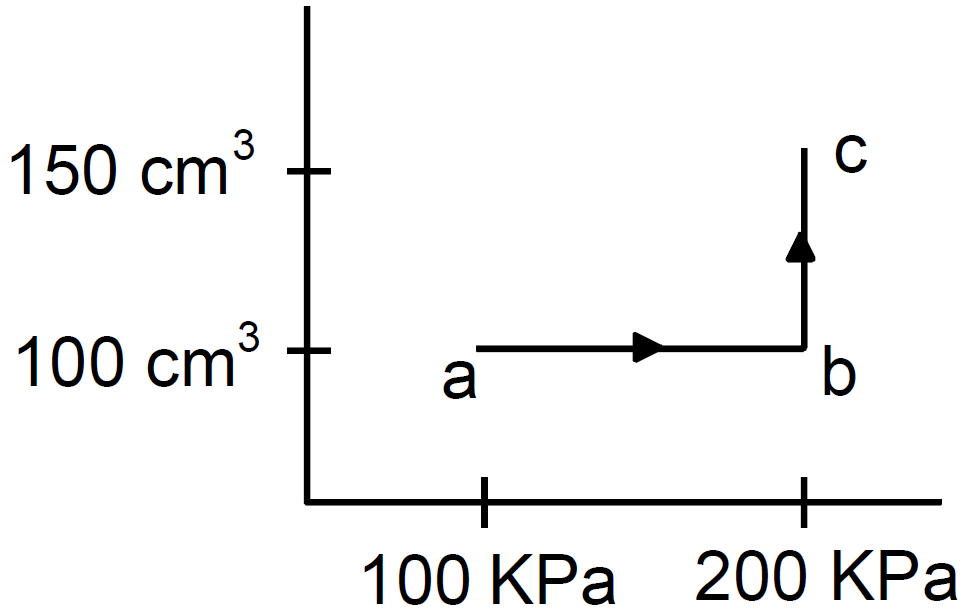
An ideal gas $(\gamma=1.67)$ is taken through the process abc shown in the figure. The temperature at point a is $300K$. Calculate,
  1. The temperatures at b and c.
  2. The work done in the process.
  3. The amount of heat supplied in the path ab and in the path bc.
  4. The change in the internal energy of the gas in the process.
Find the speed of an electron with kinetic energy:
  1. 1eV
  2. 10keV
  3. 10MeV
A $5.0\mu\text{F}$ capacitor is charged to $12V$. The positive plate of this capacitor is now connected to the negative terminal of a $12V$ battery and vice versa. Calculate the heat developed in the connecting wires.
The left end of a copper rod (length $=20 \mathrm{~cm}$ area of cross section $=0.20 \mathrm{~cm}$ ) is maintained at $20^{\circ} \mathrm{C}$ and the right end is maintained at $80^{\circ} \mathrm{C}$. Neglecting any loss of heat through radiation, find,
  1. The temperature at a point $11cm$ from the left end
  2. The heat current through the rod. Thermal conductivity of copper $=385\text{Wm}^{-1}{^{\circ}}\text{C}^{-1}.$