Question
Explain cohesive and adhesive force and write their effects.

Answer

SELF

Need a full question paper?

Generate a complete, print-ready paper with questions like this in minutes — across 16+ boards, with answer keys.

Start Generating Free

Similar questions

Match the technology in column A to its related scientific principle(s) in column B.
S. No
A. Technology
S. No
B. Scientific principle(s)
1.
Steam engine
(i)
Propagation of electromagnetic waves
2.
Nuclear reactor
(ii)
Newton's laws of motion
3.
Radio and television
(iii)
Superconductivity
4.
Computers
(iv)
Role of DNA in heredity
5.
Lasers
(v)
Thermodynamics
6.
Production of ultra high magnetic fields
(vi)
Faraday's law of induction
7.
Rocket propulsion
(vii)
Conversion of gravitational potential energy into electrical energy
8.
Genetic engineering
(viii)
Motion of charged particles in electromagnetic fields.
9.
Electric generator
(ix)
Fission of uranium by slow neutrons
10.
Hydroelectric power
(x)
Amplification by population inversion
11.
Aeroplane
(xi)
Digital logic of electronic circuits
12.
Particle accelerators
(xii)
Bernoulli's principle in fluid dynamics
Find the time period of mass M when displaced from its equilibrium positon and then released for the system shown in figure.
$(n - 1)$ equal point masses each of mass m are placed at the vertices of a regular n-polygon. The vacant vertex has a position vector a with respect to the centre of the polygon. Find the position vector of centre of mass.
The plates of a capacitor are 2.00cm apart. An electronproton pair is released somewhere in the gap between the plates and it is found that the proton reaches the negative plate at the same time as the electron reaches the positive plate. At what distance from the negative plate was the pair released?
A compound microscope has a magnifying power of $100$ when the image is formed at infinity. The objective has a focal length of $0.5cm$ and the tube length is $6.5cm$. Find the focal length of the eyepiece.
Suppose the rod with the balls $A$ and $B$ of the previous problem is clamped at the centre in such a way that it can rotate freely about a horizontal axis through the clamp. The system is kept at rest in the horizontal position. $A$ particle $P$ of the same mass $m$ is dropped from a height $h$ on the ball $B.$ The particle collides with $B$ and sticks to it:
  1. Find the angular momentum and the angular speed of the system just after the collision.
  2. What should be the minimum value of $h$ so that the system makes a full rotation after the collision.
A block of mass $2.0kg$ is pushed down an inclined plane of inclination $37^\circ$ with a force of $20N$ acting parallel to the incline. It is found that the block moves on the incline with an acceleration of $10m/s^2$. If the block started from rest, find the work done.
  1. By the applied force in the first second.
  2. By the weight of the block in the first second.
  3. By the frictional force acting on the block in the first second. Take $g = 10m/s^2$.
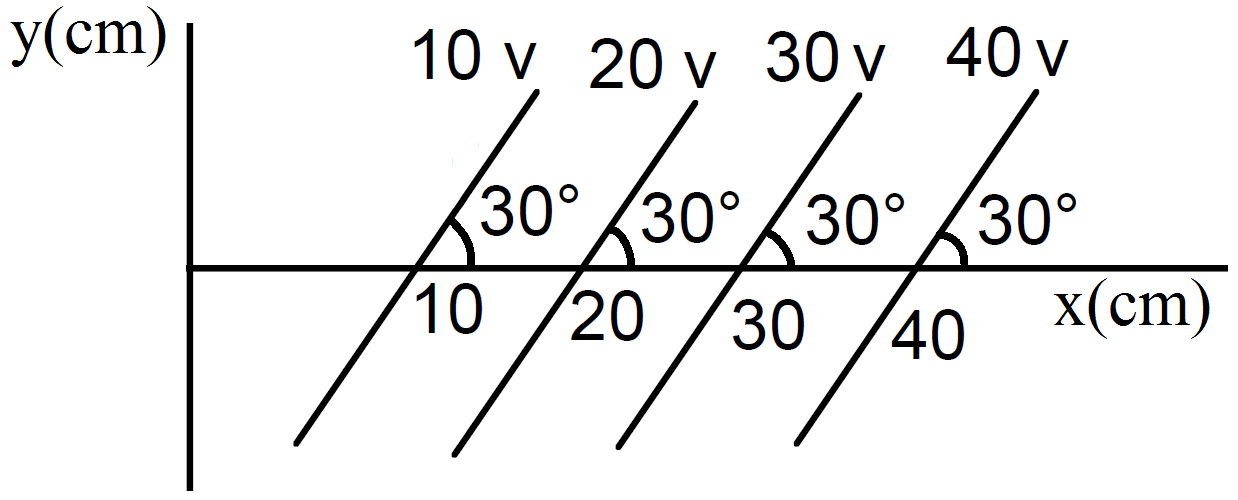
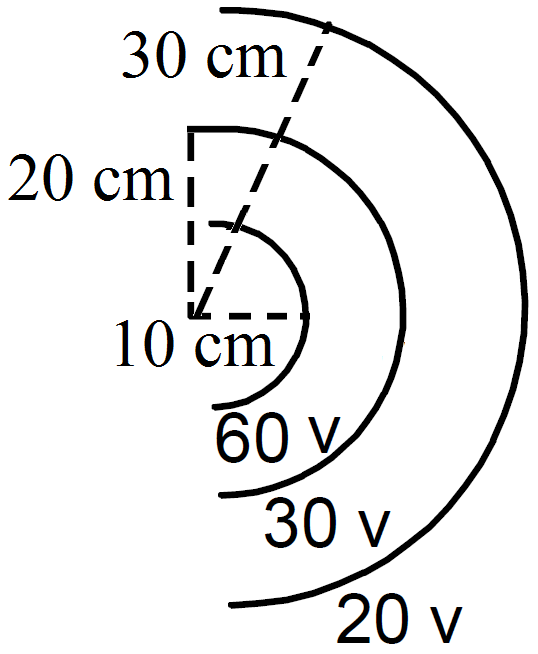
Some equipotential surfaces are shown in figure. What can you say about the magnitude and the direction of the electric field?

Which of the following symptoms is likely to afflict an astronaut in space (a) swollen feet, (b) swollen face, (c) headache, (d) orientational problem.
Two masses $M_1$ and $M_2$ are separated by a distance r. Find the moment of inertia of this arrangement about an axis passing through the centre of mass and perpendicular to the line joining them.