Question
Derive an expression for the work done in rotating a dipole from the angle $\theta_{0}$ to $\theta_{1}$ in a uniform electric field E.

Answer

Work done against the restoring torque
$\text{dW} = \tau\text{ d}\theta$
$\text{dW} = \text{pE}\sin\theta\text{ d}\theta$
$\therefore , \text{W} = \text{pE}\int^{\theta1}_{\theta0}\sin\theta\text{d}\theta$
$ = \text{pE}\cos\theta_{0} -\cos\theta_{1}.$

Need a full question paper?

Generate a complete, print-ready paper with questions like this in minutes — across 16+ boards, with answer keys.
Start Generating Free

Similar questions

Draw the graph of variation of Coulomb force (F) with $(r)$. Where the distance between the two charges of each charge pair is ( $1 \mu C , 2 \mu C$ ) and ( $2 \mu C$, $-3 \mu C$ ). Analyse the graph obtained.
A 12·5 eV electron beam is used to excite a gaseous hydrogen atom at room temperature. Determine the wavelengths and the corresponding series of the lines emitted.
A plane electromagnetic wave is propagating along Y -axis in vacuum. Write about the (i) ratio of magnitudes and (ii) directions of electric and magnetic fields.
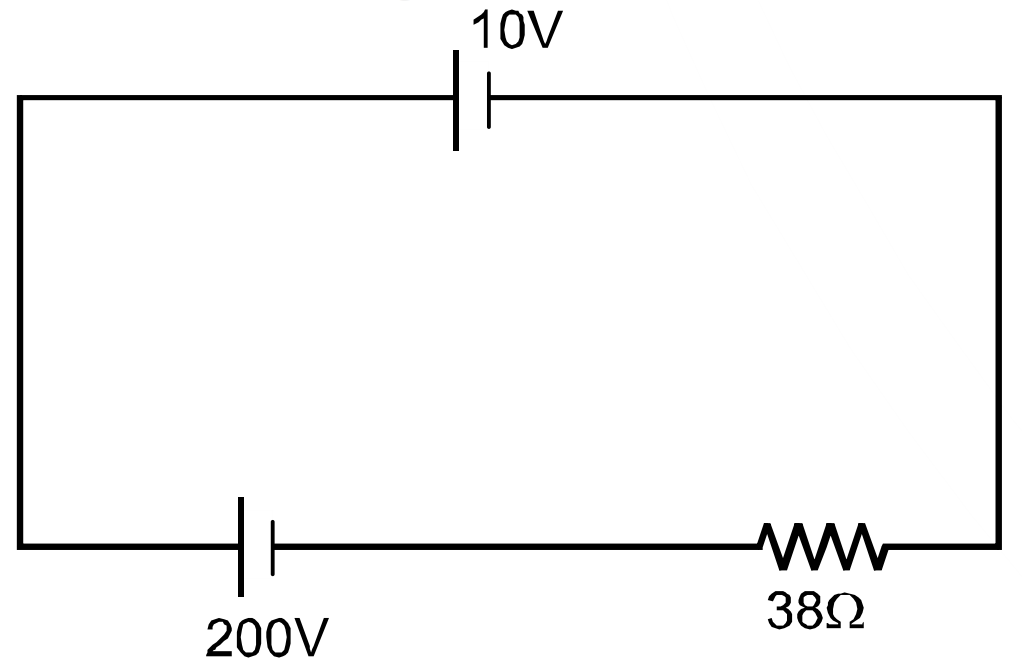
A 10V cell of negligible internal resistance is connected in parallel across a battery of emf 200V and internal resistance $38\Omega$ as shown in the figure. Find the value of current in the circuit.
What is called polar and non-polar atom ? Give example of it.
Explain the formation of the barrier potential in a p-n junction.
Two trains are travelling towards each other both at a speed of $90\ km/h.$ If one of the trains sounds a whistle at $500\ Hz,$ what will be the apparent frequency heard in the other train? Speed of sound in air $= 350\ m/s.$
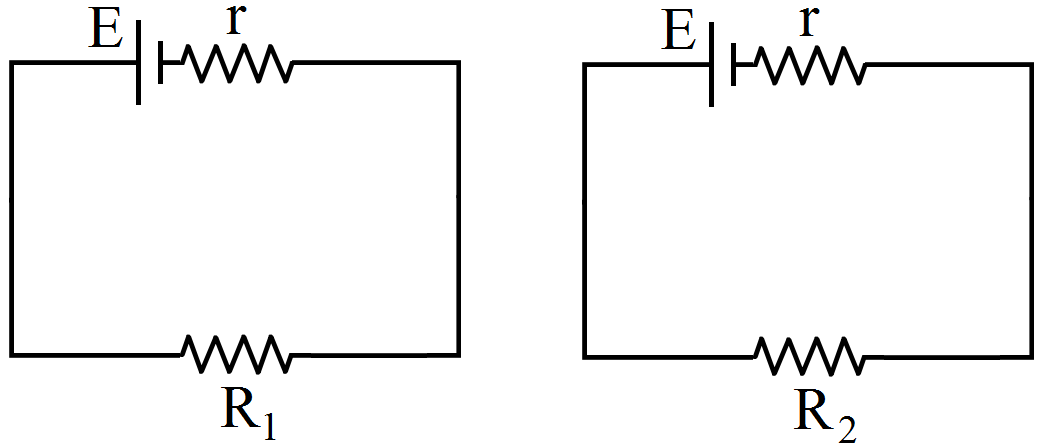
Two unequal resistances $R_1$ and $R_2$ are connected across two identical batteries of emf $\varepsilon$ and internal resistance $r$. Can the thermal energies developed in $R_1$ and $R_{2}$ be equal in a given time. If yes, what will be the condition?
Consider a gold nucleus to be a sphere of radius 6.9 fermi in which protons and neutrons are distributed. Find the force of repulsion between two protons situated at largest separation. Why do these protons not fly apart under this repulsion?
An immersion heater rated $1000W, 220V$ is used to heat $0.01m^3$ of water. Assuming that the power is supplied at $220V$ and $60\%$ of the power supplied is used to heat the water, how long will it take to increase the temperature of the water from $15^\circ C$ to $40^\circ C?$