Maharashtra BoardEnglish MediumSTD 12 SciencePhysicsRotational Dynamics4 Marks
Question
Derive an expression that relates angular momentum with the angular velocity of a rigid body.
✓
Answer
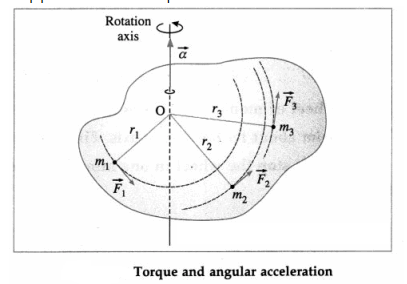
Consider a rigid body rotating with a constant angular velocity $\vec{\omega}$ about an axis through the point $O$ and perpendicular to the plane of the figure. All the particles of the body perform uniform circular motion about the axis of rotation with the same angular velocity $\vec{\omega}$. Suppose that the body consists of $N$ particles of masses $m_1, m_2, \ldots, m_n$, situated at perpendicular distances $r_1, r_2, \ldots, r_N$, respectively from the axis of rotation.
The particle of mass $m_1$ revolves along a circle of radius $r_1$, with a linear velocity of magnitude $v_1=r_1 w$. The magnitude of the linear momentum of the particle is $p_1=m_1 v_1=m_1 r_1 \omega$
The angular momentum of the particle about the axis of rotation is by definition, $\vec{L}_1=\vec{r}_1 \times \vec{p}_1$ $\therefore L_1=r_1 p_1 \sin \theta$
where $\theta$ is the smaller of the two angles between $\vec{r}_1$ and $\vec{p}_1$.
In this case, $\theta=90^{\circ} \therefore \sin \theta=1$
$\therefore L_1=r_1 p_1=r_1 m_1 r_1 \omega=m_1 r_1^2 \omega$
Similarly $L_2=m_2 r_2^2 \omega_1 L_3=m_3 r_3^2 \omega_1$ etc.
The angular momentum of the body about the given axis is
$
\begin{aligned}
L=L_1 & +L_2+\ldots+L_N \\
& =m_1 r_1^2 \omega+m_2 r_2^2 \omega+\ldots+m_N r_N^2 \omega \\
& =\left(m_1 r_1^2+m_2 r_2^2+\ldots+m_N r_N^2\right) \omega
\end{aligned}
$
$
\begin{aligned}
& =\left(\sum_{i=1}^N m_i r_i^2\right) \omega \\
\therefore L & =I \omega
\end{aligned}
$
where I $=\sum_{i=1}^N m_i r_i^2=$ moment of inertia of the body about the given axis.
In vector form, $\vec{L}=I \vec{\omega}$
Thus, angular momentum $=$ moment of inertia $\times$ angular velocity .
[Note : Angular momentum is a vector quantity. It has the same direction as $\vec{\omega}$.]
Need a full question paper?
Generate a complete, print-ready paper with questions like this in minutes — across 16+ boards, with answer keys.