Current Electricity — Physics STD 12 Science — Question
Maharashtra BoardEnglish MediumSTD 12 SciencePhysicsCurrent Electricity4 Marks
Question
Explain how a moving$-$coil galvanometer is converted into an ammeter. Derive the necessary formula.
✓
Answer
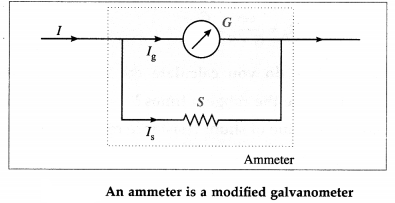
A moving$-$coil galvanometer is converted into an ammeter by reducing its effective resistance by connecting a low resistance $S$ across the coil. Such a parallel low resistance is called a shunt since it shunts a part of the current around the coil, shown in below figure. That makes it possible to increase the range of currents over which the meter is useful.
Let $I$ be the maximum current to be measured and $I_g$ the current for which the galvanometer of resistance $G$ shows a full$-$scale deflection.
Then, the shunt resistance $S$ should be such that the remaining current $I-I_g=I_s$ is shunted through it.
In the parallel combination, the potential difference across the galvanometer $=$ the potential difference across the shunt
$\therefore I_g G=I_S S$
$=\left(I-I_g\right) S$
$\therefore S=\left(\frac{I_B}{I-I_B}\right) C$
This is the required resistance of the shunt. The scale of the galvanometer is then calibrated so as to read the current in ampere or its submultiples $( mA , \mu A )$ directly.
$[$Notes :
$(1)$ Thick bars of manganin are used for shunts because manganin has a very small temperature coefficient of resistivity.
$(2)$ The fraction of the current passing through the galvanometer and shunt are, respectively, $\frac{I_g}{I}=\frac{S}{S+G}$ and $\frac{I_g}{I}=\frac{G}{S+G}$
$(3)$ On the right hand side of Eq. $(1),$ dividing both the numerator and denominator by $I_9$,
we get, $S =\frac{1}{\left(I / I_{ R }\right)-1} \cdot G =\frac{G}{p-1}$
where $p=1 / l g$ is the range-multiplying factor,
i.e $n,$ the current range of the galvanometer can be increased by a factor $p$ by connecting a shunt whose resistance is smaller than the galvanometer resistance by a factor $p-1$.
$\therefore p =\frac{G+S}{S}$
If $R_A$ is the resistance of the ammeter,
$\left. R _{ A }=\frac{G S}{G+S}=\frac{G}{p}\right]$
Need a full question paper?
Generate a complete, print-ready paper with questions like this in minutes — across 16+ boards, with answer keys.