Question
Derive Einstein’s photoelectric equation $\frac{1}{2}\text{m}\text{v}^2=\text{h}\nu-\text{h}\nu_0.$

Answer

Einstein’s Explanation of Photoelectric Effect:Einstein’s Photoelectric Equation:
Einstein explained photoelectric effect on the basis of quantum theory. The main points are,
  1. Light is propagated in the form of bundles of energy. Each bundle of energy is called a quantum or photon and has energy hν where h = Planck’s constant and ν = frequency of light.
  2. The photoelectric effect is due to collision of a photon of incident light and a bound electron of the metallic cathode.
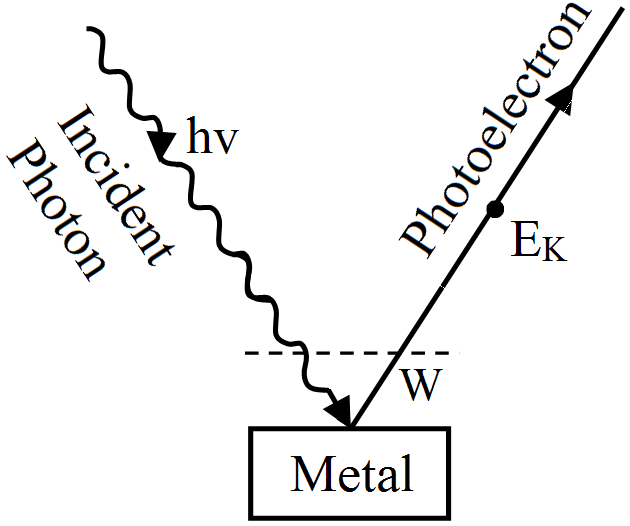
  3. When a photon of incident light falls on the metallic surface, it is completely absorbed. Before being absorbed it penetrates through a distance of nearly 10-8m (or $100\mathring{\text{A}}$). The absorbed photon transfers its whole energy to a single electron. The energy of photon goes in two parts: a part of energy is used in releasing the electron from the metal surface (i.e., in overcoming work function) and the remaining part appears in the form of kinetic energy of the same electron.
If ν be the frequency of incident light, the energy of photon = hν. If W be the work function of metal and $E_K$ the maximum kinetic energy of photoelectron, then according to Einstein’s explanation. $\text{h}\nu=\text{W}+\text{E}_\text{K}$ or $\text{E}_\text{K}=\text{h}\nu-\text{W}\dots(\text{i})$ This is called Einstein’s photoelectric equation. If $\nu_0$ be the threshold frequency, then if frequency of incident light is less then $\nu_0$ no electron will be emitted and if the frequency of incident light be $\nu_0$ then $E_K = 0$; so from equation (i) $0=\text{h}\nu_0-\text{W}$ or $\text{W}=\text{h}\nu_0$ If $\lambda_0$ be the threshold wavelength, then $\nu_0=\frac{\text{c}}{\lambda_0},$ where c is the speed of light in vacuum $\therefore$ Work function $\text{W}=\text{h}\nu_0=\frac{\text{hc}}{\lambda_0}\dots(\text{ii})$Substituting this value in equation (i), we get
$\text{E}_\text{K}=\text{h}\nu-\text{h}\nu_0$ $\Rightarrow\ \frac{1}{2}\text{mv}^2=\text{h}\nu-\text{h}\nu_0\dots(\text{iii})$This is another form of Einstein's photoelectric equation.

Need a full question paper?

Generate a complete, print-ready paper with questions like this in minutes — across 16+ boards, with answer keys.
Start Generating Free

Similar questions

A resistor of resistance $100\Omega$ is connected to an AC source $\in=(12\text{V})\sin(250\pi\text{s}^{-1})\text{t}.$ Find the energy dissipated as heat during $\text{t}=0$ to $\text{t}=1.0\text{ms}.$
A uniform ladder of length 10.0m and mass 16.0kg is resting against a vertical wall making an angle of 37° with it. The vertical wall is frictionless but the ground is rough. An electrician weighing 60.0kg climbs up the ladder. If he stays on the ladder at a point 8.00m from the lower end, what will be the normal force and the force of friction on the ladder by the ground? What should be the minimum coefficient of friction for the elctrician to work safely?
A charge Q is placed at the centre of an uncharged, hollow metallic sphere of radius a:
  1. Find the surface charge density on the inner surface and on the outer surface.
  2. If a charge q is put on the sphere, what would be the surface charge densities on the inner and the outer surfaces?
  3. Find the electric field inside the sphere at a distance x from the centre in the situations (a) and (b).
Ajit had a high tension tower erected on his farm land. He kept complaining to the authorities to remove it as it was occupying a large portion of his land. His uncle, who was a teacher, explained to him the need for erecting these towers for efficient transmission of power. As Ajit realised its significance, he stopped complaining.
Answer the following questions:
  1. Why is it necessary to transport power at high voltage?
  2. A low power factor implies large power loss. Explain.
  3. Write two values each displayed by Ajit and his uncle.
The bob of a pendulum at rest is given a sharp hit to impart a horizontal velocity $\sqrt{10\text{gl}},$ where l is the length of the pendulum. Find the tension in the string when,
  1. The string is horizontal.
  2. The bob is at its highest point.
  3. The string makes an angle of 60° with the upward vertical.
A wave is described by the equation$\text{y}=(1.0\text{mm})\sin\pi\Big(\frac{\text{x}}{2.0\text{cm}}-\frac{\text{t}}{0.01\text{s}}\Big).$
  1. Find the time period and the wavelength.
  2. Write the equation for the velocity of the particles. Find the speed of the particle at x = 1.0cm at time t = 0.01s.
  3. What are the speeds of the particles at x = 3.0cm, 5.0cm and 7.0cm at t 0.01s?
  4. What are the speeds of the particles at x 1.0cm at t = 0.011, 0.012, and 0.013s?
$a.$ Two$-$point charges $q _1$ and $q _2$ are kept $r$ distance apart in a uniform external electric field $\overrightarrow{ E }$. Find the amount of work done in assembling this system of charges.
$b.$ A cube of side $20 \ cm$ is kept in a region as shown in the figure. An electric field $\vec{E}$ exists in the region such that the potential at a point is given by $V =10 x +5$, where $V$ is in volt and $x$ is in m .
Image

Find the
$i.$ electric field $\vec{E}$, and
$ii.$ total electric flux through the cube.
It is 260km from Patna to Ranchi by air and 320km by road. An aeroplane takes 30 minutes to go from Patna to Ranchi whereas a delux bus takes 8 hours.
  1. Find the average speed of the plane.
  2. Find the average speed of the bus.
  3. Find the average velocity of the plane.
  4. Find the average velocity of the bus.
Two current-carrying wires may attract each other. In absence of other forces, the wires will move towards each other increasing the kinetic energy. Does it contradict the fact that the magnetic force cannot do any work and hence cannot increase the kinetic energy?
  1. Using Ampere's circuital law, obtain the expression for the magnetic field due to a long solenoid at a point inside the solenoid on its axis.
  2. In what respect is a toroid different from a solenoid? Draw and compare the pattern of the magnetic field lines in the two cases.
  3. How is the magnetic field inside a given solenoid made strong?