Question
Derive Einstein’s photoelectric equation $\frac{1}{2}\text{m}\text{v}^2=\text{h}\nu-\text{h}\nu_0.$

Answer

Einstein’s Explanation of Photoelectric Effect:

Einstein’s Photoelectric Equation:

Einstein explained photoelectric effect on the basis of quantum theory. The main points are,
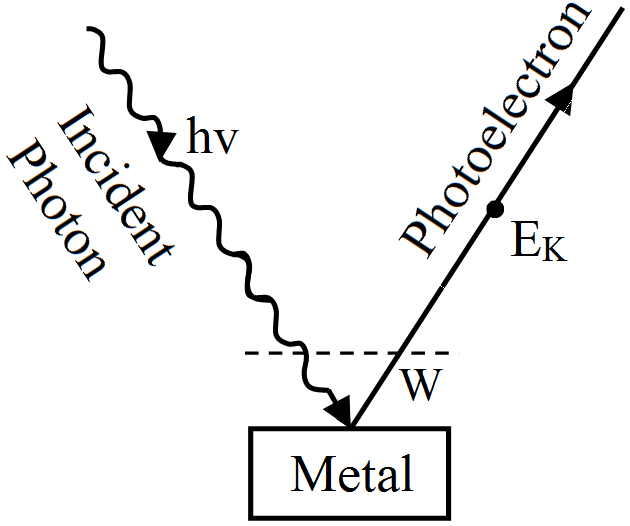
  1. Light is propagated in the form of bundles of energy. Each bundle of energy is called a quantum or photon and has energy hν where h = Planck’s constant and ν = frequency of light.
  2. The photoelectric effect is due to collision of a photon of incident light and a bound electron of the metallic cathode.
  3. When a photon of incident light falls on the metallic surface, it is completely absorbed. Before being absorbed it penetrates through a distance of nearly 10-8m (or $100\mathring{\text{A}}$). The absorbed photon transfers its whole energy to a single electron. The energy of photon goes in two parts: a part of energy is used in releasing the electron from the metal surface (i.e., in overcoming work function) and the remaining part appears in the form of kinetic energy of the same electron.
If ν be the frequency of incident light, the energy of photon = hν. If W be the work function of metal and EK the maximum kinetic energy of photoelectron, then according to Einstein’s explanation.

$\text{h}\nu=\text{W}+\text{E}_\text{K}$ or $\text{E}_\text{K}=\text{h}\nu-\text{W}\dots(\text{i})$

This is called Einstein’s photoelectric equation. If $\nu_0$ be the threshold frequency, then if frequency of incident light is less then $\nu_0$ no electron will be emitted and if the frequency of incident light be $\nu_0$ then EK = 0; so from equation (i)

$0=\text{h}\nu_0-\text{W}$ or $\text{W}=\text{h}\nu_0$

If $\lambda_0$ be the threshold wavelength, then $\nu_0=\frac{\text{c}}{\lambda_0},$

where c is the speed of light in vacuum

$\therefore$ Work function $\text{W}=\text{h}\nu_0=\frac{\text{hc}}{\lambda_0}\dots(\text{ii})$

Substituting this value in equation (i), we get

$\text{E}_\text{K}=\text{h}\nu-\text{h}\nu_0$

$\Rightarrow\ \frac{1}{2}\text{mv}^2=\text{h}\nu-\text{h}\nu_0\dots(\text{iii})$

This is another form of Einstein's photoelectric equation.

Need a full question paper?

Generate a complete, print-ready paper with questions like this in minutes — across 16+ boards, with answer keys.
Start Generating Free

Similar questions

A body is in translational equilibrium under the action of coplanar forces. If the torque of these forces is zero about a point, is it necessary that it will also be zero about any other point?
Three identical charges, each having a value 1.0 × 10-8C, are placed at the corners of an equilateral triangle of side 20cm. Find the electric field and potential at the centre of the triangle.
4 × 10²³ tritium atoms are contained in a vessel. The half-life of decay tritium nuclei is 12.3y. Find:
  1. The activity of the sample.
  2. The number of decay in the next 10 hours.
  3. The number of decays in the next 6.15y.
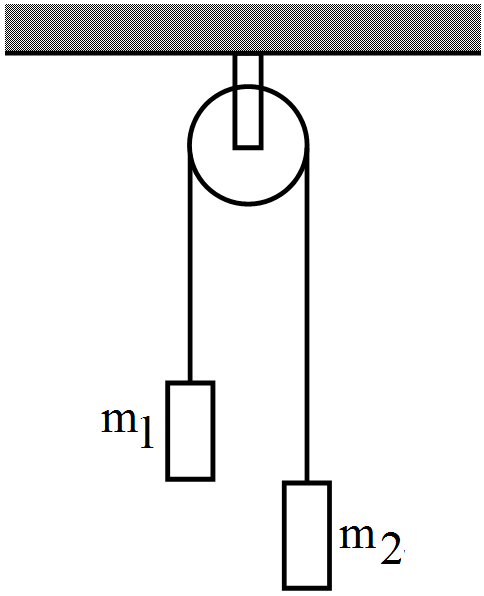
In a simple Atwood machine, two unequal masses m1 and m2 are connected by a string going over a clamped light smooth pulley. In a typical arrangement m1 = 300g and m2 = 600g. The system is released from rest.
  1. Find the distance travelled by the first block in the first two seconds.
  2. Find the tension in the string.
  3. Find the force exerted by the clamp on the pulley.

A biconvex thick lens is constructed with glass $(\mu=1.50)$ Each of the surfaces has a radius of 10cm and the thickness at the middle is 5cm. Locate the image of an object placed far away from the lens.
A body cools down from 50°C to 45°C in 5 minutes and to 40°C in another 8 minutes. Find the temperature of the surrounding.
When a proton is released from rest in a room, it starts with an initial acceleration a0 towards west. When it is projected towards north with a speed v0, it moves with an initial acceleration 3a0 towards west. Find the electric field and the maximum possible magnetic field in the room.
Define induction coefficient. Explain the phenomenon of mutual inductance with the help of an experiment. Obtain an expression for mutual inductance coefficient of two solenoids and prove that $M=\sqrt{L_1 L_2}$.
Monochromatic light of wavelength 632.8 nm is produced by a helium-neon laser. The power emitted is 9.42 mW.
(a) Find the energy and momentum of each photon in the light beam.
(b) How many photons per second on the average arrive at a target irradiated by this beam? (Assume the beam to have uniform cross-section which is less than target area), and
(c) How fast does a hydrogen atom have to travel in order to have the same momentum as that of the photon?
Distinguish the magnetic properties of dia, para- and ferro-magnetic substances in terms of (i) susceptibility, (ii) magnetic permeability and (iii) coercivity. Give one example of each of these materials. Draw the field lines due to an external magnetic field near a (i)diamagnetic, (ii) paramagnetic substance.