Question
In a simple Atwood machine, two unequal masses m1 and m2 are connected by a string going over a clamped light smooth pulley. In a typical arrangement m1 = 300g and m2 = 600g. The system is released from rest.
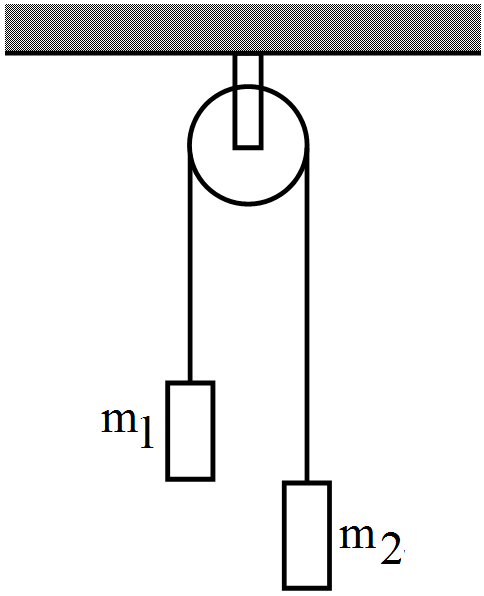
  1. Find the distance travelled by the first block in the first two seconds.
  2. Find the tension in the string.
  3. Find the force exerted by the clamp on the pulley.
Answer


m1 = 0.3kg, m2 = 0.6kg

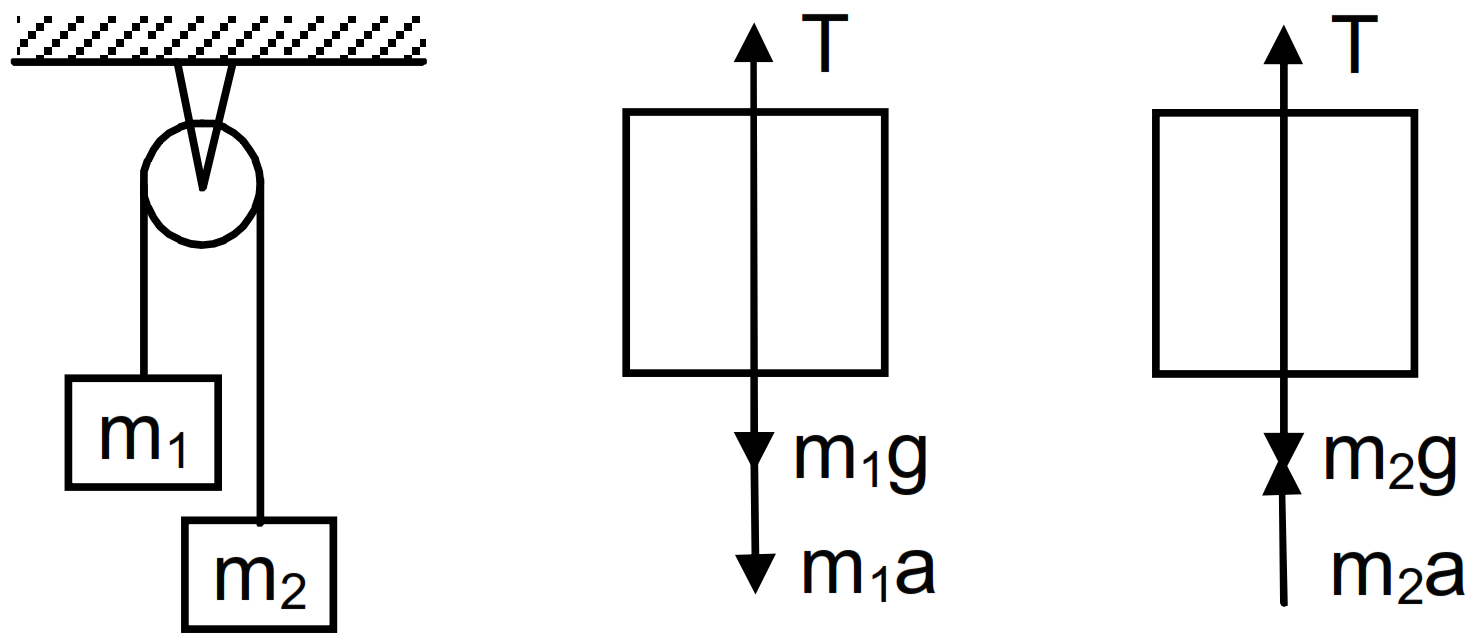
T - (m1g + m1a) = 0 …(i)

⇒ T = m1g + m1a

T + m2a - m2g = 0 …(ii)

⇒ T = m2g - m2a

From equation (i) and equation (ii)

m1g + m1a + m2a - m2g = 0, from (i)

⇒ a(m1 + m2) = g(m2 - m1)

$\Rightarrow\text{a = f}\Big(\frac{\text{m}_2-\text{m}_1}{\text{m}_1-\text{m}_2}\Big)=9.8\Big(\frac{0.6-0.3}{0.6+0.3}\Big)=3.266\text{ms}^{-2}.$

  1. t = 2 sec acceleration = 3.266 ms-2

Initial velocity u = 0

So, distance travelled by the body is,

$\text{S = ut}+\frac{1}{2}\text{at}^2\Rightarrow0+\frac{1}{2}(3.266)2^2=6.5\text{m}$

  1. From (i) T = m1(g + a) = 0.3(9.8 + 3.26) = 3.9N
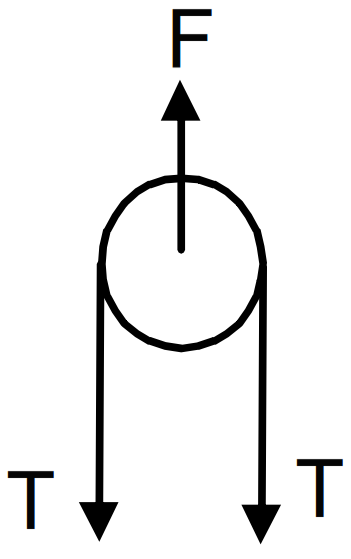
  2. The force exerted by the clamp on the pully is given by

F - 2T = 0

F = 2T = 2 × 3.9 = 7.8N.

Need a full question paper?

Generate a complete, print-ready paper with questions like this in minutes — across 16+ boards, with answer keys.

Start Generating Free

Similar questions

A container of volume 50cc contains air (mean molecular weight = 28.8g) and is open to atmosphere where the pressure is 100kPa. The container is kept in a bath containing melting ice (0°C).
  1. Find the mass of the air in the container when thermal equilibrium is reached.
  2. The container is now placed in another bath containing boiling water (100°C). Find the mass of air in the container.
  3. The container is now closed and placed in the melting-ice bath. Find the pressure of the air when thermal equilibrium is reached.
An operator sitting in his base camp sends a sound signal of frequency 400Hz. The signal is reflected back from a car moving towards him. The frequency of the reflected sound is found to be 410Hz. Find the speed of the car. Speed of sound in air = 324m/s.
Figure shows two blocks A and B, each having a mass of 320g connected by a light string passing over a smooth light pulley. The horizontal surface on which the block A can slide is smooth. The block A is attached to a spring of spring constant 40N/m whose other end is fixed to a support 40cm above the horizontal surface. Initially, the spring is vertical and unstretched when the system is released to move. Find the velocity of the block A at the instant it breaks off the surface below it. Take g = 10m/s2.
  1. Draw a ray diagram to show the image formation by a combination of two thin convex lenses in contact. Obtain the expression for the power of this combination in terms of the focal lengths of the lenses.
  2. A ray of light passing from air through an equilateral glass prism undergoes minimum deviation when the angle of incidence is $\frac{3}{4}$th of the angle of prism. Calculate the speed of light in the prism.
A boy riding on a bicycle going at 12km/h towards a vertical wall whistles at his dog on the ground. If the frequency of the whistle is 1600Hz and the speed of sound in air is 330m/s, find
  1. The frequency of the whistle as received by the wall.
  2. The frequency of the reflected whistle as received by the boy.
An unsymmetrical double convex thin lens forms the image of a point object on its axis. Will the position of the image change if the lens is reversed?
Find the value of $\frac{\text{t}}{\tau}$ for which the current in an LR circuit builds up to:
  1. 90%,
  2. 99%
  3. 99·9% of the steady-state value.
One end of a 10cm long silk thread is fixed to a large vertical surface of a charged nonconducting plate and the other end is fastened to a small ball having a mass of 10g and a charge of 4.0 × 10⁻⁵C. In equilibrium, the thread makes an angle of 60° with the vertical. Find the surface charge density on the plate.
Three thin prisms are combined as shown in figure. The refractive indices of the crown glass for red, yellow and violet rays are $\mu_\text{r},\mu_\text{y}$ and $\mu_\text{v}$ respectively and those for the flint glass are $\mu'_\text{r},\mu'_\text{y}$ and $\mu'_\text{v}$ respectively. Find the ratio $\frac{\text{A}'}{\text{A}}$ for which.

  1. There is no net angular dispersion.
  2. There is no net deviation in the yellow ray.
What is called a capacitor? Explain its principle. Find the formula for combination of capacitors in parallel and series.###Define capacitor. Establish the formula of resultant capacitance in its series and parallel combination. Also draw the necessary circuit diagram.###Define capacitor. How can we increase its capacity? Establish the formula for combining capacitors in parallel and series.