Question
Derive integrated rate equation for first order reaction containing gaseous components.

Answer

$\rightarrow$ Let us consider a typical first order gas phase reaction.
$\rightarrow \ce{A(g) \rightarrow B(g) + C(g)}$
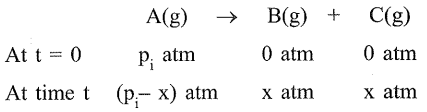
$\rightarrow$ Let $p_i$ be the initial pressure of $A$ and $p_t$ the total pressure at time $' t\ '$. Integrated rate equation for such a reaction can be derived as
$\rightarrow$ Total pressure $p _{ t }= p _{ A }+ p _{ B }+ p _{ C } ($pressure units$)$
$\rightarrow p _{ A }, p _{ B }$ and $p _{ C }$ are partial pressures of $A , B$ and $C$ respectively. If $x$ atm can be the decrease in pressure of $A$ at time $t$ and one mole each of $B$ and $C$ is being formed. The increase in pressure of $B$ and $C$ will also be $X$ atm each
Image
where, $p_i$ is the initial pressure at time $t=0$
$p _{ t }=\left( p _{ i }- x \right)+ x + x = p _{ i }+ x$
$x =\left( p _{ t }- p _{ i }\right)$
where, $p_A=p_i-x=p_i-\left(p_t-p_i\right)=2 p_i-p_t$
$k =\left(\frac{2.303}{ t }\right)\left(\log \frac{ p _{ i }}{ p _{ A }}\right)$
$ =\frac{2.303}{ t } \log \frac{ p _{ i }}{2 p _{ i }- p _{ t }}$

Need a full question paper?

Generate a complete, print-ready paper with questions like this in minutes — across 16+ boards, with answer keys.
Start Generating Free

Similar questions

$E_{\text {cell }}^0$ for the given redox reaction is 2.71 V
$Mg _{( s )}+ Cu _{(0.01 M )}^{2+} \longrightarrow \stackrel{2++ Cu _{( s )}}{ Mg _{(0.001 M )}^{2+}}$
Calculate $E_{\text {cell }}$ for the reaction. Write the direction of flow of current when an external opposite potential applied is
(i) less than 2.71 V and (ii) greater than 2.71 V .
Give reasons for the following$:$
  1. The transition metals generally form coloured compounds.
  2. $E^\circ$ value for $\ce{(Mn^{3+}|Mn^{2+})}$ is highly positive than that for $\ce{(Cr^{3+}|Cr^{2+})}$ couple.
  3. The chemistry of actinoids elements is not so smooth as that of the lanthanoids.
Sucrose decomposes in acid solution into glucose and fructose according to the first order rate law, with $t_{1/2} = 3.00$ hours. What fraction of sample of sucrose remains after $8$ hours?
A non $-$ reducing disaccharide ‘$A’$ on hydrolysis with dilute acid gives an equimolar mixture of $D-(+)-$ glucose and $D-(-)-$ fructose.
$\text{A}+\text{H}_2\text{O}\xrightarrow{\text{HCl}\ \ \ \ }\ \ \ \ \ \ \text{C}_6\text{H}_{12}\text{O}_6+\ \ \ \ \ \ \text{C}_6\text{H}_{12}\text{O}_6\\ [\alpha]_{\text{D}}=+66.5\hat{\text{O}}\phi\Omega\ \ \ \ \ +52.5\hat{\text{O}}\phi\Omega\ \ \ \ \ -92.4\hat{\text{O}}\phi\Omega$
Identify $A$. What is the mixture of $D-(+)-$ glucose and $D-(-)-$ fructose known as? Name the linkage that holds the two units in the disaccharide.
An element 'X' (At mass = 40 g $ mol^{-1} $) having fcc structure has unit cell edge length of 400 pm. Calculate the density of 'X' and the number of unit cell in 4 g of 'X'. $ (N_{A}=6.022\times10^{23}mol^{-1}) $.
Explain bimolecular nucleophilic substitutio $(SN^2)$ reaction with example.
Explain how does the - OH group attached to a carbon of benzene ring activate it towards electrophilic substitution?
The electrical resistance of a column of $0.05 M KOH$ solution of diameter $1 \ cm$ and length $45·5 \ cm$ is $4.55 \times 10^3 ohm.$ Calculate its molar conductivity.
What is meant by chelate effect?
A zinc rod is dipped in $0.1M$ solution of $ZnSO_4$. The salt is $95\%$ dissociated at this dilution at $298K$. Calculate the electrode potential $\Big(\text{E}^{\circ}_{\text{Zn}^{2+/\text{Zn}}}=-0.76\text{V}\Big).$