Question
Derive integrated rate equation for zero order reaction and also explain how the rate constant can be determine with help of graph.
Answer

$\rightarrow$ "Zero order reaction means that the rate of the reaction is proportional to zero power of the concentration of reactants."
$\rightarrow$ Consider the reaction.
$R \rightarrow P$
$\rightarrow$ Rate of reaction for this reaction can be expressed as 
$\text { Rate }=-\frac{ d [ R ]}{ dt }= k [ R ]^0$
$\rightarrow$ As any quantity raised to power zero is units.
$\text { Rate }=-\frac{ d [ R ]}{ dt }= k \text { X I }$
$\rightarrow$ Thus, the rate of zero order reaction is independent from concentration of reactants.
$d [ R ]=- k\ dt$
$\rightarrow$ Integrating both sides
$[ R ]=- kt + I ...Eq. (1)$
Where, $I$ is the constant of integration
$\rightarrow$ At $t=0$, the concentration of the reactant $R=$
$[ R ]_0$, where $[ R ]_0$ is initial concentration of the reactant.
$\rightarrow$ Substituting in equation $(1)$
${[ R ]_0=- kx 0+ I }$
${[ R ]_0= I }$
$\rightarrow$ Substituting the value of $I$ in the equation $(1)$
$[ R ]=- kt +[ R ]_0 ......Eq. (2)$
$\rightarrow$ Further simplifying equation $(2)$
$k =\frac{[ R ]_0-[ R ]}{ t } ...... Eq. (3)$
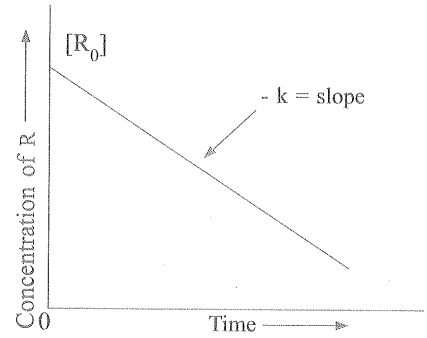
$\rightarrow$ Comparing equation $(2)$ with equation of straight line, $y=m x+c$, if we plot $[R]$ against $t ,$ we get a straight line with slope $=- k$ and intercept equal to $[ R ]_0$
Image

Need a full question paper?

Generate a complete, print-ready paper with questions like this in minutes — across 16+ boards, with answer keys.

Start Generating Free

Similar questions

Explain bimolecular nucleophilic substitutio $(SN^2)$ reaction with example.
Explain the violet colour of the complex $\left[ Ti \left( H _2 O \right)_6\right]^{3+}$ on the basis of crystal field theory.
For the reaction : 
2A + B → A2B
the rate $= k [ A ][ B ]^2$ with $k =2.0 \times 10^{-6} mol^{-2} L^2 s^{-1}$.Calculate the initial rate of the reaction when [A] = 0.1 mol L-1. [B] = 0.2 mol L-1. Calculate the rate of reaction after [A] is reduced to 0.06 mol L-1.
Calculate the molarity of 250 mL solution made by dissolving 5 g NaOH in water.
Define the following with an example of each:
  1. Write the product when $D-$glucose reacts with conc. $HNO_3.$
  2. Amino acids show amphoteric behaviour. Why?
  3. Write one difference between $\alpha-$helix and $\beta-$pleated structures of proteins. 
Zinc rod is dipped in $0.1 M$ solution of $ZnSO _4$
The salt is $95 \%$ dissociated at is dilution at $298 K$ . Calculate the electrode potential. Given
$E ^0\left( Zn ^{2+} / Zn \right)=-0.76$
Write $\text{IUPAC}$ names of the following coordination compounds$:$
  1. $\ce{[Co(NH_3)_6]Cl_3}$
  2. $\ce{[Co(NH_3)5Cl]Cl_2}$
  3. $\ce{K_3[Fe(CN)_6]}$
How much electricity will be required to obtain 1.5 gram on copper in 3 hours in an electrolytic cell of aqueous solution of copper sulphate? (Atomic mass of Cu = 63.5 )
Indicate the steps in the preparation of:
$K_2Cr_2O_7$​​​​​​​ from chromite ore.
$(A), (B)$ and $(C)$ are three non-cyclic functional isomers of a carbonyl compound with molecular formula $C_4H_8O$. Isomers $(A)$ and $(C)$ give positive Tollens’ test whereas isomer $(B)$ does not give Tollens’ test but gives positive Iodoform test. Isomers $(A)$ and $(B)$ on reduction with $Zn(Hg)$/ conc. $HCl$ give the same product $(D)$.
  1. Write the structures of $(A), (B), (C)$ and $(D)$.
  2. Out of $(A), (B)$ and $(C)$ isomers, which one is least reactive towards addition of $HCN?$