Question
Derive lens Maker formula $\frac{1}{f}=\left(n_{21}-1\right)\left(\frac{1}{R_1}-\frac{1}{R_2}\right)$. Here are the general meanings of the symbols used in the formula. Draw necessary diagram.

Answer

This formula relates the focal length of a lens to the refractive index of its material and the radii of curvature of its two surfaces.
$\frac{1}{f}=\left(n_{21}-1\right)\left(\frac{1}{R_1}-\frac{1}{R_2}\right)$,where $n_{21}$ is the refractive index,$R_1$ and $R_2$ are radii of curvature.
It is derived by considering refraction at two spherical surfaces and applying the formula $\frac{n_2}{v}-\frac{n_1}{u}=\frac{n_2-n_1}{R}$$\frac{n_2}{v} - \frac{n_1}{u} = \frac{n_2 - n_1}{R}$ for each surface.

Need a full question paper?

Generate a complete, print-ready paper with questions like this in minutes — across 16+ boards, with answer keys.
Start Generating Free

Similar questions

In the year 1939, German scientist Otto Hahn and Strassmann discovered that when an uranium isotope was bombarded with a neutron, it breaks into two intermediate mass fragments. It was observed that, the sum of the masses of new fragments formed were less than the mass of the original nuclei. This difference in the mass appeared as the energy released in the process. Thus, the phenomenon of splitting of a heavy nucleus (usually A > 230) into two or more lighter nuclei by the bombardment of proton, neutron $\alpha$-particle, etc. with liberation of energy is called nuclear fission.
$\ _{92}\text{U}^{235}+\ _0\text{n}^{1}\rightarrow_{92}\text{U}^{236} \rightarrow\ _{56}\text{B}^{114}+\ _{36}\text{Kr}^{89}\ +3\ _{0}\text{n}^{1} + \text{Q}$
$\big[\because \ _{92}\text{U}^{236}= \text{Unstable nucleus}\big]$
  1. Nuclear fission can be explained on the basis of.
  1. Millikan's oil drop method
  2. Liquid drop model
  3. Shell model
  4. Bohr's model.
  1. For sustaining the nuclear fission chain reaction in a sample (of small size) of $_{92}^{235}\text{U}$ it is desirable to slow down fast neutrons by.
  1. Friction
  2. Elastic damping/ scattering
  3. Absorption
  4. None of these.
  1. Which of the following is/ are fission reaction(s)?
  1. $_0^1\text{n}\ +\ _{92}^{235}\text{U}\rightarrow\ _{92}^{235}\text{U}\rightarrow\ _{51}^{133}\text{Sb}+\ _{41}^{99}\text{nb}+\ 4_1^0\text{n}$
  2. $_0^1\text{n}\ +\ _{92}^{235}\text{U}\rightarrow\ _{54}^{1.40}\text{Xe}+\ _{38}^{94}\text{Sr}\ +2_0^1\text{n}$
  3. $_1^2\text{H}\ +\ _1^2\text{H}\rightarrow\ _2^3\text{He}+\ _0^1\text{n}$
  1. Both II and III
  2. Both I and III
  3. Only II
  4. Both I and II
  1. On an average, the number of neutrons and the energy of a neutron released per fission of a uranium atom are respectively.
  1. 2.5 and 2 keV
  2. 3 and 1 keV
  3. 2.5 and 2 MeV
  4. 2 and 2 keV
  1. In any fission process, ratio of mass of daughter nucleus to mass of parent nucleus is.
  1. Less than I
  2. Greater than I
  3. Equal to I
  4. Depends o the mass of parent nucleus.
If the radius of a circular current carrying coil is doubled and the current flowing through it is reduced to half, then what will be effect on magnetic moment?
A short magnet makes $40$ oscillations per minute when used in an oscillation magnetometer at a place where the earth's horizontal magnetic field is $2\mu\text{T.}$ Another short magnet of magnetic moment $1.6A-m^2$ is placed $20\ cm$ east of the oscillating magnet. Find the new frequency of oscillation if the magnet has its north pole:
  1. Towards north.
  2. Towards south.
The needle of a dip circle shows an apparent dip of 45° in a particular position and 53° when the circle is rotated through 90°. Find the true dip.
A solenoid $60 \ cm$ long and of radius $4.0 \ cm$ has $3$ layers of windings of $300$ turns each. $A 2.0 \ cm$ long wire of mass $2.5 g$ lies inside the solenoid $($near its centre$)$ normal to its axis; both the wire and the axis of the solenoid are in the horizontal plane. The wire is connected through two leads parallel to the axis of the solenoid to an external battery which supplies a current of $6.0 A$ in the wire. What value of current $($with appropriate sense of circulation$)$ in the windings of the solenoid can support the weight of the wire? $g = 9.8\ m s^{–2}.$
$50cc$ of oxygen is collected in an inverted gas jar over water. The atmospheric pressure is $99.4\ kPa$ and the room temperature is $27^\circ\ C.$ The water level in the jar is same as the level outside. The saturation vapour pressure at $27^\circ\ C$ is $3.4\ kPa.$ Calculate the number of moles of oxygen collected in the jar.
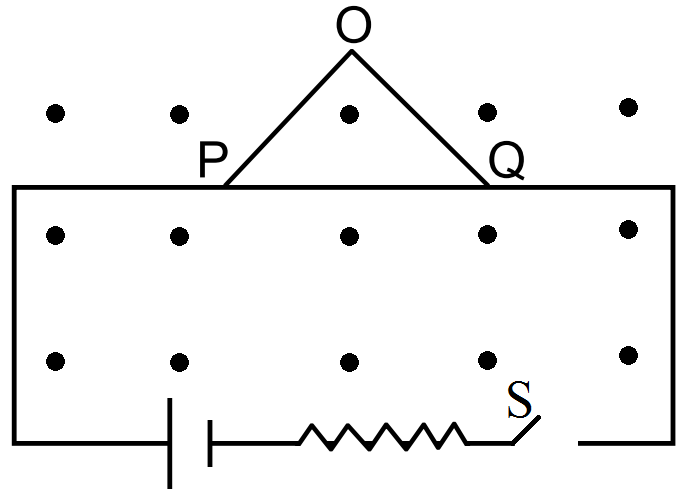
Shows a rod PQ of length 20.0cm and mass 200g suspended through a fixed point O by two threads of lengths 20.0cm each. A magnetic field of strength 0.500T exists in the vicinity of the wire PQ, as shown in the figure. The wires connecting PQ with the battery are loose and exert no force on PQ.
  1. Find the tension in the threads when the switch S is open.
  2. A current of 2.0A is established when the switch S is closed. Find the tension in the threads now.
An elevator is descending with uniform acceleration. To measure the acceleration, a person in the elevator drops a coin at the moment the elevator starts. The coin is 6ft above the floor of the elevator at the time it is dropped. The person observes that the coin strikes the floor in 1 second. Calculate from these data the acceleration of the elevator.
For a circular coil of radius R and N turns carrying current I, the magnitude of the magnetic field at a point on its axis at a distance x from its centre is given by,
$\text{B}=\frac{\mu_{0}\text{IR}^{2}\text{N}}{2(\text{x}^{2}+\text{R}^{2})^{\frac{3}{2}}}$
  1. Show that this reduces to the familiar result for field at the centre of the coil.
  2. Consider two parallel co-axial circular coils of equal radius R, and number of turns N, carrying equal currents in the same direction, and separated by a distance R. Show that the field on the axis around the mid-point between the coils is uniform over a distance that is small as compared to R, and is given by,$\text{B}=0.72\frac{\mu_{0}\text{NI}}{\text{R}}$, approximately.
[Such an arrangement to produce a nearly uniform magnetic field over a small region is known as Helmholtz coils.]
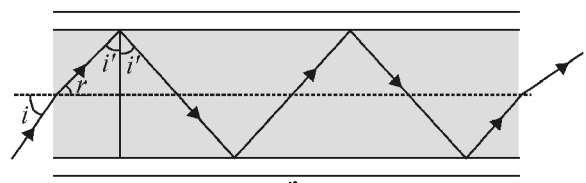
(a) Figure shows a cross-section of a 'light pipe' made of a glass fibre of refractive index 1.68. The outer covering of the pipe is made of a material of refractive index 1.44. What is the range of the angle of the incident rays with the axis of the pipe for which total reflections inside the pipe take place, as shown in the figure. Image
(b) What is the answer if there is no outer covering of the pipe?