Question
A short magnet makes $40$ oscillations per minute when used in an oscillation magnetometer at a place where the earth's horizontal magnetic field is $2\mu\text{T.}$ Another short magnet of magnetic moment $1.6A-m^2$ is placed $20\ cm$ east of the oscillating magnet. Find the new frequency of oscillation if the magnet has its north pole:
  1. Towards north.
  2. Towards south.

Answer

$\gamma_1=40$ oscillations/ minute
$\text{B}_\text{H}=25\mu\text{T}$
$m$ of second magnet $= 1.6A-m^2$
$d = 20\ cm = 0.2m$
For north facing north
$\gamma_1=\frac{1}{2\pi}\sqrt{\frac{\text{MB}_{\text{H}}}{\text{I}}}$
$\gamma_2=\frac{1}{2\pi}\sqrt{\frac{\text{M}(\text{B}_{\text{H}}-\text{B})}{\text{I}}}$
$\text{B}=\frac{\mu_0}{4\pi}\frac{\text{m}}{\text{d}^3}=\frac{10^{-7}\times1.6}{8\times10^{-3}}=20\mu\text{T}$
$\frac{\gamma_1}{\gamma_2}=\sqrt{\frac{\text{B}}{\text{B}_{\text{H}-\text{B}}}}$
$\Rightarrow\frac{40}{\gamma_2}=\sqrt{\frac{25}{5}}$
$\Rightarrow\gamma_2=\frac{40}{\sqrt{5}}$
$=17.88\approx18\text{ osci/min}$ 
For north pole facing south
$\gamma_1=\frac{1}{2\pi}\sqrt{\frac{\text{MB}_{\text{H}}}{\text{I}}}$
$\gamma_2=\frac{1}{2\pi}\sqrt{\frac{\text{M}(\text{B}_{\text{H}}-\text{B})}{\text{I}}}$
$\frac{\gamma_1}{\gamma_2}=\sqrt{\frac{\text{B}}{\text{B}_{\text{H}-\text{B}}}}$
$\Rightarrow\frac{40}{\gamma_2}=\sqrt{\frac{25}{45}}$
$\Rightarrow\gamma_2=\frac{40}{\sqrt{\Big(\frac{25}{45}\Big)}}$
$=53.66\approx54\text{ osci/min}$

Need a full question paper?

Generate a complete, print-ready paper with questions like this in minutes — across 16+ boards, with answer keys.

Start Generating Free

Similar questions

State Bohr's quantization condition for defining stationary orbits. How does de-Broglie hypothesis explain stationary orbits ?
What is logic gate? Differentiate between AND gate and OR gate.
Out of the two magnetic materials, 'A' has relative permeability slightly greater than unity while oB' has less than unity. Identify the nature of the materials 'A' and 'B'. Will their susceptibilities be positive or negative?
A transformer is essentially an $a.c.$ device. It cannot work on $d.c.$ It changes altemating voltages or currents. It does not affect the frequency of $a.c.$ It is based on the phenomenon of mutual induction. A transformer essentially consists of two coils of insulated copper wire having different number of tums and wound on the same soft iron core.
The number of turns in the primary and secondary coils of an ideal transfonner are $2000$ and $50$ respectively. The primary coil is connected to a main supply of $120V$ and secondary coil is connected to a bulb of resistance $0.6\Omega.$
  1. The value of voltage across the secondary coil is:
  1. $5V$
  2. $2V$
  3. $3V$
  4. $10V$
  1. The value of current in the bulb is:
  1. $7A$
  2. $15A$
  3. $3A$
  4. $5A$
  1. The value of current in primary coil is:
  1. $0.125A$
  2. $2.52A$
  3. $1.51A$
  4. $3.52A$
  1. Power in primary coil is:
  1. $20W$
  2. $5W$
  3. $10W$
  4. $15W$
  1. Power in secondary coil is:
  1. $15W$
  2. $20W$
  3. $7W$
  4. $8W$
Define self-inductance and write its S.I. unit. Find the self inductance for a solenoid of N turns, length $l$ and radius $r$.
On a winter day when the atmospheric temperature drops to $-10^\circ C$, ice forms on the surface of a lake.
  1. Calculate the rate of increase of thickness of the ice when $10\ cm$ of ice is already formed.
  2. Calculate the total time taken in forming $10\ cm$ of ice. Assume that the temperature of the entire water reaches $0^\circ C$ before the ice starts forming. Density of water $= 1000\ kgm^{-3}$, latent heat of fusion of ice $=3.36\times10^5\text{Jkg}^{-1}$ and thermal conductivity of ice $=1.7\text{Wm}^{-1}{^{\circ}}\text{C}^{-1}.$ Neglect the expansion of water on freezing.
A kid of mass $M$ stands at the edge of a platform of radius $R$ which can be freely rotated about its axis. The moment of inertia of the platform is $I.$ The system is at rest when a friend throws a ball of mass m and the kid catches it. If the velocity of the ball is $v$ horizontally along the tangent to the edge of the platform when it was caught by the kid, find the angular speed of the platform after the event.
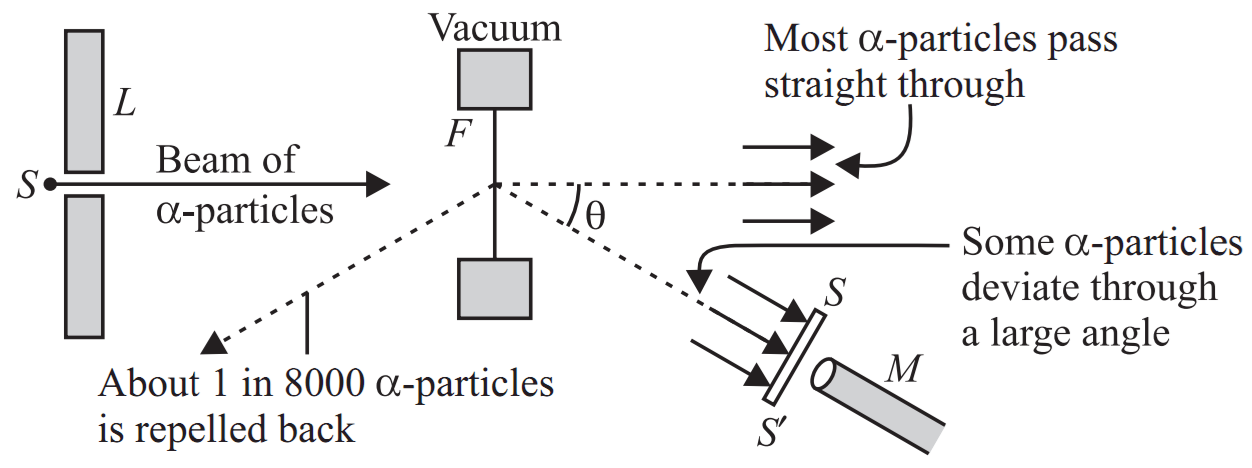
In $1911,$ Rutherford, along with his assistants, $H$.
Geiger and $E$. Marsden, performed the alpha particle scattering experiment. $H$.
Geiger and $E$. Marsden took radioactive source $(^{214}_{83}\text{Bi})$ for $\alpha- $ particles.
A collimated beam of $\alpha-$ particles of energy $5.5 MeV$ was allowed to fall on $2.1 \times 10^{-7} m$ thick gold foil. The $\alpha-$ particles were observed through a rotatable detector consisting of a Zinc sulphide screen and microscope. It was found that $CL-$ particles got scattered. These scattered $\alpha-$ particles produced scintillations on the zinc sulphide screen. Observations of this experiment are as follows?
Most of the $\alpha-$ particles passed through the foil without deflection.
Only about $0.14\%$ of the incident $\alpha-$ particles scattered by more than $1^\circ$
Only about one $\alpha-$ particle in every $8000 \ \alpha-$ particles deflected by more than $90^\circ$
These observations led to many arguments and conclusions which laid down the structure of the nuclear model of an atom.
  1. Rutherford's atomic model can be visualised as.
  1. Gold foil used in Geiger $-$ Marsden experiment is about $10^{-8}m$ thick. This ensures.
  1. Gold foil's gravitational pull is small or possible.
  2. Gold foil is deflected when $\alpha-$ particle stream is not incident centrally over it.
  3. Gold foil provides no resistance to passage of $\alpha-$ particles.
  4. Most $\alpha-$ particle will not suffer more than $1^\circ$ scattering during passage through gold foil.
  1. In Geiger $-$ Marsden scattering experiment, the trajectory traced by an $\alpha-$ particle depends on.
  1. Number of collision.
  2. Number of scattered $\alpha- $ particles.
  3. Impact parameter.
  4. None of these.
  1. In the Geiger $-$ Marsden scattering experiment, in case of head $-$ on collision, the impact parameter should be.
  1. Maximum
  2. Minimum
  3. Infinite
  4. zero
  1. The fact only a small fraction of the number of incident particles rebound back in Rutherford scattering indicates that.
  1. Number of $\alpha-$ particles undergoing head $-$ on $-$ collision is small.
  2. Mass of the atom is concentrated in a small volume.
  3. Mass of the atom is concentrated in a large volume.
  4. Both $(a)$ and $(b).$
According to wave theory, the tight of any frequency can emit electrons from metallic surface provided the intensity of light be sufficient to provided necessary energy for emission of electrons, but according to experimental observations, the light of frequency less than threshold frequency can not emit electrons; whatever be the intensity of incident light. Einstein also proposed that electromagnetic radiation is quantised. If photoelectrons are ejected from a surface when light of wavelength $\lambda_1=550\text{ nm}$ is incident on it. The stopping potential for such electrons is $V_s = 0.19V$. Suppose the radiation of wavelength $\lambda_2=190\text{ nm}$ is incident on the surface.
  1. Photoelectric effect supports quantum nature oflight because.
  1. There is a minimum frequency of light below which no photoelectrons are emitted.
  2. The maximum $K.E$. of photoelectric depends only on the frequency oflight and not on its intensity.
  3. Even when the metal surface is faintly illuminated, the photo electrons leave the surface immediately.
  4. Electric charge of the photoelectrons is quantized.
  1. $A, B, C$
  2. $B, C$
  3. $C, D$
  4. $A, D, C$
  1. ln photoelectric effect, electrons are ejected from metals, if the incident light has a certain minimum.
  1. Wavelength.
  2. Frequency.
  3. Amplitude.
  4. Angle of incidence.
  1. Calculate the stopping potential $\text{V}_{\text{s}_2}$ of surface.
  1. $4.47$
  2. $3.16$
  3. $2.76$
  4. $5.28$
  1. Calculate the work function of the surface.
  1. $3.75$
  2. $2.07$
  3. $4.20$
  4. $3.60$
  1. Calculate the threshold frequency for the surface.
  1. $500 \times 10^{12}Hz$
  2. $480 \times 10^{13}Hz$
  3. $520 \times 10^{11}Hz$
  4. $460 \times 10^{13}Hz$
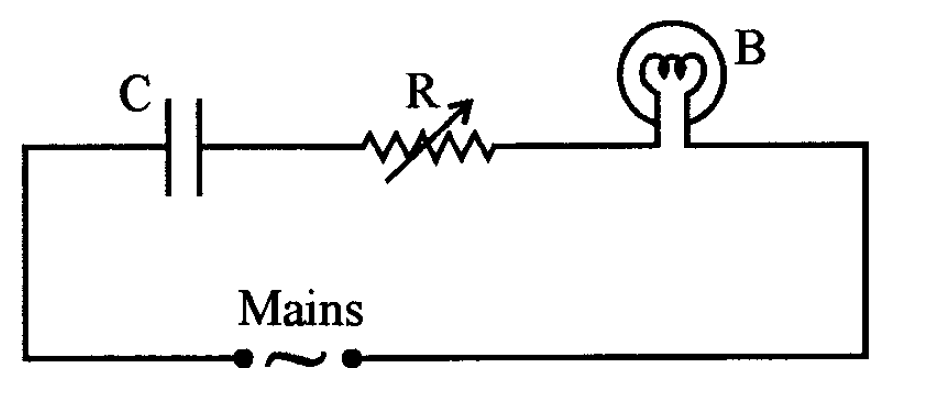
A capacitor'C', a variable resistor 'R' and a bulb 'B' are connected in series to the ac mains in circuit as shown. The bulb glows with some brightness. How will the glow of the bulb change if (i) a dielectric slab is introduced between the plates of the capacitor, keeping resistance R to be the same; (ii) the resistance R is increased keeping the same capacitance?