Question
Derive the equation of energy density for electromagnetic wave.

Answer

→Energy density : "Energy stored per unit volume is called Energy density." An electromagnetic wave contains Electric field and magnetic field both.
→Energy density associated with Electric field, $\varrho_{ E }=\frac{1}{2} \varepsilon_0 E ^2$
→Energy-density associated with magnetic field, $\varrho _{ B }=\frac{ B ^2}{2 \mu_0}$
→Total Energy-density associated with EM wave,
$\varrho =\varrho_{ E }+\varrho_{B} 
\therefore =\frac{1}{2} \varepsilon_0 E ^2+\frac{ B ^2}{2 \mu_0}$
→But the magnitudes of electric field and magnetic field change as per sine or cosine functions in an EM wave.Hence, in the equation, the rms value of electric field and magnetic field is considered.
→Energy-density $ \varrho=\frac{1}{2} \varepsilon_0 E _{\text {rms }}^2+\frac{ B _{\text {rms }}^2}{2 \mu_0}$
But $c ^2=\frac{1}{\mu_0 \varepsilon_0} \therefore \mu_0=\frac{1}{ c ^2 \varepsilon_0}$
and $\frac{E_{r m s}}{B_{r m s}}=c \therefore B_{r m s}=\frac{E_{r m s}}{c}$
→Substituting both these values in eq. (1),
$\begin{array}{l}\therefore \varrho=\frac{1}{2} \varepsilon_0 E _{\text {rms }}^2+\frac{\frac{ E _{\text {rms }}^2}{ c ^2}}{2\left(\frac{1}{ c ^2 \varepsilon_0}\right)} \\\therefore \varrho=\frac{1}{2} \varepsilon_0 E _{\text {rms }}^2+\frac{1}{2} \varepsilon_0 E _{\text {rms }}^2 \\\therefore \varrho=\varepsilon_0 E _{\text {rms }}^2\end{array}$
→In similar manner, $\varrho=\frac{B_{\text {rms }}^2}{\mu_0}$ can also be derived.

Need a full question paper?

Generate a complete, print-ready paper with questions like this in minutes — across 16+ boards, with answer keys.
Start Generating Free

Similar questions

The energy flux of sunlight reaching the surface of the earth is $1.388 \times 10^3 W / m ^2$. How many photons (nearly) per square metre are incident on the Earth per second? Assume that the photons in the sunlight have an average wavelength of 550 nm .
If the bar magnet in exercise 5.13 is turned around by 180°, where will the new null points be located?
Two long strings A and B, each having linear mass density 1.2 x 10⁻²kg/m, are stretched by different tensions 4.8N and 7.5N respectively and are kept parallel to each other with their left ends at x = 0. Wave pulses are produced on the strings at the left ends at t = 0 on string A and at t = 20ms on string B. When and where will the pulse on B overtake that on A?
Potential at an instant $t$ in an ac circuit is $E=200 \sin 157 t . \cos 157 t$ volts and current is $I=\sin \left(314 t+\frac{\pi}{3}\right) \quad$ Amperes. In this condition calculate :
(a) frequency
(b) root mean square value of voltage
(c) impedance of the circuit
(d) power factor.
Two charges 2 $\mu C$ and - 2$\mu C$ are placed at points A and B 6 cm apart.
(a) Identify an equipotential surface of the system.
(b) What is the direction of the electric field at every point on this surface?
A ball is given a speed v on a rough horizontal surface. The ball travels through a distance l on the surface and stops.
  1. What are the initial and final kinetic energies of the ball?
  2. What is the work done by the kinetic friction?
Obtain the formula for the electric field due to a long thin wire of uniform linear charge density λ without using Gauss’s law.
[Hint: Use Coulomb’s law directly and evaluate the necessary integral.]
Why are the magnification properties of microscopes and telescopes defined in terms of the ratio of angles and not in terms of the ratio of sizes of objects and images?
Two equal charges are placed at a separation of 1.0m. What should be the magnitude of the charges so that the force between them equals the weight of a 50kg person?
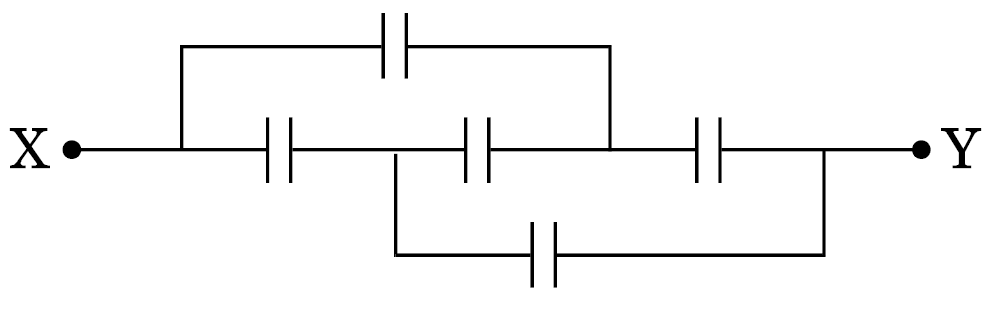
Find the equivalent capacitance of the network shown in the figure, when each capacitor is of $1\mu\text{F}$. When the ends X and Y are connected to a 6 V battery, find out (i) The charge and (ii) The energy stored in the network.