Question
Derive the expression for excess pressure inside:
  1. A liquid drop.
  2. A liquid bubble.
  3. An air bubble.

Answer

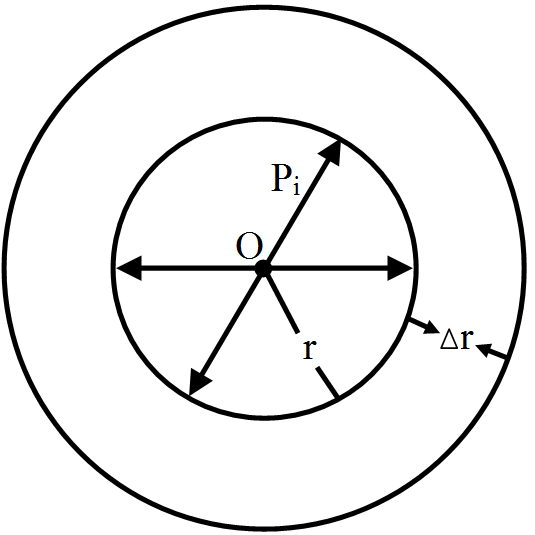
  1. Inside a liquid drop: Let r = radius of a spherical liquid drop of centre O.
T = surface tension of the liquid.
Let $P_i$ and $P_0$ be the values of pressure inside and outside the drop.
$\therefore$ Excess pressure inside the liquid drop = $P_i­ - P_0$.
Let $\Delta\text{r}$ be the increase in its radius due to excess pressure. It has one free surface outside.
$\therefore$ Increase in surface area of the liquid drop
$=4\pi(\text{r}+\Delta\text{r})^2-4\pi\text{r}^2$
$=4\pi[\text{r}^2+(\Delta\text{r})^2+2\text{r}\Delta\text{r}-\text{r}^2]$
$=8\pi\text{r}\ \Delta\text{r}\dots\text{(i)}$ $(\because\Delta\text{r}$ is small $\therefore\Delta\text{r}^2$ is neglected$)$
$\therefore$ Increase in surface energy of the drop is
W = Surface tension × increase in area
$=\text{T}\times8\pi\text{r }\Delta\text{r}\dots\text{(ii)}$
Also W = Force due to excess of pressure × dispplacement
= Excess pressure × Area of drop × increase in raduis
$=(\text{P}_\text{i}-\text{P}_0)4\pi\text{r}^2\Delta\text{r}\dots\text{(iii)}$
$\therefore$ From equations (ii) and (iii), we get
$(\text{P}_\text{i}-\text{P}_0)\times4\pi\text{r}^2\Delta\text{r}$
$=\text{T}\times\text{8}\pi\text{r }\Delta\text{r}$
$\Rightarrow\text{P}_\text{i}-\text{P}_0=\frac{\text{T}}{\text{r}}$
  1. Inside a liquid bubble: A liquid bubble has air both inside and outside it and therefore it has two free surfaces.
Thus increase in its surface area
$=2[4\pi(\text{r}+\Delta\text{r})^2-4\pi\text{r}]$
$=2\times8\pi\text{r}\Delta\text{r}=16\pi\text{r}\Delta\text{r}$
$\therefore\text{W}=\text{T}\times16\pi\text{r }\Delta\text{r}\dots\text{(i)}$
Also $\text{W}=(\text{P}_\text{i}-\text{P}_0)4\pi\text{r}^2\times\Delta\text{r}\dots\text{(ii)}$
From equations (i) and (ii), we get
$(\text{P}_\text{i}-\text{P}_0)\times4\pi\text{r}^2\times\Delta\text{r}=\text{T}\cdot16\pi\text{r}\Delta\text{r}$ or $\text{P}_\text{i}-\text{P}_0=\frac{4\text{T}}{\text{r}}.$
  1. Inside an air bubble: Air bubble is formed inside liquid, thus air bubble has one free surface inside it and liquid is outside.
If r = radius of air bubble
$\Delta\text{r}=$ increase in its radius due to excess of pressure
$(\text{P}_\text{i}-\text{P}_0)$ inside it.
T = surface tension of the liquid in which bubble is formed.
$\therefore$ Increase in surface area $=8\pi\text{r}\Delta\text{r}.$
$\therefore\text{W}=\text{T}\times8\pi\text{r}\Delta\text{r}$
Also $\text{W}=(\text{P}_\text{i}-\text{P}_0)\times4\pi\text{r}^2\Delta\text{r}$
$\therefore(\text{P}_\text{i}-\text{P}_0)\times4\pi\text{r}^2\Delta\text{r}=\text{T}\times8\pi\text{r }\Delta\text{r}$ or $\text{P}_\text{i}-\text{P}_0=\frac{2\text{T}}{\text{r}}.$

Need a full question paper?

Generate a complete, print-ready paper with questions like this in minutes — across 16+ boards, with answer keys.
Start Generating Free

Similar questions

Find the reading of the spring balance shown in figure. The elevator is going up with an acceleration of $\frac{\text{g}}{10},$ the pulley and the string are light and the pulley is smooth.
A thin circular loop of radius R rotates about its vertical diameter with an angular frequency $\omega.$ Show that a small bead on the wire loop remains at its lowermost point for $\omega\le\sqrt{\frac{\text{g}}{\text{R}}}.$ What is the angle made by the radius vector joining the centre to the bead with the vertical downward direction for $\omega=\sqrt{\frac{2\text{g}}{\text{R}}}?$ Neglect friction.
The Stress-Strain graph for a metal wire is shown in the figure upto the point E. The wire returns to its original state O along the curve EPO when it is gradually unloaded. Point B corresponds to the fracture of the wire:
  1. Upto what point of the curve is Hooke's law obeyed?
  2. Which point on the curve corresponds to the elastic limit or yield point of the wire?
  3. Indicate the elastic and plastic regions of the Stress-Strain graph.
  4. Describe what happens when the wire is loaded upto a stress corresponding to the point A on the graph, and then unloaded gradually. In particular, explain, the dotted curve.
  5. What is peculiar about the portion of the Stress-Strain graph from C to B? Upto what stress can the wire be subjected without causing fracture?
A laser light bean sent to the moon takes 2.56s to return after reflection at the Moon's surface. Calculate the radius of the lunar orbit around the earth.
A person normally weighing 50 kg stands on a mass less platform which oscillates up and down harmonically at a frequency of $2.0 s^{-1}$ and an amplitude 5.0 cm . A weighing machine on the platform gives the persons weight against time.
i. Will there be any change in weight of the body, during the oscillation? Figure In extensible string.
ii. If answer to part (a) is yes, what will be the maximum and minimum reading in the machine and at which position?
A fighter plane is flying horizontally at an altitude of 1.5km with speed 720km/ h. At what angle of sight (w.r.t. horizontal) when the target is seen, should the pilot drop the bomb in order to attack the target?
Define the following :
(i) Frequency (ii) Time period (iii) Amplitude (iv) Wave length (v) Phase angle (vi) Angular frequency (vii) Propagation con (viii) Wave velocity.
A proton goes undeflected in a crossed electric and magnetic field (the fields are perpendicular to each other) at a speed of $2.0 \times 10^5ms^{-1}$. The velocity is perpendicular to both the fields. When the electric field is switched off, the proton moves along a circle of radius $4.0cm$. Find the magnitudes of the electric and magnetic fields. Take the mass of the proton = $1.6 \times 10^{-27}kg$
A gun of mass M fires a bullet of mass m with a horizontal speed V. The gun is fitted with a concave mirror of focal length f facing tpwards the receding bullet. Find the speed of separation of the bullet and the image just after the gun was fired.
The temperature and humidity of air are 27°C and 50% on a particular day. Calculate the amount of vapour that should be added to 1 cubic metre of air to saturate it. The saturation vapour pressure at 27°C = 3600Pa.