Question
Derive the expression for force per unit length between two long straight parallel current carrying conductors. Hence define one ampere.
Answer


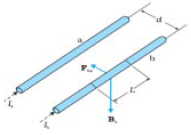
Figure shows two long parallel conductors a and b separated by a distance d and carrying (parallel) currents $I_a$ and $I _b,$ respectively. The conductor ‘a’ produces, the same magnetic field $B_a$ at all points along the conductor ‘b’. The right-hand rule tells us that the direction of this field is downwards (when the conductors are placed horizontally). Its magnitude is given by
$\text{B}_{\alpha} = \frac{\mu_\circ\text{I}_{\alpha}}{2\pi\text{d}}$
The conductor ‘b’ carrying a current $I _b$ will experience a sideways force due to the field $​​​​​​​B_a$. The direction of this force is towards the conductor ‘a’. We label this force as $​​​​​​​F_{ba}$, the force on a segment L of ‘b’ due to ‘a’. The magnitude of this force is given by
$\int_{ba} = \text{I}_{b}\text{LB}_{a}$ $ = \frac{\mu_\circ\text{I}_{a}\text{I}_{b}}{2\pi\text{d}}\text{L}$
Let $\int_{ba}$ represent the magnitude of the force $\text{F}_{ba}$ per unit length.
$\int_{ba} = \frac{\mu_\circ\text{I}_{a}\text{I}_{b}}{2\pi\text{d}}$
One ampere: The ampere is the value of that steady current which, when maintained in each of the two very long, straight, parallel conductors of negligible cross-section, and placed one metre apart in vacuum, would produce on each of these conductors a force equal to $2 × 10^{-7}$ newton per metre of their length.

Need a full question paper?

Generate a complete, print-ready paper with questions like this in minutes — across 16+ boards, with answer keys.
Start Generating Free

Similar questions

We have valence electrons and conduction electrons in a semiconductor. Do we also have 'valence holes' and 'conduction holes'?
Define the term ‘mutual inductance’ between the two coils.
Obtain the expression for mutual inductance of a pair of long coaxial solenoids each of length I and radii $r_1$ and $r_2\left(r_2 \gg r_1\right)$.
Total number of turns in the two solenoids are $\mathrm{N}_1$ and $\mathrm{N}_2$ respectively.
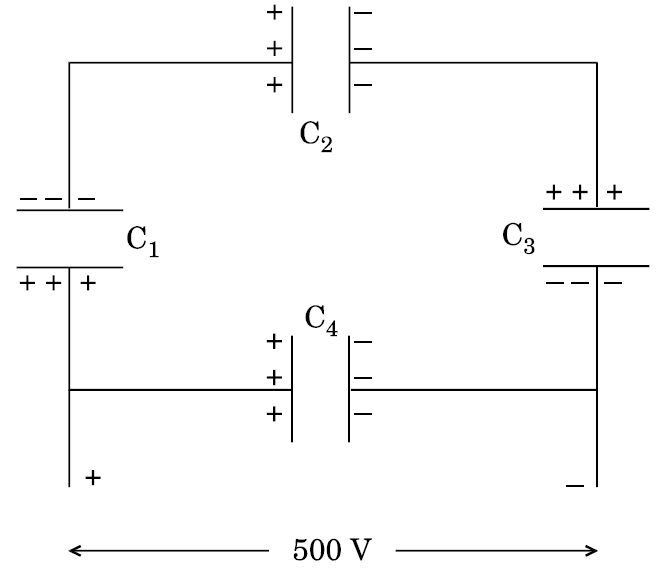
A network of four 10 $\mu$F capacitors is connected to a 500 V supply as shown in the figure. Determine the
  1. equivalent capacitance of the network and
  2. charge on each capacitor
A wire of length 1m and radius 0.1mm has a resistance of $100\Omega.$ Find the resistivity of the material.
Define the term work function of a metal. The threshold frequency of a metal is $2 f_0$. When the light of frequency $2 f_0$ is incident on the metal plate, the maximum velocity of electrons emitted is $\mathrm{v}_1$ When the frequency of the incident radiation is increased to $5 f_0$ the maximum velocity of electrons emitted is $v_2$. Find the ratio of $v_1$ to $v_2$.
Calculate the maximum kinetic energy of the beta particle emitted in the following decay scheme:
$\text{ }^{12}\text{N}\rightarrow{ }^{12}\text{C}^*+\text{e}^++\text{v}$
$\text{ }^{12}\text{C}^*\rightarrow\text{ }^{12}\text{C}+\gamma(4.43\text{MeV}).$
The atomic mass of $^{12}N$ is $12.018613u.$
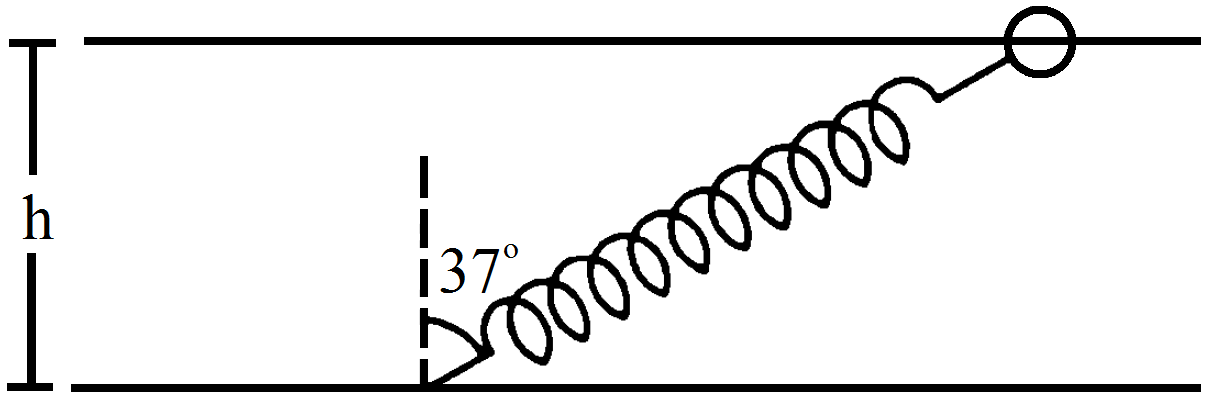
One end of a spring of natural length h and spring constant k is fixed at the ground and the other is fitted with a smooth ring of mass m which is allowed to slide on a horizontal rod fixed at a height h (figure). Initially, the spring makes an angle of 37° with the vertical when the system is released from rest. Find the speed of the ring when the spring becomes vertical.
Suppose while sitting in a parked car, you notice a jogger approaching towards you in the side view mirror of $R=2 m$. If the jogger is running at a speed of $5 m s ^{-1}$, how fast the image of the jogger appear to move when the jogger is (a) $39 m$, (b) $29 m$, (c) $19 m$, and (d) $9 m$ away.
A tank is filled with water to a height of 12.5 cm. The apparent depth of a needle lying at the bottom of the tank is measured by a microscope to be 9.4 cm. What is the refractive index of water? If water is replaced by a liquid of refractive index 1.63 up to the same height, by what distance would the microscope have to be moved to focus on the needle again?
The electric current in an X-ray tube (from the target to the filament) operating at 40kV is 10mA. Assume that on an average, 1% of the total kinetic energy of the electron hitting hte target are converted into X-rays.
  1. What is the total power emitted as X-rays
  2. How much heat is produced in the target every second?