Question
Derive the expression for resultant spring constant when two springs having constants k1 and k2 are connected
  1. In parallel.
  2. In series.

Answer

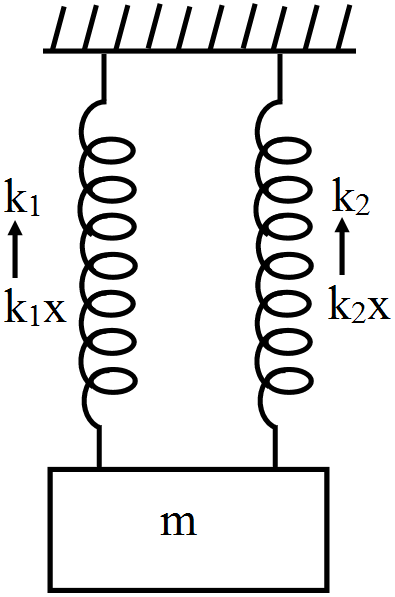
  1. When the springs are connected in parallel, the extension in them will be same and the total restoring force is the sum of their restoring forces.

$\therefore\text{F = F}_1+\text{F}_2$

$-\text{k}_{\text{eq}}\text{x}=-\text{k}_1\text{x}-\text{k}_2\text{x}$

$\text{k}_{\text{eq}}=\text{k}_1+\text{k}_2$
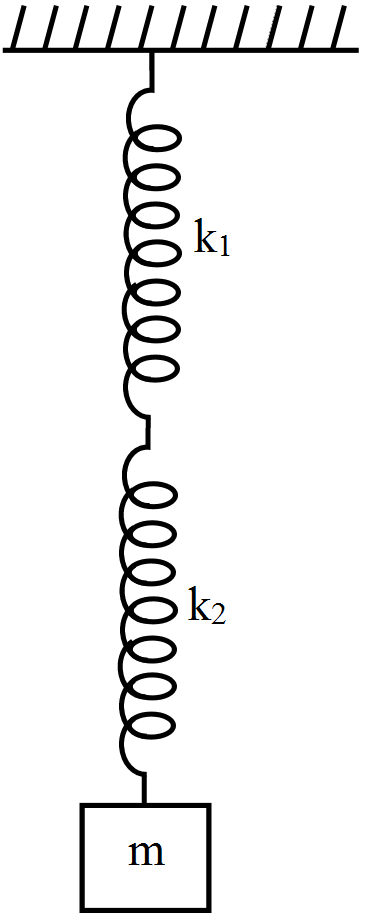
  1. When the springs are connected in series, the restoring force is same in both the springs and the extensions will be different so the not extension

i.e., $\text{x = x}_1+\text{x}_2$

$=\frac{\text{F}}{-\text{k}_{\text{eq}}}=\frac{-\text{F}}{\text{k}_1}-\frac{\text{F}}{\text{k}_2}$

$\therefore\frac{1}{\text{k}_{\text{eq}}}=\frac{1}{\text{k}_1}+\frac{1}{\text{k}_2}$

when connected in series.
Need a full question paper?

Generate a complete, print-ready paper with questions like this in minutes — across 16+ boards, with answer keys.

Start Generating Free

Similar questions

Explain with the suitable example that a reversible process must be carried slowly and a fast process is necessarily irreversible.
The centre of mass is defined as $\overrightarrow{\text{R}}=\frac{1}{\text{M}}\sum\limits_\text{i}\text{m}_\text{i}\overrightarrow{\text{r}_{\text{i}}}.$ Suppose we define "centre of charge" as $\overrightarrow{\text{R}}_\text{c}=\frac{1}{\text{Q}}\sum\limits_\text{i}\text{q}_\text{i}\overrightarrow{\text{r}_{\text{i}}}$ where qi represents the ith charge placed at $\overrightarrow{\text{r}_\text{i}}$ and Q is the total charge of the system.
  1. Can the centre of charge of a two-charge system be outside the line segment joining the charges?
  2. If all the charges of a system are in X-Y plane, is it necessary that the centre of charge be in X-Y plane?
  3. If all the charges of a system lie in a cube, is it necessary that the centre of charge be in the cube?
Read each statement below carefully and state with reason, if it is true or false :
(a) The magnitude of a vector is always a scalar,
(b) each component of a vector is always a scalar,
(c) the total path length is always equal to the magnitude of the displacement vector of a particle.
(d) the average speed of a particle (defined as total path length divided by the time taken to cover the path) is either greater or equal to the magnitude of average velocity of the particle over the same interval of time, (e) Three vectors not lying in a plane can never add up to give a null vector.
Two bodies A and B having masses me and my respectively have equal kinetic energies. If pA and PB are their respective momentaa, then prove that the ratio of momenta is equal to the square root of ratio of respective masses.
What are the conditions so that transfer of kinetic energy is maximum during a collision?
Derive an expression for the orbital velocity of a satellite in the orbit. Reduce it to an orbit close to the surface of earth. How is it related to escape velocity?
The number of particles crossing per unit area perpendicular to x-axis in unit time N is given by:
$\text{N}=-\text{D}\Big(\frac{\text{n}_2-\text{n}_1}{\text{x}_2-\text{x}_1}\Big)\text{s}$
where n1 and n2 are the number of particles per unit volume at x1 and x2 respectively. Deduce the dimensional formula for D.
A rod is inserted as the core in the current-carrying solenoid of the previous problem.
  1. What is the magnetic intensity H at the centre?
  2. If the magnetization I of the core is found to be 0.12Nm, find the susceptibility of the material of the rod.
  3. Is the material paramagnetic, diamagnetic or ferromagnetic?
A particle is moving in a circular path of radius r with constant speed. Due to change in the direction of motion of the particle continuously, the velocity of the particle is changing. But thekinetic energy of the particle remains the same. Explain why.
To maintain a rotor at a uniform angular speed of 200rad s-1, an engine needs to transmit a torque of 180Nm. What is the power required by the engine?
(Note: uniform angular velocity in the absence of friction implies zero torque. In practice, applied torque is needed to counter frictional torque). Assume that the engine is 100% efficient.