Maharashtra BoardEnglish MediumSTD 12 SciencePhysicsQuestion Bank [ 2022 ]4 Marks
Question
Derive the expression for the average pressure of an ideal gas.
✓
Answer
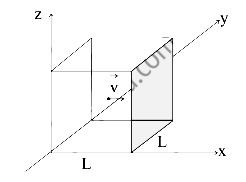
i. Let there be $n$ moles of an ideal gas enclosed in a cubical box of volume $V\left(=L^3\right)$ with sides of the box parallel to the coordinate axes, as shown in the figure. The walls of the box are kept at a constant temperature $T$.
ii. The gas molecules are in continuous random motion, colliding with each other and hitting the walls of the box, and bouncing back.
iii. As per one of the assumptions, we neglect intermolecular collisions and consider only elastic collisions with the walls.
iv. A typical molecule moving with the velocity $\overrightarrow{ v }$, about to collide elastically with the shaded wall of the cube parallel to yz-plane.
v. During an elastic collision, the component $v_x$ of the velocity will get reversed, keeping $v_y$ and $v_z$ components unaltered.
vi. Hence the change in momentum of the particle is only in the $x$ component of the momentum, $\Delta p_x$ is given by, $\Delta p _{ x }=$ final momentum - initial momentum $=\left(-m v_x\right)-\left(m v_x\right)=-2 m v_x$
vii. Thus, the momentum transferred to the wall during collision is $+2 m v_x$. The re-bounced molecule then goes to the opposite wall and collides with it.
viii. After colliding with the shaded wall, the molecule travels to the opposite wall and travels back towards the shaded wall again.
ix. This means that the molecule travels a distance of $2 L$ in between two collisions.
$x$. As $L$ is the length of the cubical box, the time for the molecule to travel back and forth to the shaded wall is $\Delta t=$ $\frac{2 L }{ v _{ x }}$.
xi. The average force exerted on the shaded wall by molecule is given as,
Average force $=$ Average rate of change of momentum
$\therefore F _{ avg }=\frac{2 mv _{ x 1}}{\frac{2 L }{ v _{ x 1}}}=\frac{ mv _{ x 1}^2}{ L }$
where $v_{x 1}$ is the $x$ component of the velocity of molecule 1 xii. Considering other molecules 2, 3, $4 \ldots$ with the respective $x$ components of velocities $v_{x 2}, v_{x 3}, v_{x 4} \ldots$, the total average force on the wall is,
$F _{ avg }=\frac{ m }{ L }\left( v _{ x 1}^2+ v _{ x 2}^2+ v _{ x 3}^2+\ldots . .\right)$
$\therefore$ The average pressure $P =\frac{\text { Average force }}{\text { Area of shaded wall }}$
$=\frac{ m \left( v _{ x 1}^2+ v _{ x 2}^2+\ldots \ldots .\right)}{ L \times L ^2}$
xiii. The average of the square of the $x$ component of the velocities is given by,
$ \overline{ v _{ x }^2}=\frac{ v _{ x 1}^2+ v _{ x 2}^2+ v _{ x 3}^2+\ldots .+ v _{ N }^2}{ N }$
$\therefore P =\frac{ mNv _{ x }^2}{ V } $
where $\overline{v_{ x }^2}$ is the average over all possible values of $v_x$. xiv. Now, $\overline{ v ^2}=\overline{ v _{ x }^2}+\overline{ v _{ y }^2}+\overline{ v _{ z }^2}$
By symmetry, $\overline{ v _{ x }^2}=\overline{ v _{ y }^2}=\overline{ v _{ z }^2}=\frac{1}{3} \overline{ v ^2}$ since the molecules have no preferred direction to move.
Therefore, average pressure, $P =\frac{1}{3} \frac{ N }{ V } m \overline{ v ^2}$
Need a full question paper?
Generate a complete, print-ready paper with questions like this in minutes — across 16+ boards, with answer keys.