Question
Explain the working of a LED.

Answer

Working :
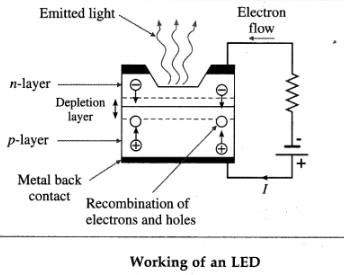
An LED is forward-biased with about $1.2\ V$ to $3.6\ V$ at $12\ mA$ to $20\ mA$ . Majority carriers electrons from n-type layer and holes from p-type layer are injected into the active layer. Electrons cross the junction into the p-layer. In the active p -layer, some of these excess minority carriers electrons, recombine radiatively with majority carriers, holes, thereby emitting photons. The resulting photon has an energy approximately equal to the bandgap of the active layer material. Modifying the bandgap of the active layer creates photons of diferent energies.
Image
In the energy band diagram this recombination is equivalent to a transition of the electron from a higher energy state in the conduction band to a lower energy state in the valence band. The energy difference is emitted as a photon of energy hv.
[Note : The photons originate primarily in the p-side of the junction which has a bandgap $E _{ Gp }$ narrower than that of the $n$-side, $E _{ Gn }$. Thus, with hv < $E _{ Gn }$, the photons are emitted through the wide-bandgap n-region with essentially no absorption.]

Need a full question paper?

Generate a complete, print-ready paper with questions like this in minutes — across 16+ boards, with answer keys.
Start Generating Free

Similar questions

Write the Boolean expression for (i) OR gate, (ii) AND gate, and (iii) NAND Gate.
Explain angular acceleration.
A small body of mass $m=0.1 \mathrm{~kg}$ at the end of a cord $1 \mathrm{~m}$ long swings in a vertical circle. Its speed is $2 \mathrm{mls}$ when the cord makes an angle $\theta=30^{\circ}$ with the vertical. Find the tension in the cord.
State and explain the hydrostatic paradox. OR Explain hydrostatic paradox.
Compare the rms speed of hydrogen molecules at $127\  {}^\circ C$ with rms speed of oxygen molecules at $27\  {}^\circ C$ given that molecular masses of hydrogen and oxygen are $2$ and $32$ respectively. 
Using Biot-Savart's law, obtain the expression for the magnetic induction near a straight infinite ly long current-carrying wire.
Complete the following equations describing nuclear decays.
(a) ${ }_{86}^{226} Ra \rightarrow \alpha+$
(b) ${ }_8^{19} O \rightarrow e^{-}+$
(c) ${ }_{90}^{228} Th \rightarrow \alpha+$
(d) ${ }_7^{12} N \rightarrow{ }_6^{12} C +$
A water molecule is made up of two hydrogen atoms and one oxygen atom, with a total of 10 electrons and 10 protons. The molecule is modelled as a dipole with an effective separation $d=3.9 \times 10^{-12} m$ between its positive and negative particles. What is the electric potential energy stored in the dipole? What does the sign of your answer mean?
Calculate the ratio of mean square speeds of molecules of a gas at 30 K and 120 K
Two charges of magnitudes -4Q and +2Q are located at points (2a, 0) and (5a, 0) respectively. What is the electric flux due to these charges through a sphere of radius 4a with its centre at the origin?