Question
Derive the expression for the heat produced due to a current ‘I’ flowing for a time interval ‘t’ through a resistor ‘R’ having a potential difference ‘V’ across its ends. With which name is the relation known? How much heat will an instrument of 12W produce in one minute if it is connected to a battery of 12V?

Answer

  1. Work done in moving the charge W = VQ
Power input,

$\text{P} = \frac{VQ}{t}$

$= {VI}$

$\therefore \text{Eergy, E = P}\times t = \text{V I t}$

This energy gets dissipated in the form of heat.

$\therefore \text{H = V I t}$

Applying Ohm's law, we get,

$H = \text{I}^{2}Rt$
  1. The relation is known as Joule's law of heating.
  2. $\text{P = 12 W} {\text{ t = 1 minute = 60s}}$
$H = P \times t$

$\text{= 12 W} \times \text{60s}$

$\text{H = 720 J}$

Need a full question paper?

Generate a complete, print-ready paper with questions like this in minutes — across 16+ boards, with answer keys.

Start Generating Free

Similar questions

An element X forms two oxides XO and $XO _2$. The oxide XO has no action on litmus solution but oxide $XO _2$ turns litmus solution red.
a. What is the nature of oxide XO ?
b. What is the nature of oxide $XO _2$ ?
c. Would you call element $X$ a metal or a non-metal? Give reason for your choice.
d. Can you give an example of element like $X$ ?
  1. Which two criteria did Mendeleev use to classify the elements in his periodic table?
  2. State Mendeleev’s periodic law.
  3. Why could no fixed position be given to hydrogen in Mendeleev’s periodic table?
  4. How and why does the atomic size vary as you go:
  1. From left to right along a period?
  2. Down a group?
Suppose you have three concave mirrors A, B and C of focal lengths 10cm, 15cm and 20cm. For each concave mirror, you perform the experiment of image formation for three values of object distance of 10cm, 20cm and 30cm. Giving reason answer the following:
  1. For the three object distances, identify the mirror/mirrors which will form an image of magnification - 1.
  2. Out of the three mirrors identify the mirror which would be preferred to be used for shaving purposes/ makeup.
  3. For the mirror B draw, ray diagram for image formation for object distances 10 cm and 20 cm.
Describe the working of human blood circulatory system with the help of a suitable diagram which shows all the steps involved.
Given below is the experimental set-up to establish that one of the atmospheric gases is essential for photosynthesis in plants.
  1. Name the atmospheric gas which is essential for photosynthesis.
  2. What is kept in watch-glass in figure 'a' and why?
  3. Write the balanced chemical equation for the process of photosynthesis.
  4. When do the desert plants takeup carbon dioxide and perform photosynthesis?
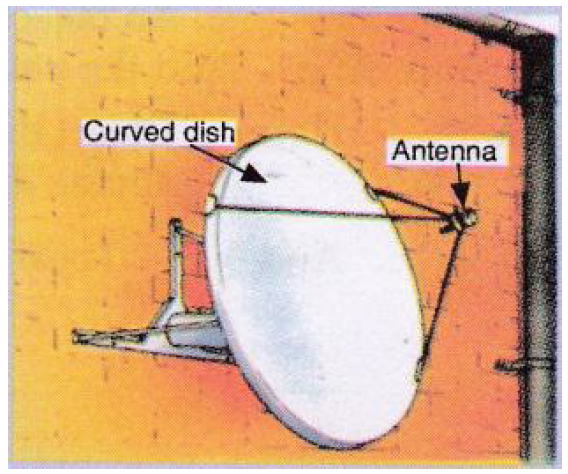
The diagram shows a dish antenna which is used to receive television signals from a satellite. The antenna (signal detector) is fixed in front of the curved dish.
  1. What is the purpose of the dish?
  2. Should it be concave or convex?
  3. Where should the antenna be positioned to receive the strongest possible signals?
  4. Explain what change you would expect in the signals if a larger dish was used.
What is meant by ‘positive geotropism’ and ‘negative geotropism’? Give one example of each type. Draw a labelled diagram to illustrate your answer indicating the plant part which shows positive geotropism and the plant part which shows negative geotropism.
How does fertilisation take place? Fertilisation occurs once in a month. Comment.
There are two important fuels A and B both of which are extracted from deep inside the earth. Fuel A is a thick, dark, foul smelling liquid whereas fuel B is a black solid. Combustion of both the fuels produces products, C, D, E and F. The product C makes the rainwater only slightly acidic but it is mainly responsible for causing global warming. The product D is neither acidic nor basic. It is harmless and does not affect the environment in any way. Both E and F attack breathing system of humans and are mainly responsible for causing acid rain. In addition to combustion of fuels A and B, the product F is also formed when lightning occurs in the sky.
  1. What are (i) fuel A, and (ii) fuel B?
  2. Name (i) C (ii) D (iii) E, and (iv) F?
  3. What is the process of formation of F during lightning known as?
  4. Which fuel is supposed to be exhausted sooner : A or B?
  5. Which fuel is mostly used for generating electricity at thermal power plants?
An object is placed 15cm from (a) a converging mirror, and (b) a diverging mirror, of radius of curvature 20cm. Calculate the image position and magnification in each case.