Question
  1. Which two criteria did Mendeleev use to classify the elements in his periodic table?
  2. State Mendeleev’s periodic law.
  3. Why could no fixed position be given to hydrogen in Mendeleev’s periodic table?
  4. How and why does the atomic size vary as you go:
  1. From left to right along a period?
  2. Down a group?

Answer

  1. The criteria used by Mendeleev in creating his periodic table:
  1. He arranged the elements on the basis of their increasing atomic masses.
  2. He put elements of similar properties in a group.
  1. He gave a law known as periodic law. The law states that the physical and chemical properties of elements are periodic function of their atomic weights.
  2. Hydrogen resembles like both the alkali metals and the halogens. Hence, it was placed in I A group VI B group and could not be given a fixed position in Mendeleev’s Periodic Table.
  1.  
  1. When we move from left to right in periodic table no. of shells remain same but the no. of electron increases due to which the size of an atom decreases.
  2. When we move down a group the no. of shells goes on increases and hence the size of atom also increases.

Need a full question paper?

Generate a complete, print-ready paper with questions like this in minutes — across 16+ boards, with answer keys.

Start Generating Free

Similar questions

Name the four main stakeholders in the management of forest resources.
A certain form of energy is available due to the difference in the temperature of water at the surface of the ocean and its deeper levels.
  1. Name the form of energy.
  2. Is this energy ultimately derived from the sun or not?
  3. Explain, how this form of energy can be converted into electricity?
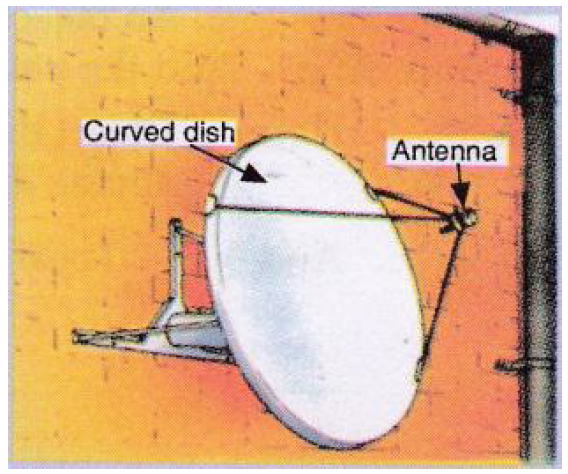
The diagram shows a dish antenna which is used to receive television signals from a satellite. The antenna (signal detector) is fixed in front of the curved dish.
  1. What is the purpose of the dish?
  2. Should it be concave or convex?
  3. Where should the antenna be positioned to receive the strongest possible signals?
  4. Explain what change you would expect in the signals if a larger dish was used.
  1. State the laws of refraction of light. Explain the term absolute refractive index of a medium and write an expression to relate it with the speed of light in vacuum.
  2. The absolute refractive indices of two media 'A' and 'B' are 2.0 and 1.5 respectively. If the speed of light in medium 'B' is 2 × $10^8$ m/ s, calculate the speed of light in:
  1. Vacuum,
  2. Medium 'A'.
There are four organisms A, B, C and D. The organism A eats only the flesh of other animals as food. The organism B can eat grains, fruits and vegetables as well as meat and fish. The organism C can make the food itself from simple inorganic substances present in the environment by utilising sunlight energy. On the other hand, organism D eats only plants and their products as food.
  1. Which organism is
  1. Omnivore,
  2. Herbivore,
  3. Carnivore?
  1. Which organism is an autotroph?
  2. Which organism is/ are heterotroph (s)?
  3. Which organism can be a producer?
  4. Which organism is/ are consumer (s)?
Give one example each of organisms which could be like A, B, C and D.
What are fossils? How are they formed? List two methods of determining the age of fossils. Explain in brief the importance of fossils in deciding the evolutionary relatrionships.
A metal which exists as a liquid at room temperature is obtained by heating its sulphide ore in the presence of air.
  1. Name the metal and write its chemical symbol.
  2. Write the name and formula of the sulphide ore.
  3. Give the equations of chemical reactions involved in the production of metal from its sulphide ore.
  4. Name a common device in which this metal is used.
  5. Can this metal displace copper from copper sulphate solution? Why?
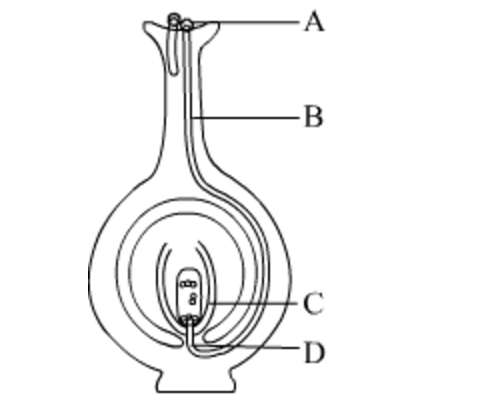
  1. Name the parts labelled as A, B, C and D in the diagram given below:
  1. What is pollination? State its significance.
  2. How does fertilisation occur in flowers? Name the parts of the flower that develop into (i) seed, and (ii) fruit after fertilisation.
When a 12 V battery is connected across an unknown resistor, there is a current of 2.5 mA in the circuit. Find the value of the resistance of the resistor.
List the factors on which diffusion in the plants depends.