Question
Derive the expression for the heat produced due to a current 'l' flowing for a time interval 't' through a resistor 'R' having a potential difference 'V' across its ends. With which name is the
relation known? How much heat will an instrument of 12W produce in one minute if it is connected to a battery of 12V?
Study the following electric circuit and find.
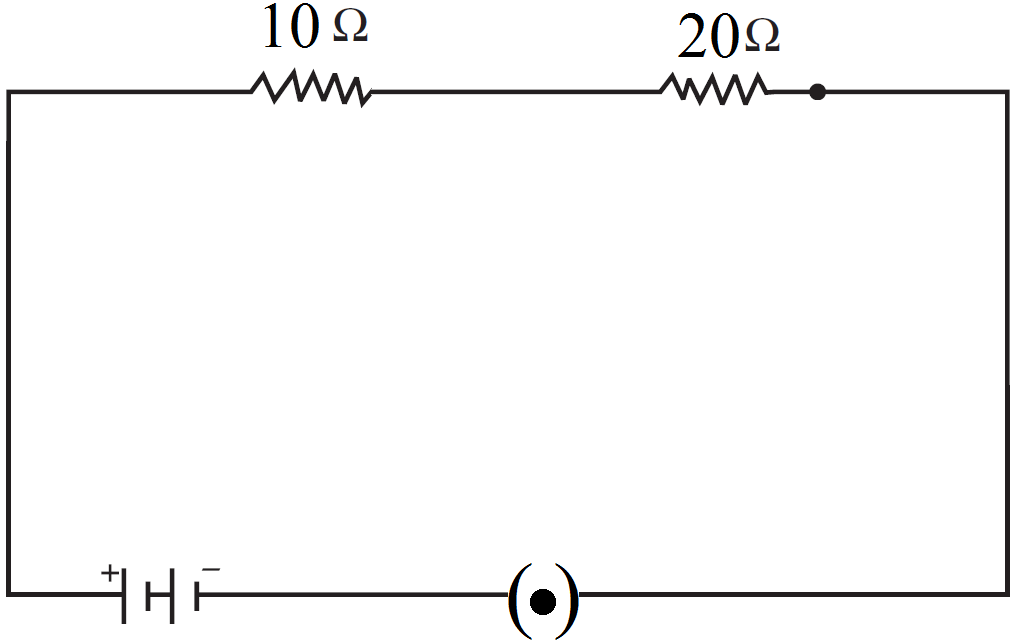
  1. The current flowing in the circuit and
  2. The potential difference across $10\Omega$ resistor.

Answer

we know that $E =\frac{ P }{ t }$
also $P = VI$
substituting we get
$E = VIt$
but $V =\mid R$
substituting we get
$E =| RIt =| * Rt$ T
his is the relation and its called joules law of heating
$P=12 W$
$t =60 sec$
$V =12 V$
$P= VI I$
$=\frac{ p }{ v }=\frac{12}{12}$
$=1 A$
now
$H = VIt =12(1) 60$
$=12(60)=720 $
$J= R _1= R _1+ R _2=10+2030 \Omega $
$V=3 V 1$.
From ohm's law $V = IR$.
$3=1 \times 30 \Rightarrow 1=\frac{3}{30}=\frac{1}{10}$ Ampere or 0.1 A
2. Potential difference across $10 \Omega$ reistor.
$V = I R$
$=\frac{1 \times 10}{10}=1$ volt.

Need a full question paper?

Generate a complete, print-ready paper with questions like this in minutes — across 16+ boards, with answer keys.

Start Generating Free

Similar questions

Three incandescent bulbs of 100W each are connected in series in an electric circuit. In another circuit another set of three bulbs of the same wattage are connected in parallel to the same source.
  1. Will the bulb in the two circuits glow with the same brightness? Justify your answer.
  2. Now let one bulb in both the circuits get fused. Will the rest of the bulbs continue to glow in each circuit? Give reason.
Rishi went to a palmist to show his palm. The palmist used a special lens for this purpose.
i. State the nature of the lens and the reason for its use.
ii. Where should the palmist place/hold the lens so as to have a real and magnified image of an object?
iii. If the focal length of this lens is 10 cm and the lens is held at a distance of 5 cm from the palm, use lens formula to find the position and size of the image.
State one use each of the following metals:
Copper, Aluminium, Iron, Silver, Gold, Mercury
State and explain the reaction, if any, of the following metals with a solution of copper sulphate:
  1. Gold.
  2. Copper.
  3. Zinc.
  4. Mercury.
One half of a convex lens of focal length 10cm is covered with a black paper. Can such a lens produce an image of a complete object placed at a distance of 30cm from the lens? Draw a ray diagram to justify your answer.
A 4cm tall object is placed perpendicular to the principal axis of a convex lens of focal length 20cm. The distance of the object from the lens is 15cm. Find the nature, position and size of the image.
The human body has an organ A which acts as a double pump. The oxygenated blood coming from the lungs through a blood vessel B enters the upper left chamber C of the double pump. When chamber C contracts, then blood goes into lower left chamber D. The contraction of chamber D forces the blood to go into a blood vessel E which supplies oxygenated blood to all the organs of the body (except the lungs). The deoxygenated blood coming out of the body organs is taken by a blood vessel F to the right upper chamber G of pumping organ. Contraction of chamber G forces the deoxygenated blood into right lower chamber H. And finally the contraction of chamber H sends the deoxygenated blood into lungs through a blood vessel I.
  1. What is organ A?
  2. Name the blood vessel (i) B (ii) E (iii) F, and (iv) I.
  3. What are chambers (i) C, and (ii) D?
  4. What are chambers (i) G and (ii) H?
What is an electromagnet? Describe the construction and working of an electromagnet with the help of a labelled diagram.
Consider the following organic compounds:
$CH _3 OH , C _2 H _5 OH , CH _3 COCH _3, CH _3 COOH , C _2 H _5 COOH , C _4 H _9 COOC _2 H _5, CH _4, C _2 H _6, CH _3 CHO , HCHO$
Out of these compounds:
a. Which compound is most likely to be sweet-smelling?
b. Which compound on treatment with conc. $H _2 SO _4$ at $170^{\circ} C$ forms an alkene?
c. Which compound on repeated chlorination forms chloroform?
d. Which compound is added to alcohol to denature it?
e. Which compound is a constituent of vinegar?
f. Which compound is used to sterilise wounds and syringes?
a. List three different categories of contraception methods.
b. Why has Government of India prohibited prenatal sex determination by law? State its benefits in the long run.
c. Unsafe sexual act can lead to various infections. Name two bacterial and two viral infections caused due to unsafe sex.
Soaps and detergents are both types of salts. State the difference between the two. Write the mechanism of the cleansing action of soaps. Why do soaps not form lather (foam) with hard water? Mention any two problems that arise due to the use of detergents instead of soaps.