Question
  1. Derive the expression for the torque acting on a current carrying loop placed in a magnetic field.
  2. Explain the significance of a radial magnetic field when a current carrying coil is kept in it.
Answer

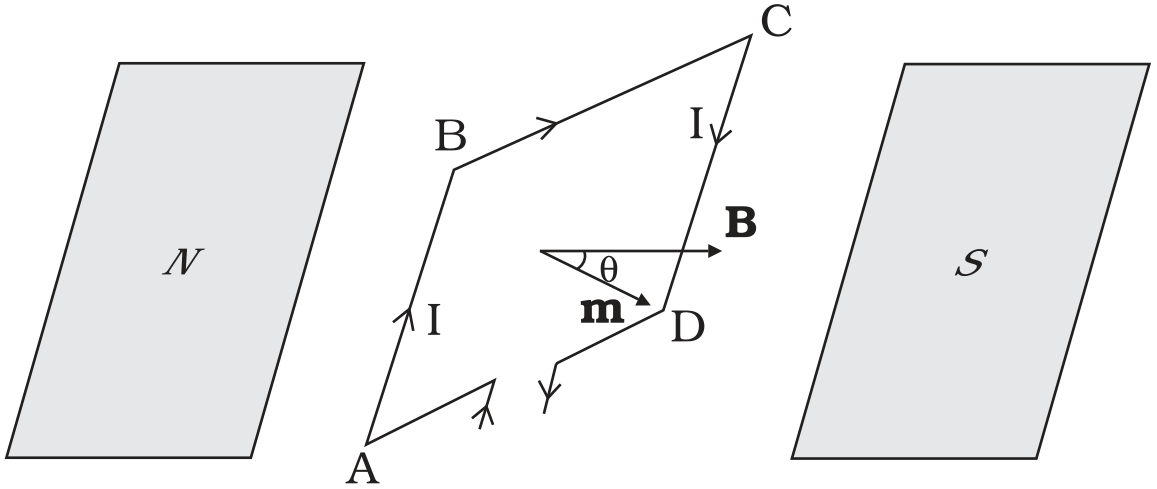
  1. The plane of the loop is not along the magnetic field but makes an angle with it.

Let the dimension of the rectangular coil ABCD, be AB × BC = a × b

The angle between the field and the normal is θ.

Forces on BC and DA are equal and opposite and they cancel each other as they are collinear.

Force on AB is F1 and force on CD is F2.

F1 = F2 = IbB

The magnitude of the torque on the loop as in the figure:
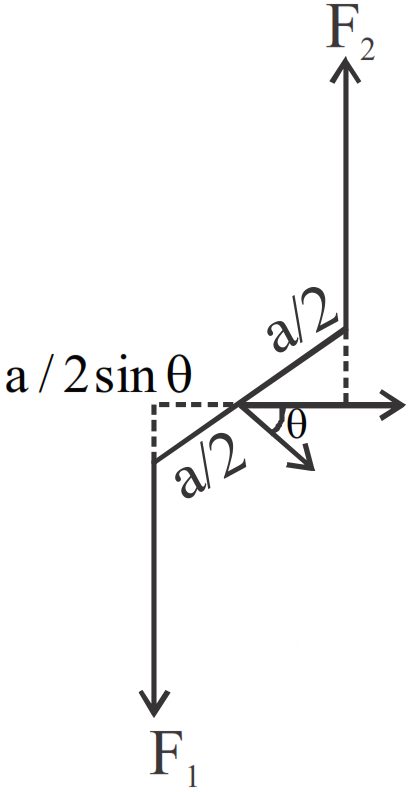
$\therefore\tau=\text{F}_1\frac{\text{a}}{2}\sin\theta+\text{F}_2\frac{\text{a}}{2}\sin\theta$

$=\text{lab}\text{B}\sin\theta$

$\tau=\text{lab}\sin\theta$

If there are 'n' such turns the torque will be $\text{n}\text{lab}\sin\theta$

The magnetic moment of the current, m = lA

$\therefore\overrightarrow{\tau}=\overrightarrow{\text{m}}\times\overrightarrow{\text{B}}$

  1. The uniform radial magnetic field keeps the plane of the coil always parallel to the direction of the magnetic field. that is, the angle between the plane of the coil and the magnetic field is zero in all the orientation of the coil.

Need a full question paper?

Generate a complete, print-ready paper with questions like this in minutes — across 16+ boards, with answer keys.
Start Generating Free

Similar questions

For a CE-transistor amplifier, the audio signal voltage across the collected resistance of 2k Ω is 2 V. Suppose the current amplification factor of the transistor is 100, find the input signal voltage and base current, if the base resistance is 1k Ω.
The equation of a travelling sound wave is $\text{y}=6.0\sin(600\text{t}-1.8\text{x})$ where y is measured in 10-5m, t in second and x in metre.
  1. Find the ratio of the displacement amplitude of the particles to the wavelength of the wave.
  2. Find the ratio of the velocity amplitude of the particles to the wave speed.
State the underlying principle of working of a moving coil galvanometer. Write two reasons why a galvanometer can not be used as such to measure current in a given circuit. Name any two factors on which the current sensitivity of a galvanometer depends.
In Exercise 4.11 obtain the frequency of revolution of the electron in its circular orbit. Does the answer depend on the speed of the electron? Explain.
A parallel beam of light of wavelength 600 nm is incident normally on a slit of width 0.2 mm. If the resulting diffraction pattern is observed on a screen 1 m away, find the distance of
a. first minimum, and
b. second maximum, from the central maximum.
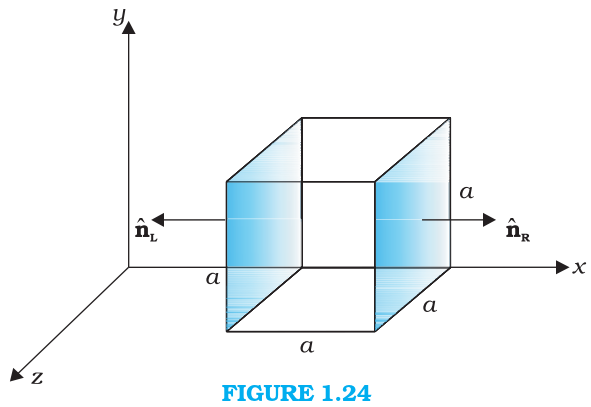
The electric field components in Fig. 1.24 are $E_x=\alpha x^{1 / 2}, E_y=E_z=0$, in which $\alpha=800 N / C m ^{1 / 2}$. Calculate (a) the flux through the cube, and (b) the charge within the cube. Assume that $a=0.1 m$.
Image
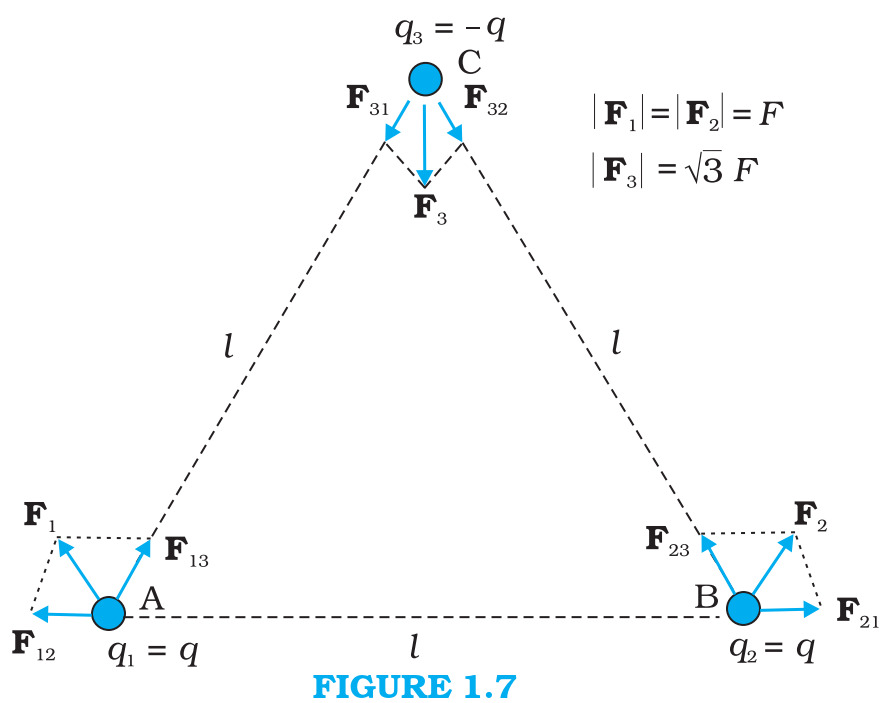
Consider the charges q, q, and –q placed at the vertices of an equilateral triangle, as shown in Fig. 1.7. What is the force on each charge?
Image
Is the colour of 620nm light and 780nm light same? Is the colour of 620nm light and 621nm light same? How many colours are there in white light?
A 12.3 eV electron beam is used to bombard gaseous hydrogen at room temperature. Upto which energy level the hydrogen atoms would be excited?
Calculate the wavelengths of the second member of Lyman series and second member of Balmer series.
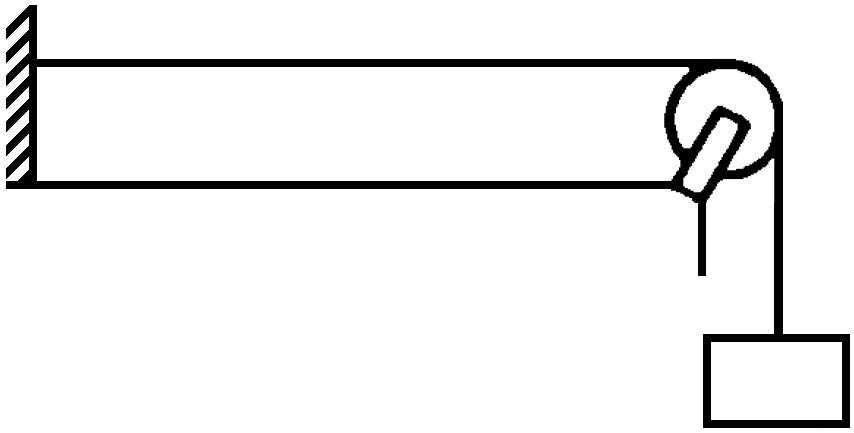
Figure, shows a string stretched by a block going over a pulley. The string vibrates in its tenth harmonic in unison with a particular tuning fork. When a beaker containing water is brought under the block so that the block is completely dipped into the beaker, the string vibrates in its eleventh harmonic. Find the density of the material of the block.