Question
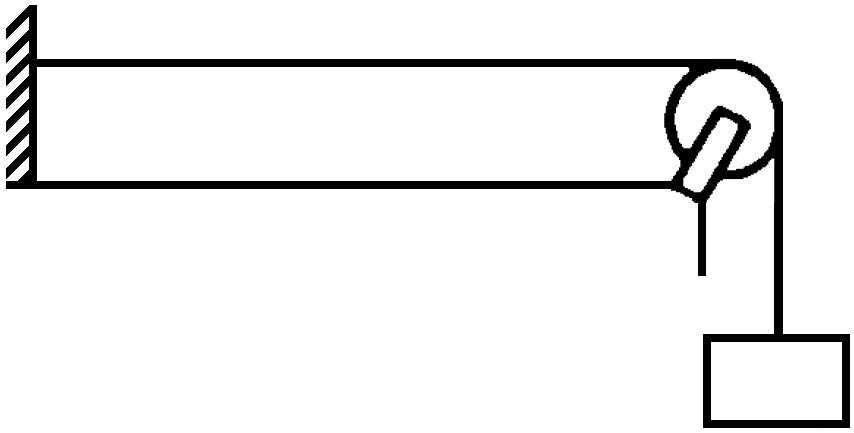
Figure, shows a string stretched by a block going over a pulley. The string vibrates in its tenth harmonic in unison with a particular tuning fork. When a beaker containing water is brought under the block so that the block is completely dipped into the beaker, the string vibrates in its eleventh harmonic. Find the density of the material of the block.
Answer

Let, $\rho\rightarrow$ density of the block

Weight $\rho\text{Vg}$ where V = volume of block

The same turning fork resonates with the string in the two cases

$\text{f}_{10}=\frac{10}{2\text{l}}\sqrt{\frac{\text{T}-\rho_\text{w}\text{Vg}}{\text{m}}}=\frac{11}{2\text{l}}\sqrt{\frac{(\rho-\rho_\text{w})\text{Vg}}{\text{m}}}$

As the f of tuning fork is same,

$\text{f}_{10}=\text{f}_{11}\Rightarrow\frac{10}{2\text{l}}\sqrt{\frac{\rho\text{Vg}}{\text{m}}}=\frac{11}{2\text{l}}\sqrt{\frac{(\rho-\rho_\text{w})\text{Vg}}{\text{m}}}$

$\Rightarrow\frac{10}{11}=\sqrt{\frac{\rho-\rho_\text{w}}{\text{m}}}$

$\Rightarrow\frac{\rho-1}{\rho}=\frac{100}{121}$ $\big($because, $\rho_\text{w}=1\text{gm/cc}\big)$

$\Rightarrow100\rho=121\rho-121$

$\Rightarrow5.8\times10^{3}\text{kg/m}^3$

Need a full question paper?

Generate a complete, print-ready paper with questions like this in minutes — across 16+ boards, with answer keys.

Start Generating Free

Similar questions

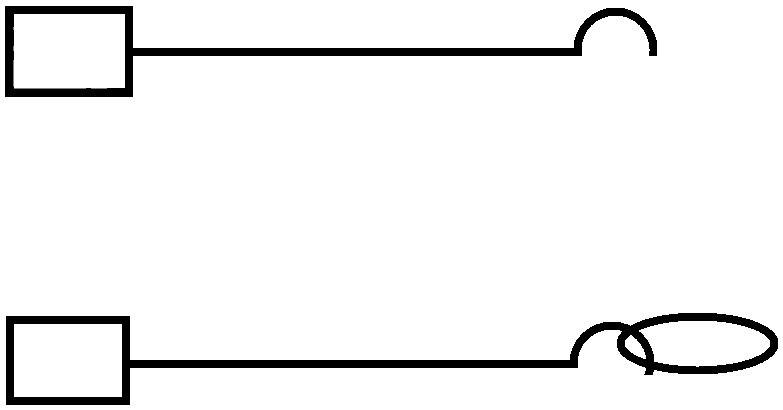
Figure shows a light rod of length l rigidly attached to a small heavy block at one end and a hook at the other end. The system is released from rest with the rod in a horizontal position. There is a fixed smooth ring at a depth h below the initial position of the hook and the hook gets into the ring as it reaches there. What should be the minimum value of h so that the block moves in a complete circle about the ring?

Theory of relativity reveals that mass can be converted into energy. The energy E so obtained is proportional to certain powers of mass m and the speed c of light. Guess a relation among the quantities using the method of dimensions.
A lens forms a real image of an object. The distance from the object to the lens is u cm and the distance of the image from the lens is v cm. The given graphs shows variation of v with u.
  1. What is the nature of the lens?
  2. Using the graph, find the focal length of this lens.
Even though an electric field E exerts a force qE on a charged particle yet the electric field of an EM wave does not contribute to the radiation pressure (but transfers energy). Explain.
Careful measurement of the electric field at the surface of a black box indicates that the net outward flux passing through the surface of the box is $8.0 \times 10^3 Nm ^2 / C$.
(a) What is the net charge inside the box?
(b) If the net outward flux through the surface of the box were zero, could you conclude that there were no charges inside the box? Why or why not?
State the underlying principle of working of a moving coil galvanometer. Write two reasons why a galvanometer can not be used as such to measure current in a given circuit. Name any two factors on which the current sensitivity of a galvanometer depends.
What is de-Broglie wave? Write an expression for its wavelength.
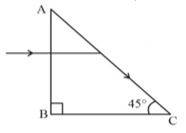
A light ray entering a right-angled prism undergoes refraction at the face AC as shown in Figure
(I) What is the refractive index of the material of the prism in Figure?

Image

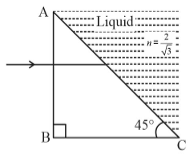
(II) (a) If the side AC of the above prism is now surrounded by a liquid of refractive index $\frac{2}{\sqrt{3}}$ as shown in Figure, determine if the light ray continues to graze along the interface AC or undergoes total internal reflection or undergoes refraction into the liquid.

Image

(b) Draw the ray diagram to represent the path followed by the incident ray with the corresponding angle values.
(Given, $\sin ^{-1}\left(\frac{\sqrt{2}}{\sqrt{3}}\right)=54.6^{\circ}$ )
To increase the current sensitivity of a moving coil galvanometer by 50%, its resistance is increased so that the new resistance becomes twice its initial resistance. By what factor does its voltage sensitivity change?
Can X-rays be used for photoelectric effect?