Question
  1. Derive the expression for the torque acting on a current carrying loop placed in a magnetic field.
  2. Explain the significance of a radial magnetic field when a current carrying coil is kept in it.
Answer

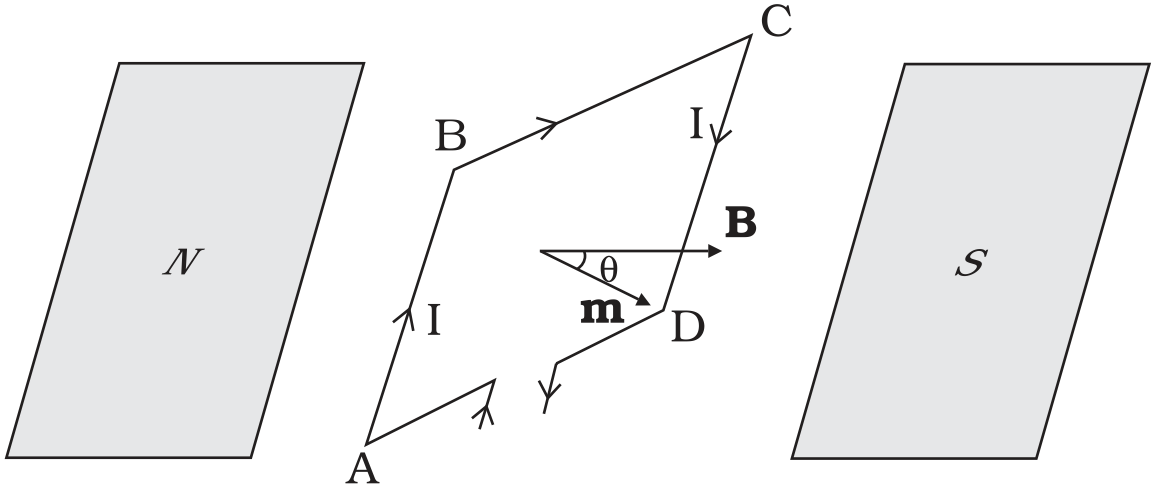
  1. The plane of the loop is not along the magnetic field but makes an angle with it.

Let the dimension of the rectangular coil ABCD, be AB × BC = a × b
The angle between the field and the normal is θ.
Forces on BC and DA are equal and opposite and they cancel each other as they are collinear.
Force on AB is $F_1$ and force on CD is $F_2.$
$F_1 = F_2 = IbB$
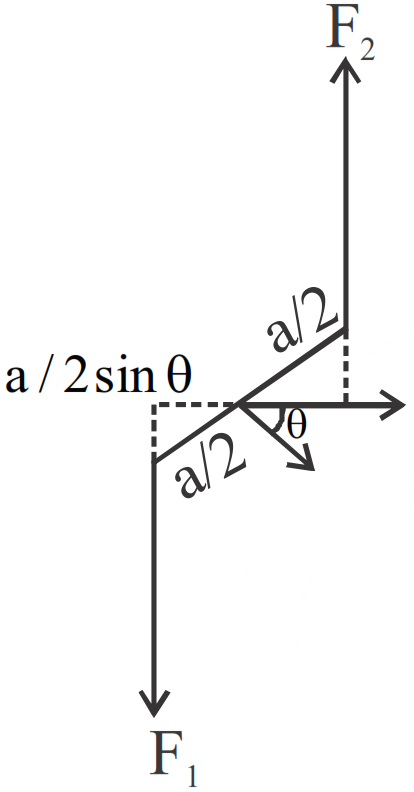
The magnitude of the torque on the loop as in the figure:

$\therefore\tau=\text{F}_1\frac{\text{a}}{2}\sin\theta+\text{F}_2\frac{\text{a}}{2}\sin\theta$
$=\text{lab}\text{B}\sin\theta$
$\tau=\text{lab}\sin\theta$
If there are 'n' such turns the torque will be $\text{n}\text{lab}\sin\theta$
The magnetic moment of the current, m = lA
$\therefore\overrightarrow{\tau}=\overrightarrow{\text{m}}\times\overrightarrow{\text{B}}$
  1. The uniform radial magnetic field keeps the plane of the coil always parallel to the direction of the magnetic field. that is, the angle between the plane of the coil and the magnetic field is zero in all the orientation of the coil.

Need a full question paper?

Generate a complete, print-ready paper with questions like this in minutes — across 16+ boards, with answer keys.

Start Generating Free

Similar questions

With what considerations in view, a photodiode is fabricated? State its working with the help of a suitable diagram. Eventhough the current in the forward bias is known to be more than in the reverse bias, yet the photodiode works in reverse bias. What is the reason?
A bar magnet of magnetic moment $1.5\ J\ T^{–1}$ lies aligned with the direction of a uniform magnetic field of 0.22 T.
  1. What is the amount of work required by an external torque to turn the magnet so as to align its magnetic moment: (i) normal to the field direction, (ii) opposite to the field direction?
  2. What is the torque on the magnet in cases (i) and (ii)?
In a pure semiconductor, the number of conduction electrons is $6 \times 10^{19}$ per cubic metre. How many holes are there in a sample of size 1cm × 1cm × 1mm?
A straight wire of length l can slide on two parallel plastic rails kept in a horizontal plane with a separation d. The coefficient of friction between the wire and the rails is $\mu.$ If the wire carries a current i, what minimum magnetic field should exist in the space in order to slide the wire on the rails?
Two electric bulbs have the following specifications.
  1. 100W at 220V.
  2. 1000W at 220V.
Which bulb has higher resistance? What is the ratio of their resistances?
Estimate the proportion of boron impurity whieh will increase the conductivity of a pure silicon sample by a factor of 100. Assume that each boron atom creates a hole and the concentration of holes in pure silicon at the same temperature is $7 \times 10^{15}$ holes per cubic metre. Density of silicon is $5 \times 10^{21}$ atoms per cubic metre.
A mosquito is sitting on an L.P. record disc rotating on a turn table at $33\frac{1}{3}$ revolutions per minute. The distance of the mosquito from the centre of the turn table is 10cm. Show that the friction coefficient between the record and the mosquito is greater than $\frac{\pi^2}{81}.$ Take $g =10 m/s^2.$
A cubical box of volume $216cm^3$ is made up of 0.1cm thick wood. The inside is heated electrically by a 100W heater. It is found that the temperature difference between the inside and the outside surface is 5°C in steady state. Assuming that the entire electrical energy spent appears as heat, find the thermal conductivity of the material of the box.
An object P is focused by a microscope M. A glass slab of thickness 2.1cm is introduced between P and M. If the refractive index of the slab is 1.5, by what distance should the microscope be shifted to focus the object again?
A nearsighted person cannot see beyond 25cm. Assuming that the separation of them glass from the eye is 1cm, find the power of lens needed to see distant objects.