Question
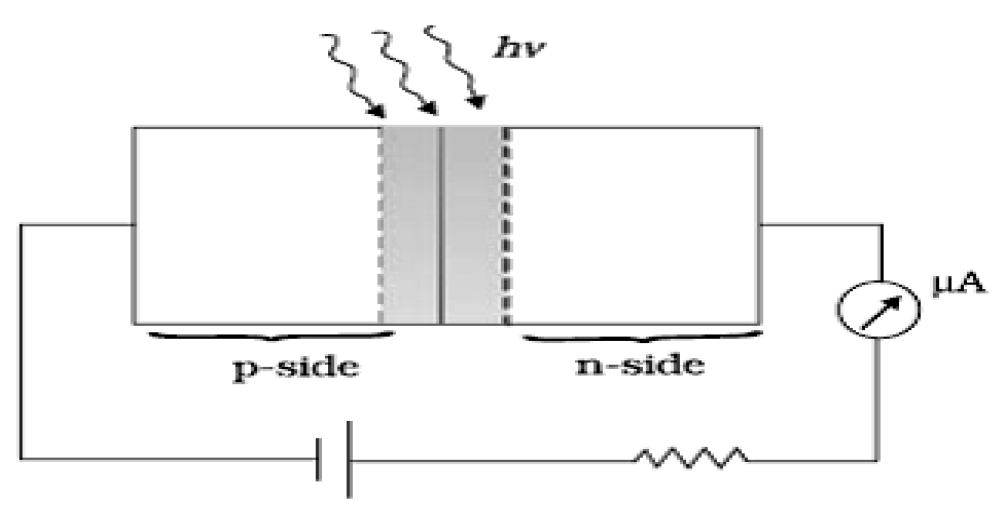
With what considerations in view, a photodiode is fabricated? State its working with the help of a suitable diagram. Eventhough the current in the forward bias is known to be more than in the reverse bias, yet the photodiode works in reverse bias. What is the reason?
Answer


It is fabricated with a transparent window to allow light to fall on diode.
When the photodiode is illuminated with photons of energy $(hv > E_g)$ greater than the energy gap of the semiconductor, electron - holes pairs are generated. These gets separated due to the junction electric field (before they recombine) which produces an emf.

Reason: It is easier to observe the change in the current, with change in light intensity, if a reverse bias is applied.
Alternate Answer
The fractional change in the minority carrier current, obtained under reverse bias, is much more than the corresponding fractional change in majority carrier current obtained under forward bias.

Need a full question paper?

Generate a complete, print-ready paper with questions like this in minutes — across 16+ boards, with answer keys.

Start Generating Free

Similar questions

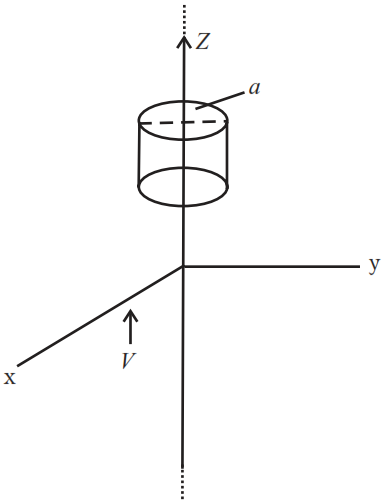
An infinitely long thin wire carrying a uniform linear static charge density λ is placed along the z-axis. The wire is set into motion along its length with a uniform velocity $\text{v}=\text{v}\hat{\text{k}}_\text{z}$. Calculate the poynting vector $\text{S}=\frac{1}{\mu_0}(\text{E}\times\text{B})$.
Derive the equation of drift velocity by explaining the drift motion of electrons and the drift velocity of electrons in a conductor.
A ball of mass 0.50kg moving at a speed of 5.0m/s collides with another ball of mass 1.0kg. After the collision the balls stick together and remain motionless. What was the velocity of the 1.0kg block before the collision?
A square plate of mass 120g and edge 5.0cm rotates about one of the edges. If it has a uniform angular acceleration of $0.2rad/s^2$, what torque acts on the plate?
The magnetic field due to a long straight wire has been derived in terms of $\mu_0,$ i and d. Express this in terms of $\in_0,$ C, i and d.
An electric bulb, when connected across a power supply of 220V, consumes a power of 60W. If the supply drops to 180V, what will be the power consumed? If the supply is suddenly increased to 240V, what will be the power consumed?
  1. State the principle of working of a meter bridge.
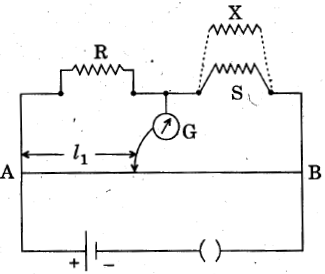
  2. In a meter bridge balance point is found at a distance $l_1$ with resistances R and S as shown in the figure.


When an unknown resistance X is connected in parallel with the resistance S, the balance point shifts to a distance $l_2$. Find the expression for X in terms of $l_1, l_2$ and S.
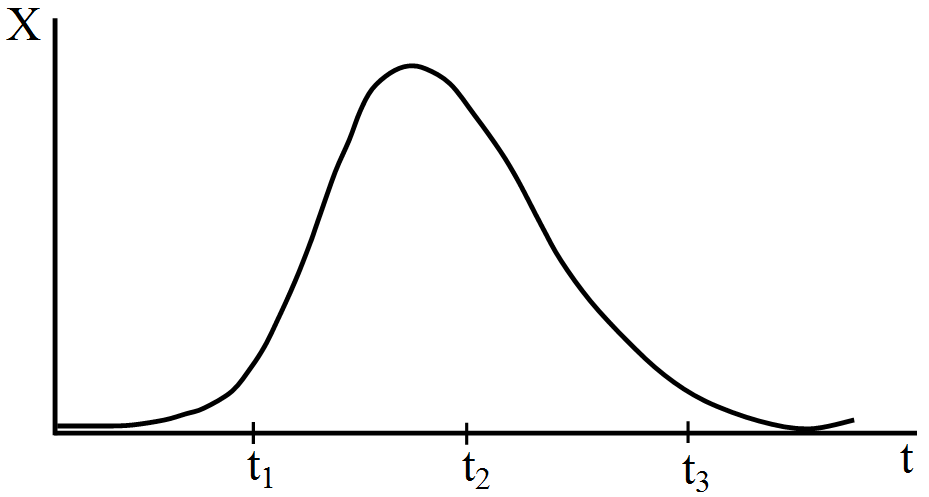
Figure shows the x coordinate of a particle as a function of time. Find the signs of $v_x$ and $a_x$ at $t = t_1, t = t_2$ and $t = t_3.$
The equation of a wave travelling on a string is:$\text{y}=(0.10\text{mm})\sin\big[(31.4\text{m}^{-1})\text{x}+(314\text{s}^{-1})\text{t}\big].$
  1. In which direction does the wave travel?
  2. Find the wave speed, the wavelength and the frequency of the wave.
  3. What is the maximum displacement and the maximum speed of a portion of the string?
  1. What characteristic property of nuclear force explains the constancy of binding energy per nucleon (BE/A) in the range of mass number 'A' lying 30
    • Show that the density of nucleus over a wide range of nuclei is constantindependent of mass numberA.