Question
Derive the formula $($equation$)$ of capacitance for a paralled plate capacitor.

Answer

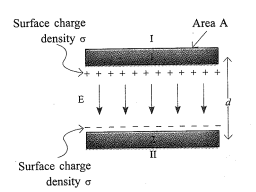
Image
$\rightarrow$ A capacitor made up of two large parallel conducting plates kept at a small distance is called parallel plate capacitor.
$\rightarrow $ Two parallel conducting plates are arranged parallel to each other as shown in figure.
Area of each plate is A and perpendicular distance between the two plates is $d$.
Charge on them is $+ Q$ and $- Q$ respectively.
$\rightarrow$ Surface charge density on both the plates is $\sigma\left(=\frac{ Q }{ A }\right)$ and $-\sigma$ respectively.
$\rightarrow$ Here the separation $(d)$ between two plates is very small compared to the area of the plates. $($ $d^2 \ll<A)$
Therefore, the electric field between the two plates can be considered uniform
​​​​​​​$($So that we can use the formula $E=\frac{\sigma}{2 \varepsilon_0}$ to find out electric field due to both plates.$)$
Electric field in the region above plate $I , E ^{\prime}=\frac{\sigma}{2 \varepsilon_0}-\frac{\sigma}{2 \varepsilon_0}=0$
$\rightarrow$​​​​​​​ Electric field in the region below plate $II, E ^{\prime \prime}=\frac{\sigma}{2 \varepsilon_0}-\frac{\sigma}{2 \varepsilon_0}=0$
$\rightarrow$ Electric field in the region above plate $I,$
$E ^{\prime}=\frac{\sigma}{2 \varepsilon_0}-\frac{\sigma}{2 \varepsilon_0}=0$
$\rightarrow$ Electric field in the region below plate $\Pi$,
$E ^{\prime \prime}=\frac{\sigma}{2 \varepsilon_0}-\frac{\sigma}{2 \varepsilon_0}=0$
$\rightarrow$ Electric field in the region between two plates,
$\therefore E =\frac{\sigma}{2 \varepsilon_0}+\frac{\sigma}{2 \varepsilon_0}$
$\therefore E =\frac{\sigma}{\varepsilon_0}$
$\therefore E =\frac{ Q }{\varepsilon_0 A}$
$\left(\because \sigma=\frac{ Q }{ A }\right)$
$\rightarrow$ Direction of this electric field is from $+ve$ plate to $-ve$ plate.
$\rightarrow$ The electric field is limited to the region between two plates and is uniform in that entire region.

Need a full question paper?

Generate a complete, print-ready paper with questions like this in minutes — across 16+ boards, with answer keys.
Start Generating Free

Similar questions

Give reasons for each of the following:
  1. The intensity of light at some points on the screen in Young’s double slit experiment is zero.
  2. The intensity of light transmitted by a polaroid is less than the intensity of the unpolarised light incident on it.
  3. In the single slit diffraction experiment, some coloured fringes around the central white maximum are observed on the screen when one uses a source of white light.
Draw a labelled diagram of a full wave rectifier circuit. State its working principle. Show the input-output waveforms.
A radioactive isotope is being produced at a constant rate $\frac{\text{dN}}{\text{dt}}=\text{R}$ in an experiment. The isotope has a half-life $\text{t}_{\frac{1}2{}}.$ Show that after a time $\text{t}>>\text{t}_{\frac{1}{2}},$ the number of active nuclei will become constant. Find the value of this constant.
Let $\overrightarrow{\text{A}}$ and $\overrightarrow{\text{B}}$ be the two vectors of magnitude 10 unit each. If they are inclined to the X-axis at angles 30° and 60° respectively, find the resultant.
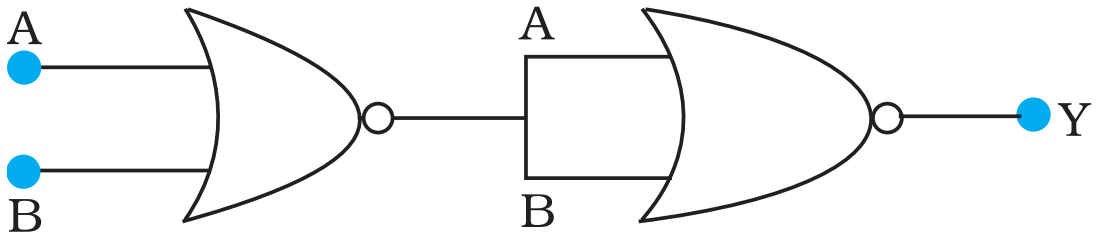
Write the truth table for circuit given in Fig. 14.47 below consisting of NOR gates and identify the logic operation (OR, AND, NOT) which this circuit is performing.
(Hint: A = 0, B = 1 then A and B inputs of second NOR gate will be 0 and hence Y=1. Similarly work out the values of Y for other combinations of A and B. Compare with the truth table of OR, AND, NOT gates and find the correct one.)
  1. For a glass prism $(\mu =\sqrt{3} )$ the angle of minimum deviation is equal to the angle of the prism. Calculate the angle of the prism.
  2. Draw ray diagram when incident ray falls normally on one of the two equal sides of a right angled isosceles prism having refractive index $\mu = \sqrt{3} . $
A uniformly moving train passes by a long platform. Consider the events' engine crossing the beginning of the platform' and 'engine crossing the end of the platform'. Which frame (train frame or the platform frame) is the proper frame for the pair of events?
Consider two conducting spheres of radii $R_1$ and $R_2$ with $R_1 > R_2$. If the two are at the same potential, the larger sphere has more charge than the smaller sphere. State whether the charge density of the smaller sphere is more or less than that of the larger one.
A flywheel of moment of inertia $5.0kg-m^2$ is rotated at a speed of 60rad/s. Because of the friction at the axle, it comes to rest in 5.0 minutes. Find:
  1. The average torque of the friction.
  2. The total work done by the friction.
  3. The angular momentum of the wheel 1 minute before it stops rotating.
Consider the situation of the previous problem. Suppose the production of the radioactive isotope starts at t = 0. Find the number of active nuclei at time t.