Question
Derive the formula (/ equation) of capacitance for a paralled plate capacitor.

Answer

Image
A capacitor made up of two large parallel conducting plates kept at a small distance is called parallel plate capacitor.
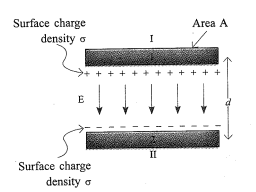
Two parallel conducting plates are arranged parallel to each other as shown in figure. Area of each plate is A and perpendicular distance between the two plates is $d$. Charge on them is + Q and - Q respectively.
Surface charge density on both the plates is $\sigma\left(=\frac{ Q }{ A }\right)$ and $-\sigma$ respectively.
Here the separation (d) between two plates is very small compared to the area of the plates. ( $d^2 \ll<$ A) Therefore, the electric field between the two plates can be considered uniform (So that we can use the formula $E=\frac{\sigma}{2 \varepsilon_0}$ to find out electric field due to both plates.) Electric field in the region above plate I , $E ^{\prime}=\frac{\sigma}{2 \varepsilon_0}-\frac{\sigma}{2 \varepsilon_0}=0$
Electric field in the region below plate II, $E ^{\prime \prime}=\frac{\sigma}{2 \varepsilon_0}-\frac{\sigma}{2 \varepsilon_0}=0$

Electric field in the region above plate I,
$E ^{\prime}=\frac{\sigma}{2 \varepsilon_0}-\frac{\sigma}{2 \varepsilon_0}=0$

Electric field in the region below plate $\Pi$,
$E ^{\prime \prime}=\frac{\sigma}{2 \varepsilon_0}-\frac{\sigma}{2 \varepsilon_0}=0$

Electric field in the region between two plates,
$\begin{array}{l}
\therefore E =\frac{\sigma}{2 \varepsilon_0}+\frac{\sigma}{2 \varepsilon_0} \\
\therefore E =\frac{\sigma}{\varepsilon_0} \\
\therefore E =\frac{ Q }{\varepsilon_0 A}
\end{array}$
$\left(\because \sigma=\frac{ Q }{ A }\right)$

Direction of this electric field is from +ve plate to -ve plate.
The electric field is limited to the region between two plates and is uniform in that entire region.

Need a full question paper?

Generate a complete, print-ready paper with questions like this in minutes — across 16+ boards, with answer keys.
Start Generating Free

Similar questions

State the underlying principle of a cyclotron. Explain its working with the help of a schematic diagram. Obtain the expression for cyclotron frequency.
Define polarization.
As the earth rotates about its axis, a person living in his house at the equator goes in a circular orbit of radius equal to the radius of the earth. Why does he/ she not feel weightless as a satellite passenger does?
Water near the bed of a deep river is quiet while that near the surface flows. Give reasons.
  1. How does one explain the emission of electrons from a photosensitive surface with the help of Einstein's photoelectric equation?
  2. The work function of the following metals is given: Na 2.75 ev, K = 2.3 eV, Mo = 4.17 eV and Ni = 5.15 eV. Which of these metals will not cause photoelectric emission for radiation of wavelength 3300 Å from a laser source placed 1 m away from these metals? What happens if the laser source is brought nearer and placed 50 cm away?
Two narrow slits emitting iight in phase are separated by a distance of 1.0cm. The wavelength of the light is 5.0 × 10⁻⁷m. The interference pattern is observed on a screen placed at a distance of 1.0m.
  1. Find the separation between the consecutive maxima. Can you expect to distinguish between these maxima?
  2. Find the separation between the sources which will give a separation of 1.0mm between the consecutive maxima.
What is the advantage of using thick metallic strips to join wires in a potentiometer?
A square coil of edge l and with n turns carries a current i. It is kept on a smooth horizontal plate. A uniform magnetic field B exists parallel to an edge. The total mass of the coil is M. What should be the minimum value of B for which the coil will start tipping over?
Three simple harmonic motions of equal amplitudes A and equal time periods in the same direction combine. The phase of the second motion is 60° ahead of the first and the phase of the third motion is 60° ahead of the second. Find the amplitude of the resultant motion.
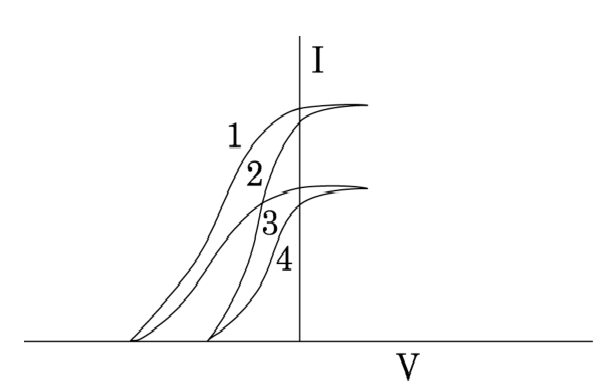
The given graph shows the variation of photo-electric currently) with the applied voltage(V) for two different materials and for two different intensities of the incident radiations. Identify and explain using Einstein's photo electric equation the pair of curves that correspond to (i) different materials but same intensity of incident radiation (ii) different intensities but same materials.