Question
  1. How does one explain the emission of electrons from a photosensitive surface with the help of Einstein's photoelectric equation?
  2. The work function of the following metals is given: Na 2.75 ev, K = 2.3 eV, Mo = 4.17 eV and Ni = 5.15 eV. Which of these metals will not cause photoelectric emission for radiation of wavelength 3300 Å from a laser source placed 1 m away from these metals? What happens if the laser source is brought nearer and placed 50 cm away?
Answer

  1. Einstein’s Photoelectric equation is

$hv=\varphi_0+K_{\text{max}}$

When a photon of energy $'hv'$ is incident on the metal, some part of this energy is utilised as work function to eject the electron and remaining energy appears as the kinetic energy of the emitted electron.

  1. $E=\frac{hc}{\lambda}=\frac{6.63\times10^{-34}\times3\times10^8}{3.3\times10^{-7}\times1.6\times10^{-19}}eV$

$=3.77\text{eV}$

The work function of Mo and Ni is more than the energy of the incident photons; so photoelectric emission will not take place from these metals. Kinetic energy of photo electrons will not change, only photoelectric current will change.

Need a full question paper?

Generate a complete, print-ready paper with questions like this in minutes — across 16+ boards, with answer keys.

Start Generating Free

Similar questions

Answer the following question:
Why must both the objective and the eyepiece of a compound microscope have short focal lengths?
A 60kg man skating with a speed of 10m/s collides with a 40kg skater at rest and they cling to each other. Find the loss of kinetic energy during the collision.
Write nuclear reaction equations for
  1. $\alpha\text{-decay of }\ ^{226}_{88}\text{Ra}$
  2. $\alpha-\text{decay of }\ ^{226}_{94}\text{Pu}$
  3. $\beta\text{-decay of }\ ^{32}_{15}\text{P}$
  4. $\beta\text{-decay of }\ ^{210}_{83}\text{Bi}$
  5. $\beta\text{-decay of }\ ^{11}_{6}\text{C}$
  6. $\beta^+\text{-decay of }\ ^{97}_{43}\text{Tc}$
  7. $\text{Electron capture of }\ ^{120}_{54}\text{Xe}$
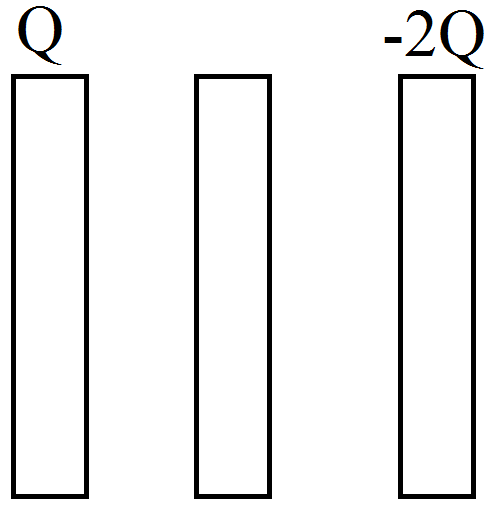
Three identical metal plates with large surface areas are kept parallel to each other as shown in figure. The leftmost plate is given a charge Q, the rightmost a charge -2Q and the middle one remains neutral. Find the charge appearing on the outer surface of the rightmost plate.

Prove that the force acting on a current-carrying wire, joining two fixed points a and b in a uniform magnetic field, is independent of the shape of the wire.
Two charges $3 \times 10^{-8} C$ and $-2 \times 10^{-8} C$ are located $15 cm$ apart. At what point on the line joining the two charges is the electric potential zero? Take the potential at infinity to be zero.
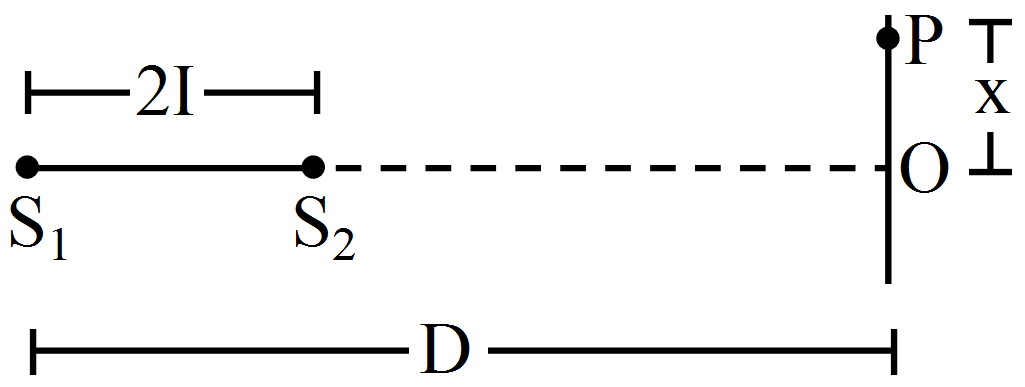
Two coherent narrow slits emitting sound of wavelength $\lambda$ in the same phase are placed parallel to each other at a small separation of $2\lambda.$ The sound is detected by moving a detector on the screen $\sum$ at a distance $\text{D}(>>\lambda)$ from the slit S1 as shown in figure. Find the distance x such that the intensity at P is equal to the intensity at 0.

A water particle of mass 10.0mg and having a charge of 1.50 × 10-6C stays suspended in a room. What is the magnitude of electric field in the room? What is its direction?
A charge Q is uniformly distributed over a rod of length l. Consider a hypothetical cube of edge l with the centre of the cube at one end of the rod. Find the minimum possible flux of the electric field through the entire surface of the cube.