Question
Derive the formula for determining activation energy from Arrhenius equation using rate constant at different temperatures. And also explain how activation energy can be determined using graph.
Answer

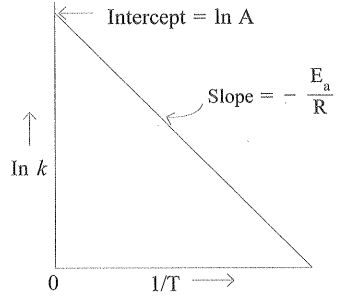
Activation energy using graph:
$\rightarrow$ Taking natural logarithm on both the side of Arrhenius equation $k = Ae ^{-\frac{ E _{ a }}{ RT }}$
$\rightarrow \ln k =-\frac{ E _{ a }}{ RT }+\ln A \ \ \ \ldots \ldots$ Eq. $(1)$
$\rightarrow$ The plot of $\ln k$ vs $1 / T$ gives a straight line as shown in figure.
Image
$\rightarrow$ In figure, slope $=-\frac{E_{ a }}{R}$ and intercept $=\ln A$. So, we can calculate activation energy $( E _{ a } )$ and Arrhenius constant $A$ using these values.
Formula of activation energy:
$\rightarrow$ It has been found from Arrhenius equation that increasing the temperature or decreasing the activation energy will result in an increase in the rate of the reaction and an exponential increase in rate constant.
$\rightarrow$ Thus, at temperature $T_1$, equation $(1)$ is
$\ln k _1=-\frac{ E _{ a }}{ RT _1}+\ln A..........$ Eq. $(2)$
$\rightarrow$ at temperature $T _2$, equation $(1)$
is $\ln k _2=-\frac{ E _{ a }}{ RT _2}+\ln A............$ Eq. $(3)$
$($since $A$ is constant for given reaction$)$
$k _1$ and $k _2$ are rate constant at temperatures $T _1$ and $T _2$ respectively.
$\rightarrow$ Subtracting equation $(2)$ from $(3),$ we obtain
$\ln k _2-\ln k _1=\frac{- E _{ a }}{ RT _2}+\frac{ E _{ a }}{ RT _1}$
$\ln \frac{ k _2}{ k _1}=\frac{ E _{ a }}{ R }\left[\frac{1}{T_1}-\frac{1}{T_2}\right]$
$\log \frac{ k _2}{ k _1}=\frac{ E _{ a }}{2.303 R }\left[\frac{1}{T_1}-\frac{1}{T_2}\right]$
$\log \frac{ k _2}{ k _1}=\frac{ E _{ a }}{2.303 R }\left[\frac{ T _2- T _1}{T_1 T_2}\right]$
$\rightarrow$ From above formula activation energy can be calculate using measured values of rate constants at different temperatures.

Need a full question paper?

Generate a complete, print-ready paper with questions like this in minutes — across 16+ boards, with answer keys.

Start Generating Free

Similar questions

What is rate of a chemical reaction? Explain average and instantaneous rate of reaction with help of graph and also give unit of rate of reaction.
Explain the following:
(i) Electrophilic chlorination (substitution) of toluene.
(ii) Free radical halogenation of alkanes.
Give equations for the following reactions :
(i) Oxidation of propan-1-ol with alkaline $KMnO _4$ solution.
(ii) Bromine in presence of $C S _{ 2 }$ with phenol.
(iii) Dilute nitric acid with phenol.
Crystal structure of oxides of transition metals often show defects. Given reason. (2)
(a) For the complex $\left[ Fe ( CN )_6\right]^{4-}$, write the hybridization magnetic character and spin type of the complex. [At. Number : Fe $=26$ ]
(b) Draw one of the geometrical isomers of the complex $\left.Co ( en )_2 Cl _2\right]^{+}$which is optically active.
Explain how the molecularity of a complex reaction determined? And give the points showing difference between molecularity of a reaction and order of a reaction.
Describe the froth floatation process of concentration of ores.
Indicate the steps in the preparation of :
(i) $K _2 Cr _2 O _7$ from chromite ore
(ii) $KMnO _4$ from pyrolusite ore.
Write the mechanism of hydration of ethene to yield ethanol.
Read the following text carefully and answer the questions that follow:
The f-block consists of elements in which 4f and 5f orbitals are progressively filled. They are placed in a separate panel at the bottom of the periodic table. The names transition metals and inner transition metals are often used to refer to the elements of $d-$and $f-$blocks respectively. The d-block occupies the large middle section of the periodic table flanked between $s$ and $p$ blocks in the periodic table. In general, the electronic configuration of the outer orbitals of these elements is $(n-1)d^{1-10}ns^{1-2}$. The electronic configurations of outer orbitals of $Zn, Cd, Hg$ and $Cn$ are represented by the general formula $(n - 1)d^{10}ns^2$. The transition metals and their compounds also exhibit catalytic property and paramagnetic behaviour. Transition metal also forms an alloy. An alloy is a blend of metals prepared by mixing the components. Alloys may be homogeneous solid solutions in which the atoms of one metal are distributed randomly among the atoms of the other.
i. Transition metals form alloys. Justify? 
ii. Why do transition elements exhibit higher enthalpies of atomization? 
iii. Transition metals and many of their compounds show paramagnetic behaviour. Give reason.