Question
Describe the froth floatation process of concentration of ores.

Answer

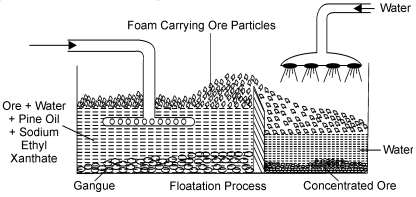
Froth Floatation Process :This method is used for the concentration of sulphide ores. In this method powdered ore is added to water containing pine oil and air is passed through it. Ore particles stick to the oil droplet and rise to the surface in the form of froth. Gangue particles are wetted by water and sink to the bottom.
Image

Need a full question paper?

Generate a complete, print-ready paper with questions like this in minutes — across 16+ boards, with answer keys.
Start Generating Free

Similar questions

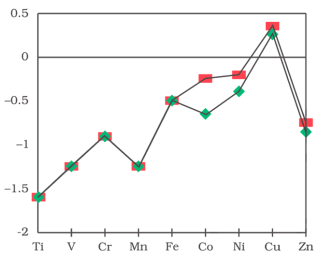
The unique behaviour of $Cu ,$ having a positive $E ^{\circ}$ accounts for its inability to liberate $H _2$ from acids. Only oxidising acids $($nitric and hot concentrated sulphuric$)$ react with $Cu ,$ the acids being reduced. The stability of the half $-$ filled $d$ sub $-$ shell in $Mn ^{2+}$ and the completely filled $d ^{10}$ configuration in $Zn ^{2+}$ are related to their $E ^{\circ}$ values, whereas $E ^{\circ}$ for $Ni$ is related to the highest negative $\Delta_{h y d} H ^{\circ}$. An examination of the $E{\left(M^{3+} / M^{2+}\right)}^o$ values the low value for $Sc$ reflects the stability of $Sc ^{3+}$ which has a noble gas configuration. The comparatively high value for $Mn$ shows that $Mn ^{2+}\left( d ^5\right)$ is particularly stable, whereas a comparatively low value for $Fe$ shows the extra stability of $Fe ^{3+}\left( d ^5\right)$. The comparatively low value for $V$ is related to the stability of $V ^{2+} \ ($half $-$ filled $t _{2 g}$ level$)$.
Image
i. Why $Zn$ has high value for $M^{3+}/M^{2+}$ Standard Electrode Potentials?
ii. Transition metals, despite high $E^\circ$ oxidation, are poor reducing agents. Justify.
iii. Why is $Cr^2+$ reducing and Mn³+ oxidising when both $Cr$ and $Mn$ have $d^4$ configuration?
$OR$
iii. Why $Cu^{2+}$ is more stable than $Cu^+$?
Heptane and octane form an ideal solution. At 373 K, the vapour pressures of the two liquid components are 105.2 kPa and 46.8 kPa respectively. What will be the vapour pressure of a mixture of 26.0 g of heptane and 35 g of octane?
What is the effect of pressure and temperature on crystal structure?
Explain how the molecularity of a complex reaction determined? And give the points showing difference between molecularity of a reaction and order of a reaction.
Write down the electronic configuration of :
(i) Cr3+ (ii) Pm3+ (iii) Cu+ (iv) Ce4+ (v) Co2+ (vi) Lu2+ (vii) Mn2+ (viii) Th4+
An organic compound (A) [Molecular formula $\left.C _8 H _{10} O _2\right]$ was hydrolysed with dilute sulphuric acid to give a carboxylic acid (B) and an alcohol (C). Oxidation of (C) with chromic acid produced (B). (C) on dehydration gives but-1-ene.
Write equations for the reactions involved.
Determine the osmotic pressure of a solution prepared by dissolving 25 mg of K2SO4 in 2 litre of water at 25°C, assuming that it is completely dissociated.
A solution of glucose in water is labelled as 10% w/w, what would be the molality and mole fraction of each component in the solution? If the density of solution is 1.2 g mL-1, then what shall be the molarity of the solution?
Indicate the steps in the preparation of :
(i) $K _2 Cr _2 O _7$ from chromite ore
(ii) $KMnO _4$ from pyrolusite ore.