Question
Derive the formula for determining activation energy from Arrhenius equation using rate constant at different temperatures. And also explain how activation energy can be determined using graph.

Answer

Activation energy using graph:
→ Taking natural logarithm on both the side of Arrhenius equation $k = Ae ^{-\frac{ E _{ a }}{ RT }}$
→ $\ln k =-\frac{ E _{ a }}{ RT }+\ln A \ \ \ \quad \ldots \ldots$ Eq. (1)
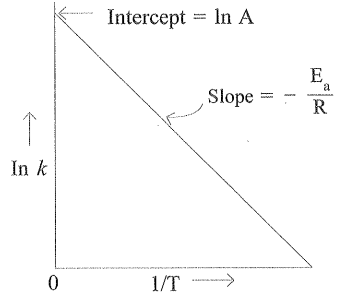
→ The plot of $\ln k$ vs $1 / T$ gives a straight line as shown in figure.
Image
→ In figure, slope $=-\frac{E_{ a }}{R}$ and intercept $=\ln A$. So, we can calculate activation energy ( $E _{ a }$ ) and Arrhenius constant A using these values.
Formula of activation energy:
→ It has been found from Arrhenius equation that increasing the temperature or decreasing the activation energy will result in an increase in the rate of the reaction and an exponential increase in rate constant.
→ Thus, at temperature $T_1$, equation (1) is
$\ln k _1=-\frac{ E _{ a }}{ RT _1}+\ln A$ $\quad$....Eq. (2)
→ at temperature $T _2$, equation (1)
is $\ln k _2=-\frac{ E _{ a }}{ RT _2}+\ln A$ $\qquad$ .. Eq. (3)
(since A is constant for given reaction)
$k _1$ and $k _2$ are rate constant at temperatures $T _1$ and $T _2$ respectively.
→ Subtracting equation (2) from (3), we obtain
$
\begin{array}{l}
\ln k _2-\ln k _1=\frac{- E _{ a }}{ RT _2}+\frac{ E _{ a }}{ RT _1} \\
\ln \frac{ k _2}{ k _1}=\frac{ E _{ a }}{ R }\left[\frac{1}{T_1}-\frac{1}{T_2}\right] \\
\log \frac{ k _2}{ k _1}=\frac{ E _{ a }}{2.303 R }\left[\frac{1}{T_1}-\frac{1}{T_2}\right] \\
\log \frac{ k _2}{ k _1}=\frac{ E _{ a }}{2.303 R }\left[\frac{ T _2- T _1}{T_1 T_2}\right]
\end{array}
$
→ From above formula activation energy can be calculate using measured values of rate constants at different temperatures.

Need a full question paper?

Generate a complete, print-ready paper with questions like this in minutes — across 16+ boards, with answer keys.
Start Generating Free