Question
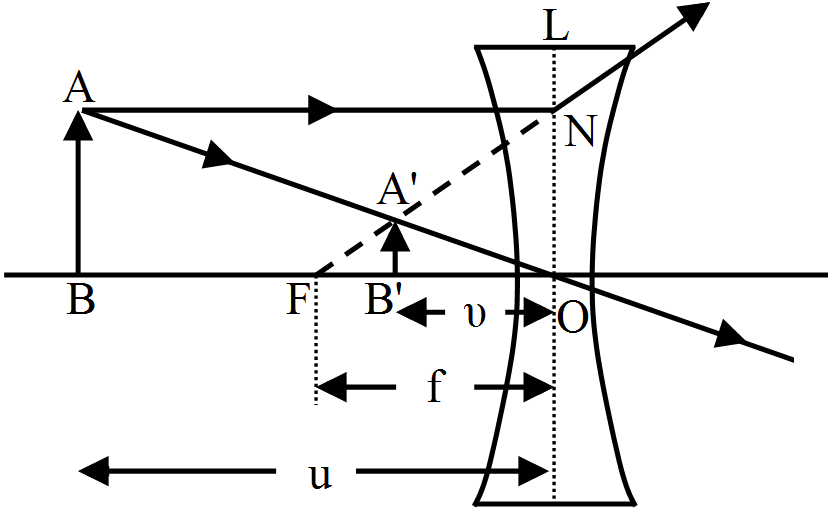
Derive the lens formula $\frac{1}{\text{f}}=\frac{1}{\text{v}}-\frac{1}{\text{u}}$ for a thin concave lens, using the necessary ray diagram.
Answer

The formation of image by a concave lens 'L' is shown in fig. AB is object and A' B' is the image. Triangles ABO and A' B' O are similar $\frac{\text{AB}}{\text{A}'\text{B}}=\frac{\text{OB}}{\text{OB}'}\dots(\text{i})$ Also triangles NOF and A' B' F are similar $\frac{\text{NO}}{\text{A}'\text{B}}=\frac{\text{OP}}{\text{FB}'}$ But NO = AB $\frac{\text{AB}}{\text{A}'\text{B}'}=\frac{\text{OB}}{\text{FB}'}\dots(\text{i})$ Comparing equation (i) and (ii) $\frac{​\text{OB}​}{\text{OB}'}=\frac{\text{OF}}{\text{FB}'}$ $\Rightarrow\frac{\text{OB}}{\text{OB}'}=\frac{\text{OF}}{\text{OF}-\text{OB}'}$ Using sign conventions of coordinate geometry OB = -u, OB' = -v, OF = -f
$\frac{-\text{u}}{-\text{v}}=\frac{-\text{f}}{-\text{f}+\text{v}}$ $\Rightarrow\text{uf}-\text{uv}=\text{vf}$ $\Rightarrow\text{uv}=\text{uf}-\text{uf}$ Dividing throughout by uvf, we get $\frac{1}{\text{f}}=\frac{1}{\text{v}}-\frac{1}{\text{u}}$ This is the required lens formula.

Need a full question paper?

Generate a complete, print-ready paper with questions like this in minutes — across 16+ boards, with answer keys.
Start Generating Free

Similar questions

Consider $N = n_1n_2$ identical cells, each of emf $\epsilon$ and internal resistance $r$. Suppose $n_1$ cells are joined in series to form a line and $n_2$ such lines are connected in parallel. The combination drives a current in an external resistance $R. (a)$ Find the current in the external resistance. $(b)$ Assuming that $n_1$ and $n_2$ can be continuously varied, find the relation between $n_1, n_2, R$ and $r$ for which the current in $R$ is maximum.
Do permeability and relative permeability have the same dimensions?
A block slides down an inclined surface of inclination 30° with the horizontal. Starting from rest it covers 8m in the first two seconds. Find the coefficient of kinetic friction between the two.
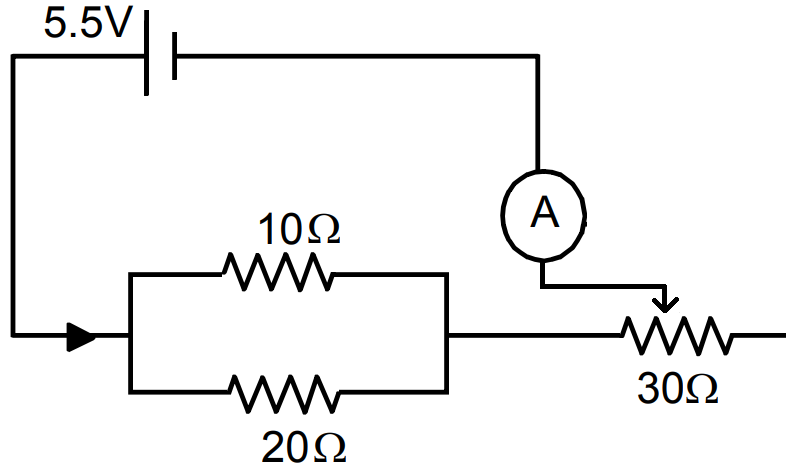
The resistance of the rheostat shown in the figure. is $30\Omega.$ Neglecting the meter resistance, find the minimum and maximum currents through the ammeter as the rheostat is varied.
A telephone cable at a place has four long straight horizontal wires carrying a current of $1.0 A$ in the same direction east to west. The earth’s magnetic field at the place is $0.39 G,$ and the angle of dip is $35^\circ$ . The magnetic declination is nearly zero. What are the resultant magnetic fields at points $4.0 \ cm$ below the cable?
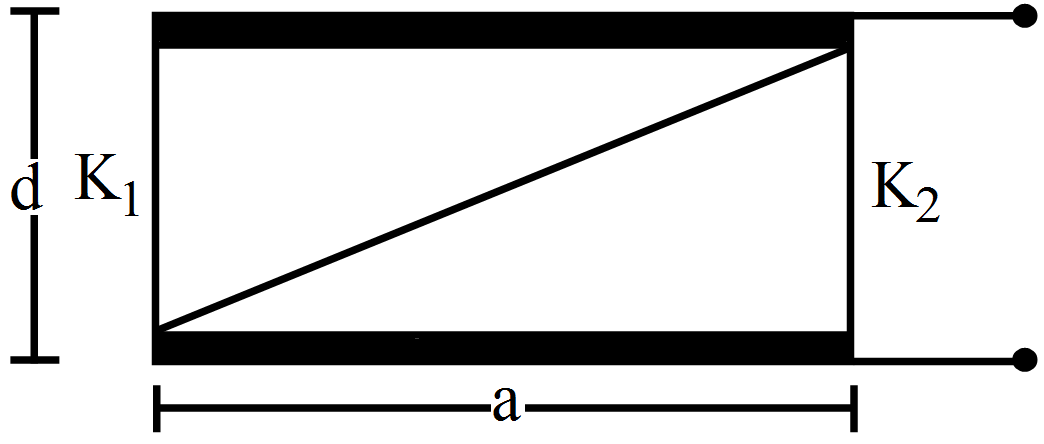
A capacitor is formed by two square metal$-$plates of edge a, separated by a distance $d.$ Dielectrics of dielectric constants $K_1$ and $K_2$ are filled in the gap as shown in figure. Find the capacitance.
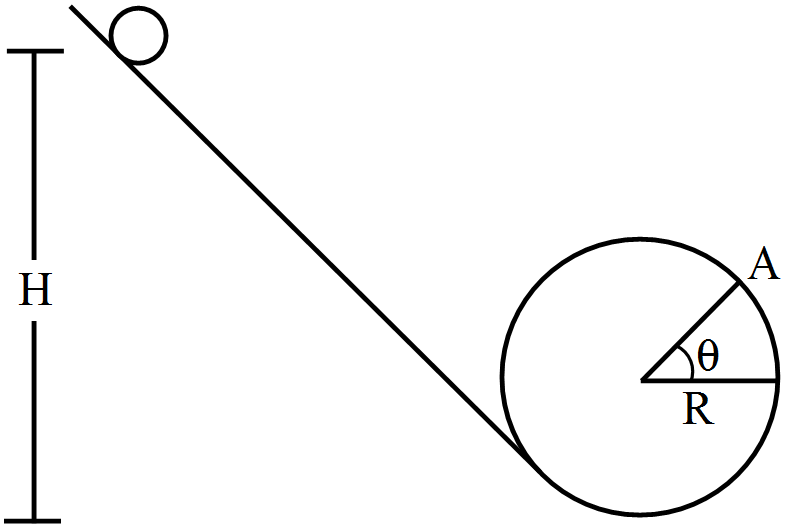
Figure shows a small spherical ball of mass m rolling down the loop track. The ball is released on the linear portion at a vertical height H from the lowest point. The circular part shown has a radius R.
  1. Find the kinetic energy of the ball when it is at a point A where the radius makes an angle $\theta$ with the horizontal.
  2. Find the radial and the tangential accelerations of the centre when the ball is at A.
  3. Find the normal force and the frictional force acting on the ball if H = 60cm, R = 10cm, $\theta=0 $ and m = 70g.
A wave propagates on a string in the positive $x-$direction at a velocity v. The shape of the string at $t =$ to is given by $\text{g}(\text{x},\text{t}_0)=\text{A}\sin\big(\frac{\text{x}}{\text{a}}\big).$ Write the wave equation for a general time t.
Discuss the diffraction of monochromatic light at single thin slit. Establish the formula for angular width of central maxima and secondary maxima.
Do permeability and relative permeability have the same dimensions?