Question
Do permeability and relative permeability have the same dimensions?

Answer

Magnetic permeability $(\mu)$ is the ratio of magnatic flux density (B) to the megnatising field strength (H).
$\mu=\frac{\text{B}}{\text{H}}$
In CGS (centimeter-gram-second) dimension of B and H is same. Hence, magnetic permeability is dimensionless. But in SI unit, dimension of B and H is not same. Thus, permeability is not dimensionless.
Relative ​permeability is defined as the ratio of magnetic permeability of any medium to the permeability of the vaccum. Hence, it is dimensionless. Thus, permeability and relative permeability have the same dimensions in CS system.

Need a full question paper?

Generate a complete, print-ready paper with questions like this in minutes — across 16+ boards, with answer keys.
Start Generating Free

Similar questions

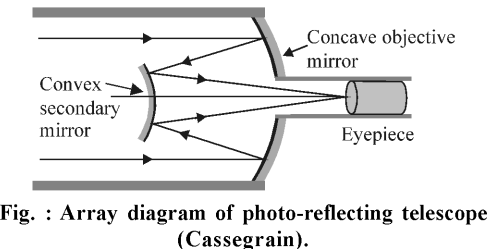
A Cassegrain telescope uses two mirrors as shown in Fig. Such a telescope is built with the mirrors 20 mm apart. If the radius of curvature of the large mirror is 220 mm and that of small mirror is 140 mm, where will the final image of an object at infinity be?
Image
A block of mass m is placed on a smooth wedge of inclination 0. The whole system is accelerated horizontally so that the block does not slip on the wedge. The force exerted by the wedge on the block has a magnitude:
  1. $\text{mg}$
  2. $\frac{\text{mg}}{\cos\theta}$
  3. $\text{mg}\cos\theta$
  4. $\text{mg}\tan\theta$
Explain ac voltage applied on inductor and explain that when only pure inductor is joined in a circuit, the current lags emf by a phase angle of $\frac{\pi}{2}$.
In semiconductors, thermal collisions are responsible for taking a valence electron to the conduction band. Why does the number of conduction electrons not go on increasing with time as thermal collisions conμnuously take place?
A copper wire having resistance $0.01$ ohm in each metre is used to wind a $400-$turn solenoid of radius $1.0\ cm$ and length $20\ cm.$ Find the emf of a battery which when connected the solenoid will eauee a magnetic field of $1.0 \times 10^{-2}T$ near the centre of the solenoid.
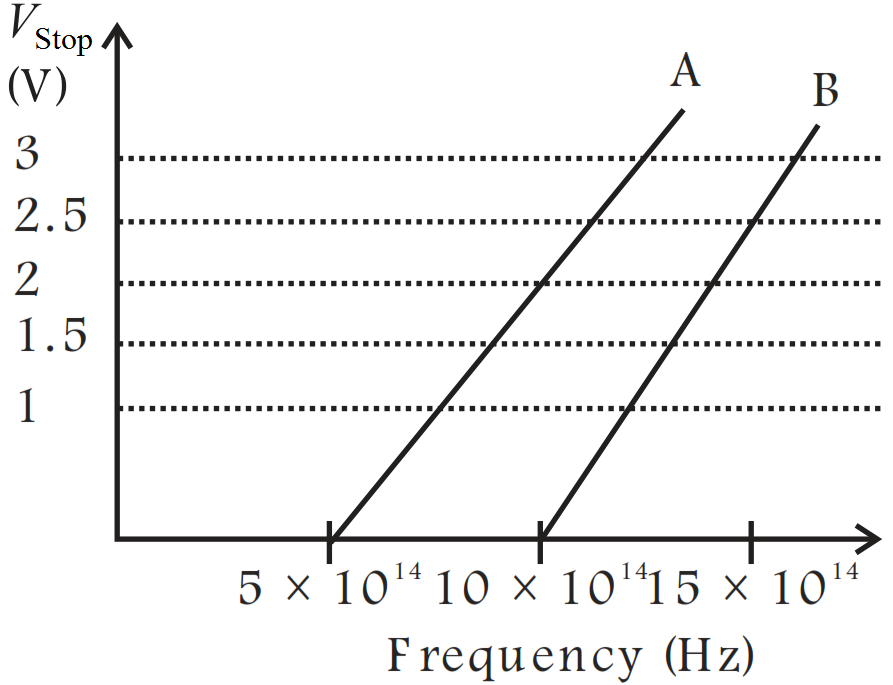
A student performs an experiment on photoelectric effect, using two materials $A$ and $B. A$ plot of $V$ stop vs $ν$ is given in Fig.
  1. Which material $A$ or $B$ has a higher work function?
  2. Given the electric charge of an electron $= 1.6 \times 10^{-19}C,$ find the value of $h$ obtained from the experiment for both $A$ and $B$.
Comment on whether it is consistent with Einstein’s theory:
Do permeability and relative permeability have the same dimensions?
A solenoid is connected to a battery so that a steady current flows through it. If an iron core is inserted into the solenoid, will the current increase or decrease? Explain.
Give the shape of interference fringes observed
a. in a Young's double-slit experiment
b. in the air wedge experiment
c. in the Lloyd's mirror experiment
d. when a small lamp is placed before a thin mica sheet and light waves reflected from the front and back surfaces of the sheet combine to produce interference pattern on a screen behind the lamp. (Pohl's experiment)
e. from a thin air film formed by placing a convex lens on top of a flat glass plate (Newton's arrangement).
A charge of $1\mu\text{C}$ is given to one plate of a parallel-plate capacitor of capacitance $0.1\mu\text{F}$ and a charge of $2\mu\text{C}$ is given to the other plate. Find the potential difference developed between the plates.