Question
Derive the Rydberg formula.

Answer

SELF

Need a full question paper?

Generate a complete, print-ready paper with questions like this in minutes — across 16+ boards, with answer keys.
Start Generating Free

Similar questions

How do you count for the following observations?
Though alkaline potassium permanganate and acidic potassium permanganate both are used as oxidants, yet in the manufacture of benzoic acid from toluene we use alcoholic potassium permanganate as an oxidant. Why? Write a balanced redox equation for the reaction.
Two flasks 'A' and 'B' have equal volumes. Flask 'A' contains $H_2$ and is maintained at $300K$ while 'B' contains equal mass of $CH_4$ gas and is maintained at $600K$.
  1. Which flask contains greater number of molecules? How many times more?
  2. In which flask pressure is greater? How many times more?
  3. In which flask molecules are moving faster?
  4. In which flask the number of collisions with walls are greater?
i. A vessel of $1.00 dm ^3$ capacity contains $16.00$ g of oxygen and $8.00$ g of hydrogen at $17^{\circ} C$. Calculate the partial
ii. According to kinetic molecular theory, explain why gases exert pressure?
iii. How is isotherm at critical temperature of a gas different from those at lower temperatures?
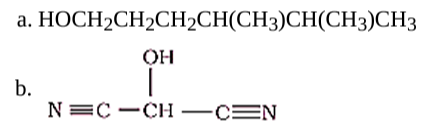
1. For each of the following compounds, write a condensed formula and also their bond-line formula.
Image
2. How does
i. an electron withdrawing group (EWG) and
ii. an electron donating group (EDG) influence the acid strength of carboxylic end?
If $1$ gram of each of the following gases are taken at STP, which of the gases will occupy (a) greatest volume and (b) smallest volume?
$CO, H_2O, CH_4, NO$.
Describe the types of thermodynamic systems with examples.
Pressure is determined as force per unit area of the surface. The SI unit of pressure, Pascal is as shown below:
$1 \mathrm{~Pa}=1 \mathrm{~N} \mathrm{~m}^{-2}$
If mass of air at sea level is $1034 \mathrm{~g} \mathrm{~cm}^{-2}$, calculate the pressure in Pascal.
Calculate the volume of water required to dissolve 0.1g lead (II) chloride to get a saturated solution.
($K_{sp}$ of $PbCl_2 = 3.2 \times 10^{–8}$ , atomic mass of $Pb = 207u$).
Draw the Lewis structures for the following molecules and ions: $\text{H}_2\text{S},\ \text{SiCl}_4,\ \text{BeF}_2,\ \text{CO}^{2-}_3,\ \ \text{HCOOH}$
Match the following equilibria with the corresponding condition.
Column I
Column II
i.
Liquid ⇌ Vapour
a.
Saturated solution
ii.
Solid ⇌ Liquid
b.
Boiling point
iii.
Solid ⇌ Vapour
c.
Sublimation point
iv.
Solute(s) ⇌ Solute (solution)
d.
Melting point
 
 
e.
Unsaturated solution