Question
Derive the three equations of motion by calculus method. Express conditions under which they can be used.

Answer

Consider an object moving in straight line with uniform acceleration $= a$. Let at $t = 0$ velocity of the body $= u$ at $t = t$ velocity of the body $= v$
  1. Velocity$-$time relation : Let $dv$ be the change in velocity in time interval. dt. Then acceleration
$\text{a}=\frac{\text{dv}}{\text{dt}}$
$\text{dv}=\text{a dt}$
Integrating from $0 \rightarrow t$ when velocity changes from $u \rightarrow v$
$\int\limits^\text{v}_\text{u}\text{dv}=\text{a}\int\limits^{\text{t}}_\text{0}\text{dt}$
$\text{v}-\text{u}=\text{at}$
$\text{v}=\text{u}+\text{at}\ \dots(\text{i})$
  1. Distance$-$time relation: Consider an object moving in a straight line with uniform acceleration $'a\ '$. Let at any instant $t, dx$ be the displacement of the object in time interval at., Then instantaneous velocity $v$ is given by:
$\text{v}=\frac{\text{dx}}{\text{dt}}$
$\text{dx}=\text{vdt}$
$\text{dx}=(\text{u}+\text{at})\text{dt} [$from $(i) \text{v}=\text{u}+\text{at}]$
Let $x_0 =$ displacement at $t = 0$
$x =$ displacement at $t = t$
Integrating within limits
$\int\limits^\text{x}_{\text{x}_0}\text{dx}=\int\limits^{\text{t}}_0(\text{u}+\text{at})\text{dt}$
$=\text{u}\int\limits^{\text{t}}_0\text{dt}+\text{a}\int\limits^{\text{t}}\text{tdt}$
$\text{x}-\text{x}_0=\text{ut}+\frac{1}{2}\text{at}^2$
$\text{x}=\text{x}_0+\text{ut}+\frac{1}{2}\text{at}^2\ \dots(\text{ii})$
If $x - x_0 = s$ = distance covered by an object in time $t$ then
$\text{s}=\text{ut}+\frac{1}{2}\text{at}^2$
  1. Velocity-displacement relation.
Consider a particle moving in a straight line with initial velocity $u$, and uniform acceleration $'a\ '.$
then $\text{a}=\frac{\text{dv}}{\text{dt}}=\frac{\text{dv}}{\text{dx}}\times\frac{\text{dx}}{\text{dt}}=\text{v}\frac{\text{dv}}{\text{dx}}$
$\text{adx}=\text{vdv}$
Let $u$ be the velocity of object at position $x_0\  v$ be the velocity of object at position $x$
Integrating above within limits
$\int\limits^{\text{x}}_{\text{x}_0}\text{a dx} = \int\limits^{\text{c}}_{\text{u}}\text{v dv}$
$\text{a}(\text{x}-\text{x}_0)=\frac{\text{v}^2}{2}-\frac{\text{u}^2}{2}$
$\text{v}^2-\text{u}^2=2\text{a}(\text{x}-\text{x}_0)$
Putting $x - x_0=s$ we get
$\text{v}^2+-\text{u}^2=2\text{as}\ \dots(\text{iii})$
The above three laws are valid under the conditions, only when the acceleration is uniform.

Need a full question paper?

Generate a complete, print-ready paper with questions like this in minutes — across 16+ boards, with answer keys.
Start Generating Free

Similar questions

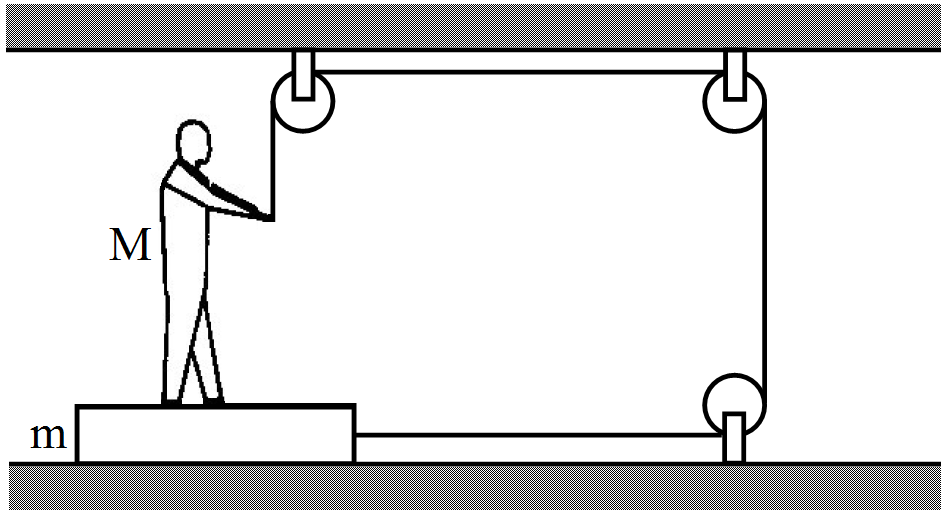
The friction coefficient between the board and the floor shown in figure is $\mu.$ Find the maximum force that the man can exert on the rope so that the board does not slip on the floor.
A synchronous motor is used to lift an elevator and its load of $1500kg$ to a height of $20m$. The time taken for job is $20s$. What is work done? What is the rate at which work is done? If the efficiency of the motor is $75%$, at which rate is the energy supplied to the motor?
  1. Define SHM. What are its characteristics? At what distance from the mean position in SHM of amplitude r the energy is half kinetic and half potential?
  2. A spring having a force constant K is divided into three equal parts. What would be force constant for each individual parts?
A hundred metre sprinter increases his speed from rest uniformly at the rate of $1m/s^2$ for three quarters of the length and covers the last quarter with a uniform speed. How long does he take to cover the first half and second half of the run?
A small block of mass m and a concave mirror of radius R fitted with a stand lie on a smooth horizontal table with a separation d between them. The mirror together with its stand has a mass m. The block is pushed at $t = 0$ towards the mirror so that it starts moving towards the mirror at a constant speed V and collides with it. The collision is perfectly elastic. Find the velocity of the image:
  1. At a time $\text{t}<\frac{\text{d}}{\text{V}}$
  2. At a time $\text{t}>\frac{\text{d}}{\text{V}}.$
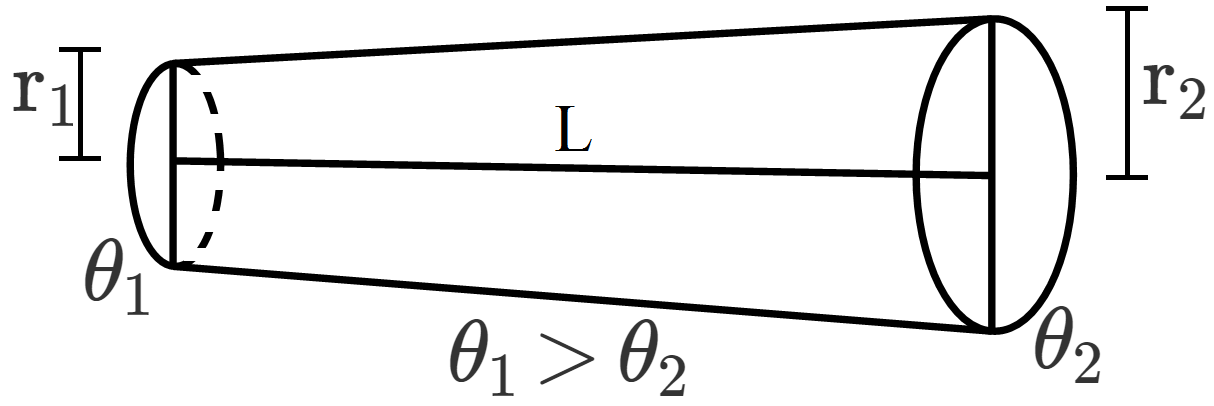
Find the rate of heat flow through a cross section of the rod shown in figure, $\big(\theta_2>\theta_1\big).$ Thermal conductivity of the material of the rod is K.
A cubical block of density $\rho$ iis floating on the surface of water. Out of its height L, fraction x is submerged in water. The vessel is in an elevator accelerating upward with acceleration a . What is the fraction immersed?
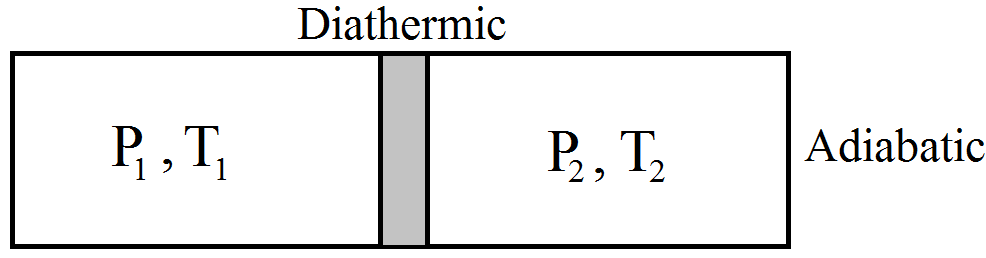
Figure. shows a cylindrical tube of volume V with adiabatic walls containing an ideal gas. The internal energy of this ideal gas is given by 1.5nRT. The tube is divided into two equal parts by a fixed diathermic wall. Initially, the pressure and the temperature are $P_1, T_1$ on the left and $p_2, T_2$ on the right. The system is left for sufficient time so that the temperature becomes equal on the two sides.
  1. How much work has been done by the gas on the left part?
  2. Find the final pressures on the two sides.
  3. Find the final equilibrium temperature.
  4. How much heat has flown from the gas on the right to the gas on theleft?
A block of mass m moves on a horizontal circle against the wall of a cylindrical room of radius R. The floor of the room on which the block moves is smooth but the friction coefficient between the wall and the block is $\mu.$ The block is given an initial speed $\nu_0.$ As a function of the speed $\nu$ write,
  1. The normal force by the wall on the block.
  2. The frictional force by the wall.
  3. The tangential acceleration of the block.
  4. Integrate the tangential acceleration $\Big(\frac{\text{d}\nu}{\text{dt}}=\nu\frac{\text{d}\nu}{\text{ds}}\Big)$ to obtain the speed dt ds of the block after one revolution.
Define molar specific heat capacities at constant volume and pressure. Considering thermodynamical process in a cylinder with parameters P, V and T, derive the Mayer's relation.