Question
Describe about the working principle of Leclanche cell.

Answer

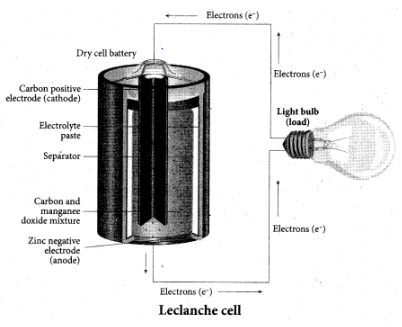
Image
1. Leclanche cell:
Anode: Zinc container
Cathode: Graphite rod in contact with $MnO _2$
Electrolyte: Ammonium chloride and Zinc chloride in water.
emf of the cell $=1.5 V$
2. Cell reaction:
Oxidation at anode
$Zn _{( s )} \rightarrow Zn ^{2+}{ }_{( aq )}+2 e _{-}$
Reduction at cathode
$
2 NH ^{+}{ }_{4( aq )}+2 e ^{-} \rightarrow 2 NH _{3( aq )}+ H _{2( aq )}
$
3. The hydrogen gas is oxidised to water by $MnO _2$
$
H _{2( g )}+2 MnO _{2( s )} \rightarrow Mn _2 O _{3( s )}+ H _2 O _{(1)} \ldots \ldots . \text { (3) }
$
Adding equations 1,2,3 the overall redox reaction
$
Zn _{( s )}+2 NH ^{+}{ }_{4( aq )}+2 MnO _{2( s )} \rightarrow Zn ^{2+}{ }_{( aq )}+ Mn _2 O _{3( s )}+ H _2 O _{(1)}+2 NH _3
$
4. The ammonia produced at the cathode combines with $Zn ^{2+}$ to form a complex ion [ $Zn$ $\left.\left( NH _3\right)_4\right]_{2+}$ (aq). As the reaction proceeds, the concentration of $NH _4{ }^{+}$will decrease and the aqueous $NH _3$ will increase which lead to the decrease in the emf of the cell.

Need a full question paper?

Generate a complete, print-ready paper with questions like this in minutes — across 16+ boards, with answer keys.
Start Generating Free

Similar questions

Discuss about the hydrolysis of salt of weak acid and weak base and derive pH value for the solution.
Using the Ellingham diagram,(A) Predict the conditions under which
  1. Aluminium might be expected to reduce magnesia.
  2. Magnesium could reduce alumina.
(B) it is possible to reduce $Fe_2O_3$ by coke at a temperature around 1200 K
Describe about the double strand helix structure of DNA.
How does ammonia react with
1. Excess $Cl _2$
2. $Na$
3. $CuSO _4$
4. $O _2 / \Delta$
Write short note on metal excess and metal deficiency defect with an example.
An organic compound (A) of molecular formula $C _6 H _6 O$ gives violet colour with neutral $FeCl _3$. (A) reacts benzene diazoniurn chloride in basic medium to give (B) as an azo dye. (A) reacts with acidified $K _2 Cr _2 O _7$ gives (C) of formula $C _6 H _4 O _2$. (A) on reaction with $H _2$ in the presence of nickel gives (D) of formula $C _6 H _{12} O$. Identify $A , B , C , D$ and explain the reaction involved.
Write the formulae for the following coordination compounds :
Answer:
  1. Tetraamminediaquacobalt (III) chloride.
  2. Potassium tetracyanonickelate (II).
  3. Tris ( ethane – 1, 2 – diamine ) chromium (III) chloride.
  4. Amminebromidochloridonitrito – N – platinate (II).
  5. Dichlorobis(ethane – 1, 2 – diamine ) platinum (IV) nitrate.
  6. Iron (III) hexacyanoferrate (II)
What are general characteristics of solids?
 An organic compound $(A)$ of molecular formula $C _3 HO$ on reaction $P / l _2$ gives $C _3 H _7 l$ as (B). (B) on reaction with $AgNO O _2$ produces $( C )$ with formula $C _3 H _7 NO _2$. (C) on reaction with nitrous acid gives (D) of molecular formula $C _3 H _6 N_2 O _3$. (D) on reaction with KOH produces blue colour. Identify $A , B$. C, D and explain the reaction.
For a decomposition reaction the values of rate constant $k$ at two different temperatures are given below:
$k _1=2.15 \times 10 L mol ^{-1} s ^{-1} \text { at } 650 K$
$k _2=2.39 \times 10 L mol ^{-1} s ^{-1} \text { at } 700 K$
Calculate the value of activation energy for this reaction. $\left( R =8.314 J K ^{-1} mol ^{-1}\right)$