Question
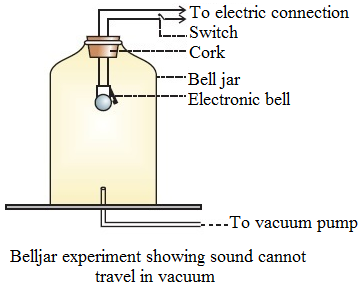
Describe an experiment to show that sound cannot pass through vacuum.

Answer

Sound cannot travel through vacuum. This can be shown by the following experiment:
  1. A ringing electric bell is placed inside an air tight glass jar containing air. We can hear the sound of ringing bell clearly. Thus, when air is present as medium in the bell jar, sound can travel through it and reach our ears.
  2. The bell jar containing ringing bell is placed over the plate of a vacuum pump. Air is gradually removed from the bell jar by switching on the vacuum pump. As more and more air is removed from the bell jar, the sound of ringing bell becomes fainter and fainter. And when all the air is removed from the bell jar, no sound can be heard at all. Thus, when vacuum is created in the bell jar, then the sound of ringing bell placed inside it cannot be heard.
This shows that sound cannot travel through vacuum.

Need a full question paper?

Generate a complete, print-ready paper with questions like this in minutes — across 16+ boards, with answer keys.
Start Generating Free

Similar questions

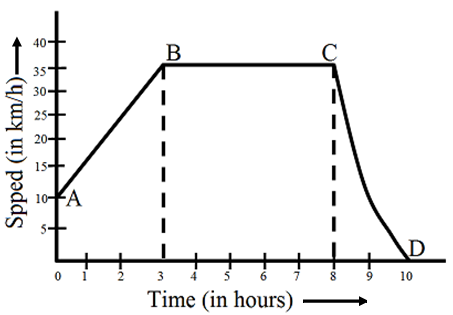
The graph given alongside shows how the speed of a car changes with time:
  1. What is the initial speed of the car?
  2. What is the maximum speed attained by the car?
  3. Which part of the graph shows zero acceleration
  4. Which part of the graph shows varying retardation?
  5. Find the distance travelled in first 8 hours.
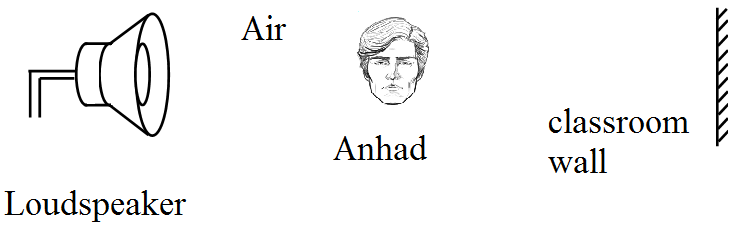
In an experiment, Anhad studies sound waves. He sets up a loudspeaker to produce sound as shown below:
Anhad adjusts the signal to the loudspeaker to give a sound of frequency 200Hz.
  1. What happens to the air in-between Anhas and the loudspeaker?
  2. Explain how Anhad receives sound in both ears.
Describe a simple experiment to show that the prongs of a sound producing tuning fork are vibrating.
  1. How does a boat float in water?
  2. A piece of steel has a volume of $12\ cm^3$, and a mass of $96\ g$. What is its density: (i) in $g/cm\ ^3$​​​​​​​(ii) in $kg/m\ ^3$?
Describe the method of separating a mixture containing common salt, sand and ammonium chloride.
$A, B$ and $C$ are all liquids. Liquid A has a comparatively low boiling point. On heating, liquid a vaporizes completely without leaving behind any residue. Liquid A is being used increasingly as a fuel in motor vehicles either alone or by mixing with petrol. Liquid $B$ has a very high boiling point. It also vaporizes completely on heating, without leaving any residue. Liquid $B$ is a conductor of electricity and used in making thermometers. Liquid $c$ has a moderate boiling point. On heating, liquid C vaporises leaving behind a white solid $D$ which is used in cooking vegetables. The condensation of vapours from $C$ give a liquid $E$ which turns anhydrous $CuSO _4$ to blue.
a. Which liquid could be an element? Name this element.
b. Which liquid could be a mixture? Name this mixture.
c. Which liquid could be a compound? Name this compound.
d. What could the solid $D$ be?
e. What do you think is liquid $E$ ?
How will you separate a mixture of kerosene oil and water? Explain with the help of a labeled diagram
The mass of one atom of an element $X$ is $2.0 \times 10^{-23}g.$
  1. Calculate the atomic mass of element $X.$
  2. What could element $X$ be?
Suppose a planet exists whose mass and radius both are half those of the earth. Calculate the acceleration due to gravity on the surface of this planet.
Describe the Rutherford’s model of an atom. State one drawback of Rutherford’s model of the atom.