Question
Describe briefly one way producing an induced e.m.f ?

Answer

Induced current can be produced by following activity:
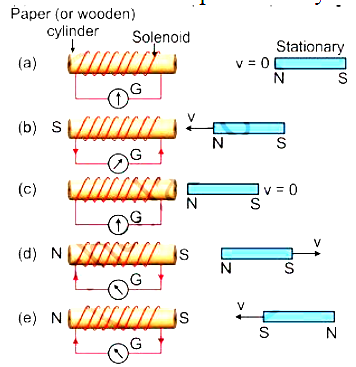


(i) When the magnet is stationary there is no deflection in galvanometer. The pointer read zero. [Fig (a)]

(ii) When the magnet with north pole facing the solenoid is moved towards the solenoid, the galvanometer shows a deflection towards the right showing that a current flows in the solenoid in the direction as shown in Fig (b)

(iii) As the motion of magnet stops, the pointer of the galvanometer to the zero position [Fig (c)]. This shows that the current in the solenoid flows as long as the magnet is moving.

(iv) If the magnet is moved away from the solenoid, the current again flows in the solenoid, but now in the direction opposite to that shown in [Fig. (b)] and therefore the pointer of the galvanometer deflects towards left [Fig. (d)].

(v) If the magnet is moved away rapidly i.e. with more velocity, the extent of deflection in the galvanometer increases although the direction of deflection remains the same. It shows that more current flows now.

(vi) If the polarity of the magnet is reversed and then the magnet is brought towards the solenoid, the current in solenoid flows in the direction opposite to that shown in Fig (b) and so the pointer of galvanometer deflect towards left [Fig. (e)].

Need a full question paper?

Generate a complete, print-ready paper with questions like this in minutes — across 16+ boards, with answer keys.

Start Generating Free

Similar questions

The following are an example of levers. State the class of lever to which each one belongs giving the relative positions of Load (L), Effort (E), Fulcrum (F):
(i) Scissors (ii) Sugar tongs (iii) Nutcracker (iv) Pliers.
The diagram shows the use of a lever.
(i) State the principle of moments as applied to the above lever.
(ii) Which class of lever is this? Give an example of this class of lever.
(iii) If FA = 100 cm, AB = 90 cm, calculate the minimum effort required to lift the load.
State relative advantages and disadvantages of ring system of wiring over the tree system.
A cell of e.m.f. $1.5 V$ and internal resistance $1.0 W$ is connected to two resistors of $4.0 W$ and $20.0$ in series as shown in the figure: Calculate the:(i) Current in the circuit.
(ii) Potential difference across the $4.0$ ohm resistor.
(iii) Voltage drop when the current is flowing.
(iv) Potential difference across the cell.
What is a block and tackle system of pulleys? What precautions would you observe while rounding the string so that the effort is applied in the downward direction?
A machine is driven by a $50$ kg mass falling at a rate of $10.0$ m in $5 s$ . It lifts n load of 250 kgf . Taking the force of gravity on 1 kg mass as 10 N . Calculate the power input to the machine. If the efficiency of the machine is $60 \%$, find the height to which the load is raised in $5 s $.
(i) 50 g of ice at $0^{\circ} C$ is added to 300 g of a liquid at $30^{\circ} C$. What will be the final temperature of the mixture when all the ice has melted? The specific heat capacity of the liquid is $2.65 Jg ^{-19} C ^{-1}$ while that of water is $4.2 Jg ^{-1}{ }^{\circ} C ^{-1}$. Specific latent heat of fision of ice $=336 Jg ^{-1}$.
(ii) A metal drill of power 500 W , drills a bole in a metal cube of mass 0.25 kg in 6.5 s . If the specific heat capacity of metal cube is $130 Jkg ^{-1}{ }^{\circ} C ^{-1}$, calculate
(a) Energy generated by the drill in ls.
(b) Energy generated by the drill in 6.5 s.
(c) If $t^{\circ} C$ is the rise in temperature, state the amount of heat energy absorbed by metal cube in terms of $t$.
(d) Write down an equation and calculate the value of t .
(iii) Explain the following
(a) Water is used in hot water bottles for fomentation purposes.
(b) A wise farmer always waters his fields in the evening, if there is a forecast for frost.
(c) The specific heat of fusion of lead is $27 Jg ^{-1}$. What do you understand from the statement?
A cork piece is floating on the surface of the water in a pond. A piece of pebble is dropped into the water. What will be your observation?
The mechanical advantage of a machine is 5 and its efficiency is $80\%$. It is used to lift a load of 200 kgf to a height of $20 m.$ Calculate:
(i) The effort required, and
(ii) The work done on the machine $(g = 10 ms^{−2}).$
Why is less effort needed to lift a load over an inclined plane as compared to lifting the load directly?